Writing Tip: The Writer as Psychologist
“It is our responsibility to understand each of characters to the core of their emotional, spiritual, and psychological being.”

“It is our responsibility to understand each of characters to the core of their emotional, spiritual, and psychological being.”
Whenever one of my university students in the DePaul School of Cinematic Arts meets with me to discuss adding a minor, I always suggest one subject: Psychology. If they are interested in history, economics, biology, whatever, great, I say, “Do that.” But if they are not locked down on a potential minor, I tell them psychology is an excellent adjunct field of study for someone interested in creative writing.
Why?
Because as writers, we spend so much time with our characters, it is akin to becoming their therapist.
We know their Want / Conscious Goal.
We know their Need / Unconscious Goal.
We know their Personal History and Backstory.
We know their biography.
We know what they fear the most.
We know why this specific set of story elements is happening in their lives and how the journey is going to transform them emotionally and psychologically.
After all the time we spend living with and getting to know our characters, we probably know them better than they know themselves.
In a Film Courage interview, I shared how being an Air Force brat — moving around as much as I did as a youth — translated into me having an “honorary B.A. in psychology.”
It is one thing to interface with other people. It is quite another to interpret those interactions and assign a character type to those individuals. At a fundamental level, that is what psychologists do. And that’s what I did as a military brat, moving every two to three years to a new place.
Who are the bullies? Who are the smart kids? Who are the creatives? Who are the jocks? Where can I fit in and what ‘mask’ must I wear with this or that group?
As part of my ongoing ‘education’ in psychology, I was interested to read a recent article by Harper West, a psychotherapist and author. Here is an excerpt from that article:
Most diagnoses can be explained by one powerful, primal emotion — shame.
More specifically, nearly all mental disorders are, in fact, shame intolerance disorders. A child who feels unworthy and unloved, usually due to childhood developmental trauma (aka bad parenting) learns maladaptive ways of coping with these feelings. To manage fears of inadequacy, rejection and failure, individuals behave in three very predictable patterns I call Blame-shifting Strategies:
- Other-Blaming: “You are at fault.”
- Self-Blaming: “I am at fault.”
- Blame Avoiding: “No one is at fault.”
The key assessment for the three strategies is: When criticized or held accountable, what does the person do? A cornerstone of psychological wellness is the ability to hear criticism or experience failure, accept the truth, and acknowledge one’s faults with equanimity.
In contrast, Other-blamers feel inadequate but lack self-compassion to deal with their mistakes. When they fear the experience of shame they become hyper-vigilant to perceived or real criticism. They are unwilling to look honestly at their faults and may over-react and lash out to preempt, defend against, or attack criticism. Some with poor shame tolerance may even become enraged, abusive and violent, because criticism feels like such a deep, personal wound.
— —
Ironically, Other-blamers are so busy managing shame in counterproductive ways that they act in shameful and immoral ways. The pro-social self-conscious emotions work to hold most people accountable, though they have little efficacy with Other-blamers who have learned to disconnect from guilt through habitual blame-shifting. Other-blamers have difficulty following the normal moral and social codes that healthy individuals find to be a fundamental guide to their behavioral choices.
The character traits of Other-blamers may seem unconnected but they are all in service of protecting their fragile psyche. They lie to themselves continuously, so they have no difficulty lying to others. Other-blamers demand loyalty, control, manipulate, or intimidate to set up relationships with people who will be submissive and will not challenge them, correct them, or blame them. The truth is a threat, so they blame the messenger. To avoid responsibility, they justify, make excuses and rationalize. They crave power because it helps insulate them from criticism and accountability. Some engage in strategies that enhance their social status, (self-aggrandizing, boasting, greed, vanity) but they also destroy relationships by cheating, conniving, and manipulating others. Fear can take over, leading to paranoia and delusional thinking as they imagine that others are out to humiliate them. They can be physically and emotionally abusive, angry, hateful, and stubborn. The result is high-conflict relationships because of their inability to admit fault or compromise. They are vindictive against those they feel have insulted them.
West applies this Other-Blamer character type to a well-known public figure (I leave it to you to deduce who the subject of the article might be), but when I read the piece, I added that information to my faux psychology B.A.: Shame, Other-Blaming, Self-Blaming, Blame Avoiding.
In working with characters, we can explore how shame may or may not play a role in each character’s psychological makeup. And if there is a shame dynamic at work in their psyche, we can ask:
- Do they blame others?
- Do they blame themselves?
- Do they avoid blaming anyone?
There’s even this: What if a character starts off blaming others and over the course of the story realizes the truth — they are to blame? As I sat pondering this idea, I realized it is a dynamic at work in The Shawshank Redemption.
Remember this exchange?
Red: You’re gonna fit right in. Everyone in here is innocent. Heywood, what’re you in here for?
Heywood: Didn’t do it. Lawyer fucked me.
The prisoners blame others for their imprisonment. We see this in subtext in the Red parole hearing subplot:
In the first parole hearing, Red acts like an innocent. He is fully rehabilitated.
In the second parole hearing, which occurs ten years later — 30 years into his serving his sentence — he utters the same words he did a decade ago, but with less conviction. He’s in the middle of his transformation arc — facilitated in large part due to Andy’s influence — and can’t summon up the false bravado to sell his case to the board.
In the third parole hearing, which occurs forty years into his prison sentence… well, Red demonstrates he is a changed man:
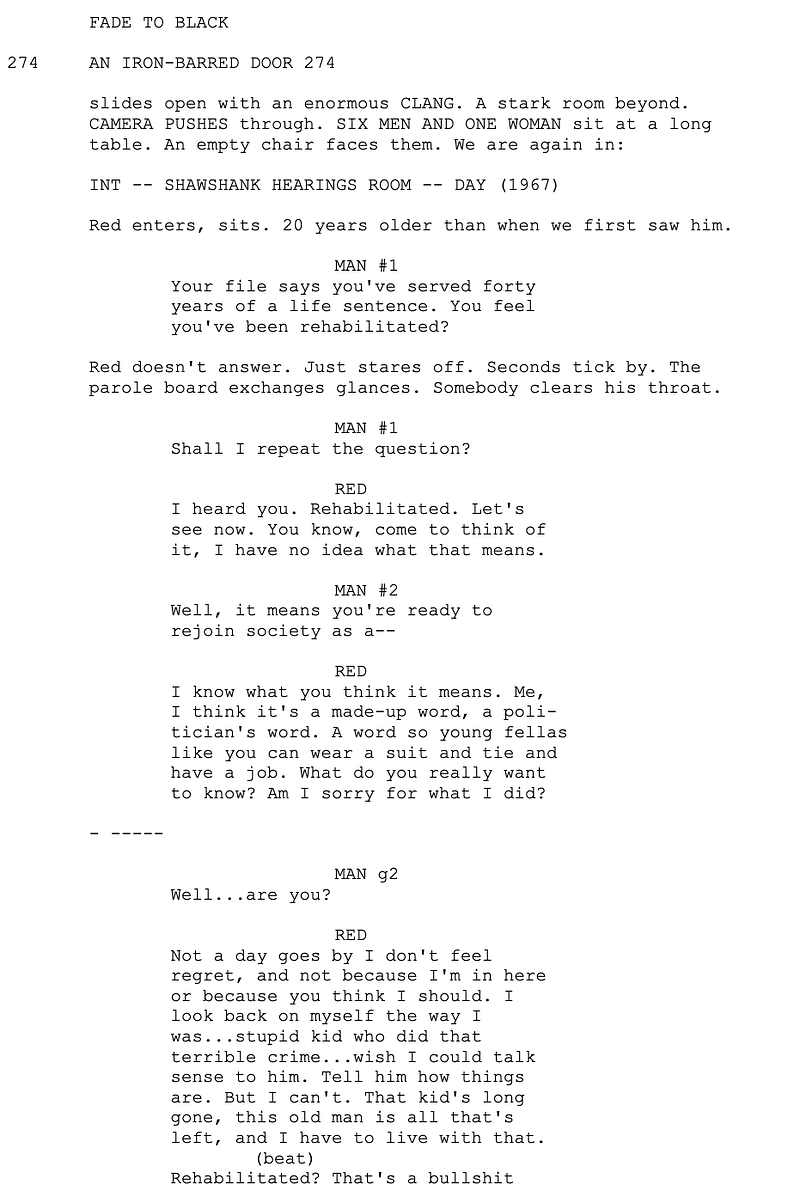
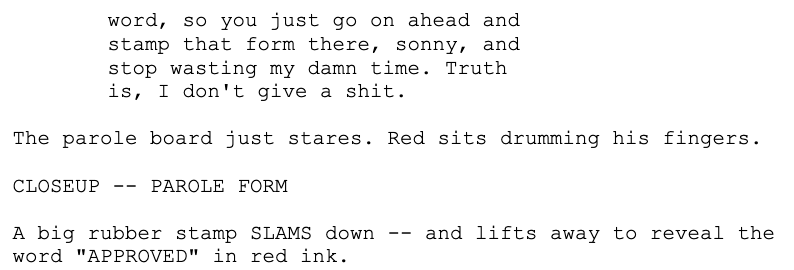
Red not only acknowledges the shame he feels for the murderous acts he committed as a youth, he fully accepts the blame for them. As a result…
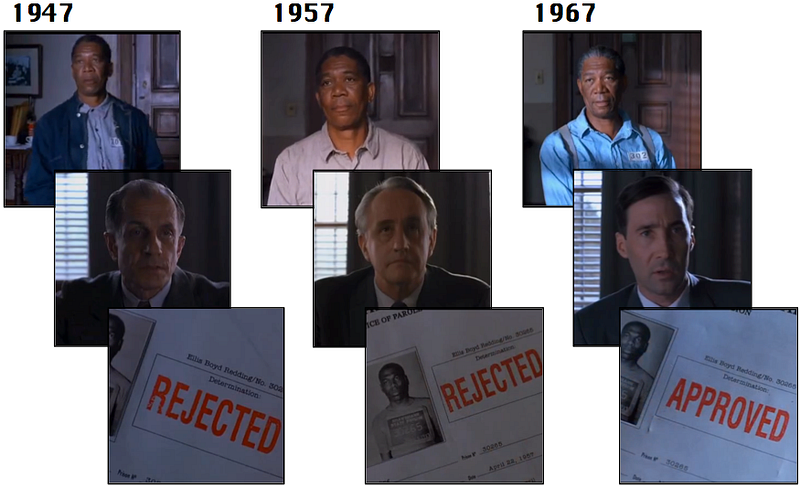
As writers, when we get to know our characters and develop them for our stories, we are nothing less than psychologists.
It is our responsibility to understand each of characters to the core of their emotional, spiritual, and psychological being. That process not only enables us to write complex, multilayered characters, it also informs us as to how each character ties into the overall narrative as well as the shape of the story’s structure.
In other words, we should all get an honorary B.A. in psychology!
For the rest of the Harper West article, go here.