Writing Tip: Screenplay Structure Simplified
“Plot is critical, but how a writer gets to plot is even more critical.”
“Plot is critical, but how a writer gets to plot is even more critical.”
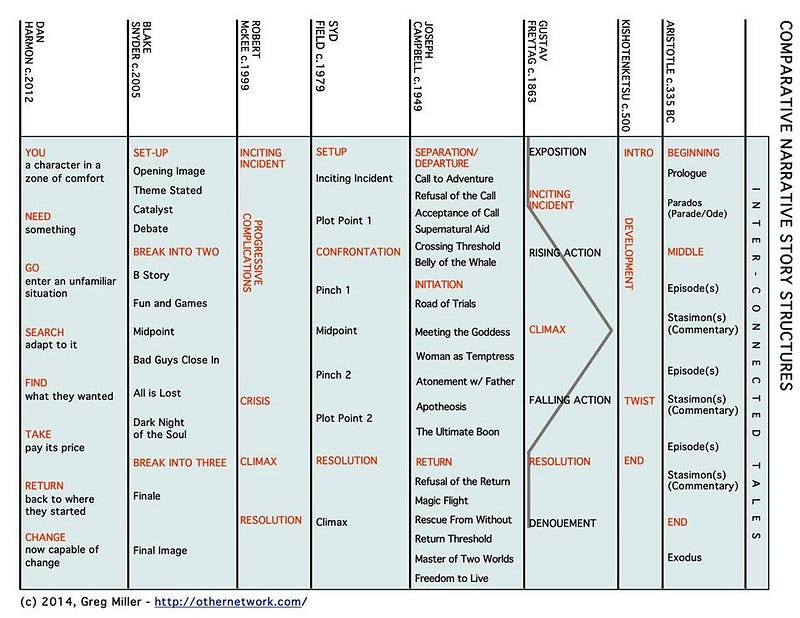
Recently, I stumbled across this infographic in my social media feed:
It’s ostensibly about story structure, but note that Syd Field, Robert McKee, Blake Snyder, and Dan Harmon are all known for their theories about screenplays or episodic TV. And, of course, The Hero’s Journey as explored by Joseph Campbell has been adapted to screenplays by Chris Vogler.
The chart looks complicated, doesn’t it? Different jargon, different points of emphasis, different structures. What strikes me as more significant is how — with the exception of Dan Harmon — these approaches to story (read: screenplay) structure reduce structure to plot.
That is only half the story!
Yes, plot is critical, but how a writer gets to plot is even more critical. Because where there’s Action in the External World of the plot, there is a character’s Intentions in their Internal World defining why they act the way they do. And where there’s Dialogue in the External World of the plot, there is a character’s Subtext in their Internal World conveying deeper meaning in what they say.
Thus, while there is a story’s Physical Journey through time and space as evidenced by the events of the Plot, there is also a story’s Psychological Journey as characters, most notably, the Protagonist responds to the events of the plot and interacting with other characters by going through a change, what Campbell calls transformation.
Therefore, we can simplify screenplay structure by focusing on the psychological journey of the Protagonist with four movements:
Disunity (Act One)
Deconstruction (Act Two Part A)
Reconstruction (Act Two Part B)
Unity (Act Three)
These four movements represent the unity arc. If you immerse yourself into the life of your Protagonist, you will discover a synergy between their internal life (psychological journey) and the external world (physical journey) which feeds the character’s transformation process.
Note: Some Protagonists don’t have a unity arc in which they move from Disunity to Unity, while some Protagonist don’t change, but rather change others. However, a vast majority of movies feature a Protagonist who does integrate key aspects of their psyche and end up on a path toward wholeness.
My advice: Start with your characters, most critically the Protagonist. Dig into who they are at the beginning of the story, the disjunctive nature of their psyche. Zero in on their need, that aspect of their psyche which lies latent within and over time emerges into the light of consciousness. Consider how that process transforms the nature of the Protagonist as they move forward through the plot.
“The goal of the individuation process is the synthesis of the self.” — Carl Jung
I go into this story-crafting approach in-depth in my book The Protagonist’s Journey: An Introduction to Character-Driven Screenwriting and Storytelling. An Amazon #1 Best Seller in Film and Television, the book has been endorsed by over 30 screenwriters, novelists, and academics including Don Winslow (City on Fire), Meg Gardiner (Heat 2), Peter Craig (The Batman), Eric Heisserer (Arrival), Stephany Folsom (Toy Story 4), Greg Garrett (Professor, Baylor University), and Keith Giglio (Associate Professor, Syracuse University).
The book begins and ends with this writing mantra I came up with years ago: Begin with character. End with character. Find the story in between.
And that includes discovering the screenplay structure.