Writing Tip: Don’t stand in water where you should be fishing
I use fishing as a metaphor for one’s approach to screenwriting. Seriously.
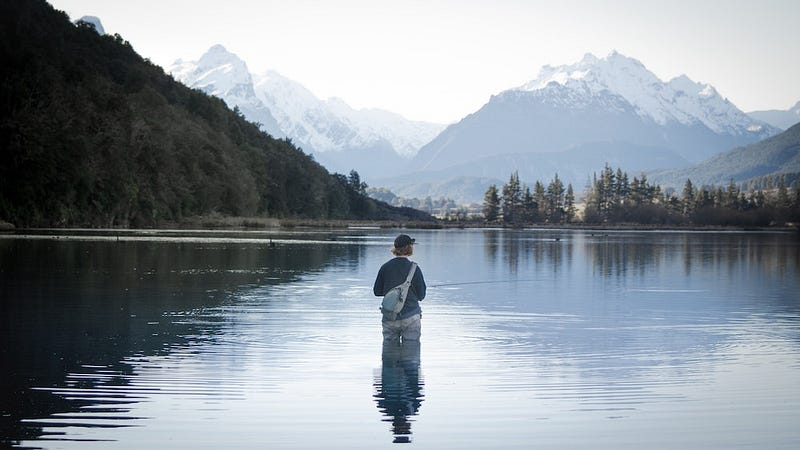
I use fishing as a metaphor for one’s approach to screenwriting. Seriously.
It’s Saturday morning and I am here, seated amidst a half-dozen other men, my brother, and my ten year-old son at Murray’s Fly Shop in Edinburg, Virginia. We have gathered to fish on the Shenandoah River. But before we dive into our waders, we have to be schooled in the ways of the river.
My brother is a successful lawyer. He loves sailing, tennis, cooking, but most of all fly fishing. He and I have taken fishing trips together in Colorado, Minnesota and Alaska. Military brat bonding. Brothers at arms.
This trip is for Luke, my brother’s conniving attempt to lure the boy into a life of angling.
Now let me confess I am not a morning person. Evidently fish are. Which is why we are up at this uncomfortable hour of the day. So my degree of consciousness as I listen to Jeff [our fishing guru] is a bit foggy. Moreover the day before, we had done a float down the Shenandoah River for 8 hours in nearly 100 degree heat. My son caught a mere two fish, calling into question the value of our collective Wicked Witch of the West “I’m melting” experience. I even managed to get sunburned on the tops of my feet.
So as I sit in this hard-backed chair, early in the morning, my scorched feet radiating heat, listening to Jeff pontificate about the finer points of trout fishing, I’m pretty much about as far removed from anything creative as I can possibly be.
Then a gift from the Muses. A screenwriting lesson wrapped in a fishing aphorism:
Don’t stand in water where you should be fishing.
When it comes to fishing, a critical component to success is the ability to read the river. I gather that to be true because Jeff has said as much at least a dozen times in his presentation. And evidently, a whole lot of amateur fishermen [myself included] spend a whole lot of time casting over here… and over there… when the damn fish are swooshing around right at our feet (sunburned or otherwise).
Don’t stand in water where you should be fishing.
I hear that and I go, bingo! I caught a Go Into The Story post!
Let’s say you’re an aspiring screenwriter. Whenever you read an interview with a working screenwriter and they are asked, “What should I write,” the response is almost always this:
“Write what you’re passionate about.”
That sounds so earnest, honest, and aesthetically responsible.
But what if what you’re passionate about is a period piece involving three misbegotten siblings, each of whom begins their journey in a different distant land, eventually intersecting at their rural family homestead for a week long exercise in recalling random, obscure stories from their past, the sagas conveyed in lengthy monologues. And did I mention the central connecting theme is pigeon keeping?
That story is you casting your line way over here.
Or you’re just totally itching to write that script about a failed artist in which the only two characters are the artist and the sculpture he’s working on — a unicorn — that comes to life in the moonlight. And did I mention it’s also a period piece? And a musical? In Mandarin?
That’s you casting your line way over there.
But facts are facts. And each of those scripts is a really hard sell in Hollywood.
Meanwhile swirling around your feet — right there! — are schools of potential projects Hollywood is dying to catch: Action. Comedy. Drama. Horror. Science Fiction. Thriller. The six biggest genres in contemporary filmmaking.
Think of them as big-ass fish swishing between your legs, just waiting to be caught.
So how in God’s green earth are you managing to avoid latching onto these humongous fish right there at your feet?
Probably because those same well-intentioned writers or screenwriting gurus who once told you to write what you’re passionate about failed to let you in on the fact that Hollywood barely gives two poops about your passion unless it aligns with what THEY are passionate about: making money.
That’s why they troll in the same waters all the time: Action, Comedy, Drama, Horror, Science Fiction, Thriller. Genres that have proven time and again they are the most likely to net big box office revenues.
My advice: Find a strong story concept in one those six major genres, a story for which you DO have passion. Then write the hell out of it.
That’s your best bet to hook a deal in Hollywood.
Don’t stand in the water where you should be fishing!