Writing Tip: Discovery Writing and Efficient Writing
Another way of thinking about writing and rewriting.

Another way of thinking about writing and rewriting.
I tell my students that a first draft is a “journey of discovery.”
No matter how much thought you may have given to the story prep process, when you sit down to write each scene in a first draft, clear your mind, connect with the characters and where they are emotionally…
Then write from a feeling place.
That is, feel your way into and through the writing of each scene.
Whatever you may know about your story, there are whole other layers of stuff going on which you can best tap into through your emotions.
As the great screenwriting guru Obi-Wan Kenobi told Luke in confronting his Final Struggle:

Trust. Your. Feelings.
That is the essence of what I call Discovery Writing.
So what if you write a 150-page first draft.
So what if some scenes run to 4, 5, or 6 pages.
So what if there’s dialogue you know will have to be cut.
During the story prep and first draft process, you need to open yourself to your emotional connection to the story… to the psychological state of being of each character in each scene.
Your first draft is — again — a journey of discovery. Give yourself over to your feelings and those of your characters.
See where that energy takes you.
Besides, you know your first draft will not be perfect, that you will need to rewrite it, that is inevitable.
And that is what I call Efficient Writing.
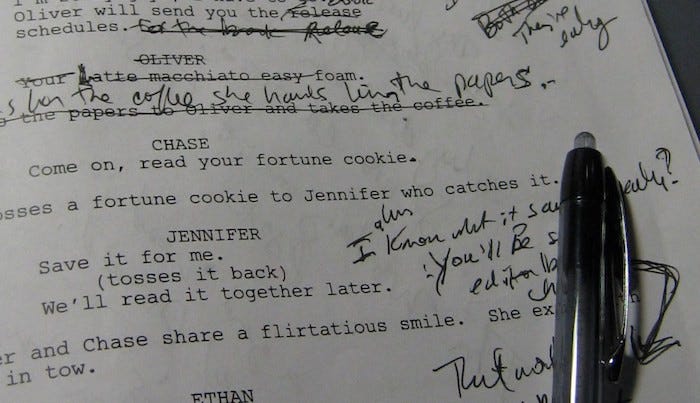
Tighten this scene.
Cut that line.
Rework this character.
Retool that subplot.
Work on those transitions.
Make the first page pop.
Strengthen your verbs.
Enter each scene as late as possible.
Exit each scene as soon as possible.
Trim widows and orphans.
Balance action and dialogue.
Ensure each character has a clear narrative function.
Minimize exposition.
If there’s a setup, be sure to land the payoff.
Look for potential talismans.
Pay attention to atmosphere and tone.
Embrace the story’s pace.
And always heed the observation by screenwriter William Goldman:
“The camera is relentless. Makes you keep running.”
This simple fact puts a premium on efficient writing.
The screenwriting mantra: Minimum Words, Maximum Impact.
But…
And this calls for a big font…
BUT…
Don’t go to efficient writing before you’ve given yourself over to discovery writing. You need to surface that raw narrative material laden with your emotional sensibilities before you start your rigorous critical analysis and screenwriter’s consciousness which is about making…
Every. Single. Word…
Count.
Discovery Writing + Efficient Writing → Good Writing.