Writing Goals: 2019
10 part series for writers to consider what we did in 2018 and will do in 2019.

10 part series for writers to consider what we accomplished this year and what we aim to achieve next year.
Every December, I run a 10-part series inviting readers to reflect on their writing progress this year and go about the process of setting achievable goals for the next year.
It’s a very simple thing, really — setting goals — but for many, if not most people, it is an invaluable part of their creative process. You can go here to read some background on why setting goals is important and how to be S.M.A.R.T. about it.
You may be someone who likes to set goals. Or someone who hates it. Maybe you’ve never really tried to formalize the process.
Whatever your inclinations or prior experience has been, I encourage you to try it to prepare for next year. Three big reasons why:
#1: With all its distractions, life has a way of dissipating positive energy. We may have some general sense of what we’d like to accomplish, but the mere fact we live with the gigantic time-suck that is the Internet, that alone has a way of squandering countless hours of time when we could be writing. One of the best ways I know to deal with this natural tendency toward dissolution of focus is to take a definitive stand: Declare your intentions and stay fixed on those goals every day.
#2: If you’re familiar with Script Girl, her tagline offers one of the most fundamental truths about the screenwriting business there is: “You can’t sell it, if you don’t write it.” You have to finish that script. In fact, to maximize your chances at success, let me amend that last statement: You have to finish those scripts. As in plural. The more scripts you write, the more you understand the craft, the better you get as a writer, and the more you prepare yourself for a possible career as a screenwriter. Plus, you have more content to show to managers and agents. And each of those scripts represents a story you can sell potentially. But if you don’t write them… cue Script Girl.
#3: There’s an anecdote I believe in William Goldman’s memoir “Adventures in the Screen Trade,” still perhaps the best book about screenwriting even thirty plus years after its publication. As I recall the story, Goldman was friends with a top NBA basketball player, a man renowned for the amount of time he spent practicing. Even after he had become a successful professional athlete, he was the kind of guy who would be shooting jump shots in a lonely gym after midnight. Goldman asked him, “Why do you practice so much.” The player’s answer: “Because when I’m not practicing, someone else is.” The screenwriting version: If you’re not writing, someone else is. Screenwriting is an incredibly competitive field. To give yourself an edge over the competition, you simply have to spend time — a lot of it! — writing.
Three reasons for you to be serious about setting writing goals for next year. I’m sure you could provide even more.
Here is the entire series.
#1: Looking Backward
An important first step in setting writing goals is to look back at what you accomplished in the last twelve months. If you’ve achieved a lot, great. By reviewing your accomplishments, you can use that as a springboard to propel you into the New Year. You can also assess what you’ve done to provide a logical transition from these projects this year to the ones you choose to write in the upcoming year.
On the other hand, if you look back at this year and realize you did not get nearly enough done on the writing front, that should serve as motivation as well. You don’t want to let another year slip by without making significant progress, correct? All the more reason to try establishing some simple, measurable, achievable, realistic, and timely goals for the upcoming year.
Why not take the time to look back at your year in writing? I invite you to head to Comments and share with us what you accomplished this year. How many scripts did you write? How many story concepts did you generate? How many short stories or poems did you write? Maybe you signed with an agent or manager. Maybe you sold a script. Maybe you started your very first script. Anything you accomplished is worth celebrating, so I encourage you to share that with us so we can celebrate together.
The next step in this process of setting writing goals for the new year: Assessing where you are as a writer. Sit down with yourself and take a critical, honest look at where you are, what you’ve done, and where you want to be. Zero in on finding those areas about which you feel really passionate. That’s where we’ll start when we pick up the process tomorrow.
Bottom line: Set some specific, achievable goals for next year.
#2: Assessing Where You Are
We started by looking back on what we accomplished this year. That part of the process is practical, aggregating our significant events and tangible achievements in the previous twelve months. Next, we assess where we are as writers. This aspect of the process is more emotional, even spiritual.
Get curious about your Creative Self. Perhaps ask one or more of these questions:
- Is this where I want to be as a writer?
- Am I writing what I want to be writing?
- What do I want to write?
- What do I need to write?
- Is there a particular story I have surfaced about which I am particularly passionate?
- Has something important happened in my life this year which has shifted my writing perspective?
- Am I in touch with my Creative Self?
- What can I do to be a better writer?
How about you? Where are you as a writer? How would you assess where your Creative Self is just now? If it’s unclear, a piece of advice: Go into a room, shut the door, turn off all electronic conveyances, and ask yourself some of those questions noted above. What is your Creative Self calling you to do as a writer?
#3: Where Do You Want To Go As A Writer?
Now direct your self-reflection toward the Future. Not just next year, but beyond. Five years from now. Ten years. Twenty. Consider the question: Where do you want to go as a writer?
Of course, we can’t know the answer. Indeed we can’t even assume we’ll make any money in the creative arts. As I wrote in this Business of Screenwriting column is: “Movies don’t owe anybody a living.” Swap out any kind of writing for ‘movies,’ it’s the same thing.
But while we must keep our feet firmly planted on the ground, understanding the odds against financial success, there is no good reason why we can’t put our head in the clouds, indeed poke above them to catch a glimpse of our possible bright future. In fact, it’s important to envision what a successful career in the entertainment field would look like because when you break into the business, one of the earliest conversations you will have with your agents and/or manager is around this question: What do you want to do?
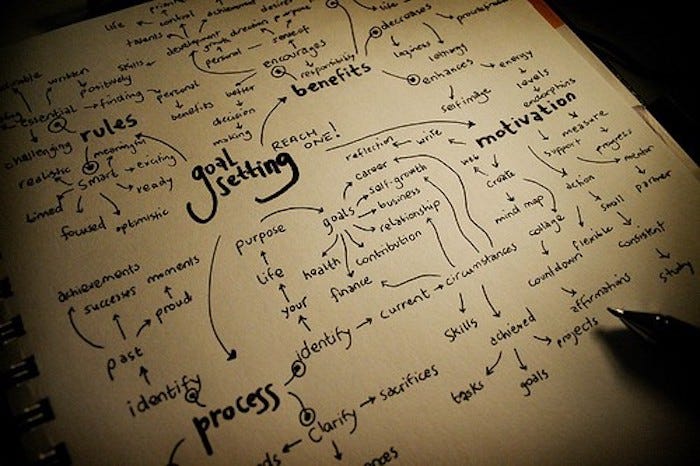
During this part of your reflection process, if your mind wanders off into images of a home in the Hollywood Hills, a new sports car, walking the red carpet at a movie premiere, Spielberg on the phone to ask you to salvage a troubled script, your Academy Award acceptance speech, I have no problem with that. We all deserve and need fantasies such as those to kick-start our motivation from time to time.
But the focus here is specific: You and your writing. Where do you want to be with it in a decade or longer? What would be the most fulfilling use of your creativity as a writer?
Again if you haven’t joined in with our collective ruminations in this series of posts yet, now is a perfect opportunity. First off, there’s zero negativity involved in this mental exercise today, rather it’s all about a positive sense of your future (i.e., fun stuff). Second whether you subscribe to the theory of creative visualization or not, having a specific image of yourself as a writer in the future at least provides you with a point of focus for your efforts in the present.
Here are some questions you may ask yourself:
- Do you want just to write movies?
- Do you want just to write TV?
- Do you want to write both?
- Do you want to write and direct?
- Do you want to write and produce?
- Do you want to bounce between writing big commercial movies and character-driven indie films?
- Do you want to write screenplays and novels?
- Do you want to carve out a niche writing specific types of movies or write across multiple genres?
I’m sure you have other questions to add to the list. Whatever you ask yourself, the important thing is to project into the future and imagine where you want your writing to take you. Stop by Comments, won’t you, and share your thoughts.
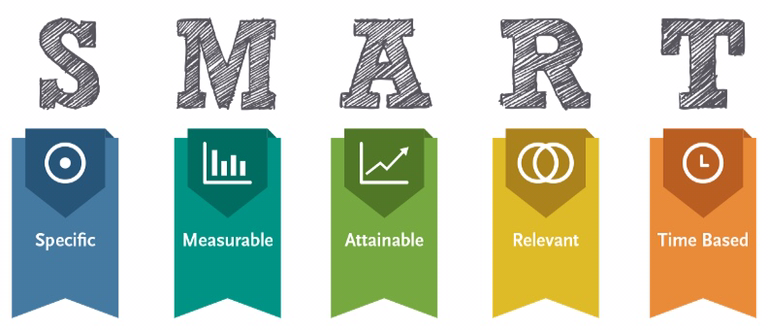
Tomorrow, we focus on practical matters. Remember what we’re trying to do here is be S.M.A.R.T. about our choices when it comes to Writing Goals.
S = Smart
M = Measurable
A = Attainable
R = Relevant
T = Time Based
#4: Practical Matters
When trying to lock down writing goals, considering the points raised thus far is a good and welcome set of reflective activities.
However, there is this little thing that impacts our plans. You know it, don’t you? That little thing known as Life?
It’s great to generate a list of things we want to accomplish, but if we don’t take into account the realities of our day to day, week to week, month to month existence, the practical matters of Life, then that set of goals becomes… unreachable. And if unreachable, it becomes… dispiriting. And if dispiriting… over time all our story ideas get dispatched to the dead-end land of dust and tumbleweeds… and our writing dreams wither and die.
To avoid that fate, you’ve got to be realistic.
It’s important to have goals, but you have to be S.M.A.R.T. about it. Once again: Smart, Measurable, Achievable, Realistic, Timely.
Aim high. But deal with reality.
You have a job. Maybe you’ve got a second job. Or you’re in school.
You have friends. You have family. Maybe a spouse or a lover.
In other words, Responsibilities. You have them. I have them. And we can’t ignore them when coming up with a plan to reach our writing goals. Otherwise it’s not really a plan, is it, but rather nothing more than a wish list.
When I look at that S.M.A.R.T. list, the one that opens its jaws and roars at me, desperate to get my attention is this one: Realistic.
I am great at coming up with ideas. I am also great at making the leap. So when I have ideas, I am prone to jump into them.
Part of this is my belief in The Spirit of the Spec. You get an idea. You act on it. You put it out there. My decision to take a break from academics. Accepting an invitation to visit Aspen to see if I could make it as a musician. “I can do that,” my response to a question about if I could write a screenplay (when I had never written one before). The spec script K-9. Taking up teaching part-time. Starting this blog. Partnering with the Black List. Launching Screenwriting Master Class. Doing the Quest Initiative. The Zero Draft Thirty Challenge. Assistant professor position at the DePaul University School of Cinematic Arts. On and on and on it goes, my life a litany of having ideas and acting on them.
Now that’s all good, of course, with respect to being a self-starter. Combined with being a military brat and having zero aversion to work, along with a pretty good track record for sticking to things and seeing them through to the end, I get a lot done.
The problem is I take on too much.
There. I said it. Yep. I ain’t Superman. I can’t answer all my emails. I can’t say “yes” to every request. I can’t take on every idea I come up with.
The simple fact is the key to setting realistic expectations is to be able to say NO.
Moving forward, I’ve got to say NO to some things in order to accomplish my goals. I know this will be hard. I will have to fight my instincts more than once.
But in order to create quality with regard to this particular project, I’m going to have to be extra careful about the quantity of things I do.

Can anyone else relate to this issue? Do you tend to do too much?
The reality is unless you are single, have zero interest in a social life, live like a monk so don’t require much in the way of income, and can afford to write 20 hours per day, you have to figure out a way to handle the requirements of your life and make progress as a writer. Which means whatever writing goals you choose for the upcoming year, they have to be realistic. Be honest with yourself. What of these things can I reasonably expect to accomplish next year?
In other words — as noted above — an actual plan, not a wish list.
#5: Going Public
Why go public?
Because if we just think about your goals, they are nothing more than illusions, hazy, half-baked phantasms in our heads, here and potentially gone like all the other zillion thoughts that spurt through our consciousness each day.
Because if you don’t formalize your writing goals, you may forget them.
Because having some sort of tangible, physical list gives you a touchstone to remind you what you need be focusing on throughout the year.
Because by proclaiming your goals to the Universe, they become real.
And the biggest reason of all: That simple act of courage — declaring your goals publicly — engenders positive energy, recalling the line by the Rev. Basil King who said, “Be bold and mighty forces will come to your aid.”
What then do I mean by going public?
Anything that gets the goals out of your head and into the physical universe. Such as:
- Write down your goals onto 3×5 index cards.
- Compose a letter to yourself with your goals, stick said letter in an envelope, and tack it to your desk where you can see and know it’s there when you write.
- Email your family and friends with the list of goals.
- Host a party at which you recite your goals and invite people’s moral and emotional support.
- Hire the Goodyear Blimp and flash your goals on it over the Rose Bowl.
Or you can simply post your writing goals here on GITS.
Here’s how I look at writing goals: They are similar to the relationship a writer has with an outline. An outline can be a tremendous benefit to a writer, wrangling the story and giving shape to it. But once you hit FADE IN, you have to be willing to follow the characters wherever they take you. Sometimes the characters follow the outline perfectly. Other times, they don’t. In the case of the latter, you never stifle your characters, instead you have to have the courage to set your outline aside, and go with the creative flow.
Same thing with writing goals and whatever opportunities come along. Your goals give shape to the potential narrative of your creative year. Sometimes events lay out just like you figured they would. But other times, some project pops up, a unique opportunity to write a story about which you feel passionate. In those cases, you have to be willing to veer away from the schedule for your goals — not the goals themselves, just how and when you are go about realizing them.
#6: Schedule
Going public with your writing goals does not mean your planning work is done. It will do you little good if you generate a list of goals, but don’t figure out a time frame within which to accomplish those goals.
When I was writing screenplays full-time for a living, I had a routine: Mornings were for exercise and taking care of personal business. Afternoons were for writing. Nights and weekends were for research and brainstorming other projects [for more on stacking projects, go here]. In fact for the afternoon writing sessions, I had this little numeric code: 1 to 5, 5 to 7. That is I wrote from 1PM to 5PM every week day and expected to produce 5 to 7 pages each writing session. If I knocked out 7 pages by 3 or 3:30, I had the option of knocking off early, or continuing to plow ahead if I had built up a good head of steam.
That was a simple system and didn’t require much in the way of oversight other than a commitment to work every day.
Now that I have so many different types of writing [creative writing, teaching, blogging, lectures, research, script feedback], I have had to revise my work habits and the way I handle schedules. The key is the calendar. In fact, were I not so fastidious about using a calendar, there is no way I could manage all the writing I do.
Because one of my primary email accounts is Gmail, I use Google Calendar. For planning purposes, I break things up this way:
- Annually
- Quarterly
- Monthly
- Weekly
- Daily
I plug in a projection of how I see the year laying out. Obviously that is going to flex along the way, but I find it’s helpful to lay out markers for gigs and writing goals throughout the upcoming year.
I divide things up quarterly to help break down goals into more manageable chunks and to stack projects more effectively.
At the end of each month, I create a lay-out of what I project will need to happen over the next 30 days to manage everything.
Same thing with the weekly schedule where I get very specific with daily items that need to be handled.
Finally, a daily calendar breakdown.
Three particular things about schedule:
- Open items on my calendar that need to be taken care of are GREEN. When I finish that task, I change it to BLUE. This not only helps me have a visual reference as to what I need to do, it also provides a tiny, but satisfying experience of knocking things off the list.
- Prioritizing: This has made a huge difference for me. I have always been good about making lists, but in the past I have tended to have a rather laissez faire approach to how I would work my way through the things I had to do. Because nowadays I have so many different things going on, I prioritize the items on my list, and go through them in the order of their importance.
- Do the hardest thing first: My Air Force Colonel father drilled this into the core of my being, so when I prioritize writing tasks, I put the tougher ones at the head of the list.
This may sound like a hugely schematic way to write, but I look at it like an extension of my own creative writing process in that my schedule is like a story outline: It’s how I provide shape to the ‘narrative’ of my daily, weekly, monthly, and so on ‘story.’
#7: Time Management
If there is a consistent refrain I hear about the problem with writing — and one I find myself muttering as well — it’s this: “I don’t have enough time.”
The simple fact is that may be true, especially so for writers who are working on the craft as an avocation or second job. While writing may be their number one creative priority, there is the small matter of keeping the lights on and the rent or mortgage paid, so on the fiduciary front, writing by necessity must take a back seat to bringing home the bacon. Depending upon the amount of hours they have to pull to cover their work, combined with family, friend and significant other responsibilities, their desire and energy for creative writing can run into a daily buzz saw of zero time.
What can a writer do in that situation? For one thing, reassess their goals. Perhaps they have to scale back their expectations. Instead of pounding out a spec script every two months, what about a more realistic goal? Remember it’s possible to create two scripts per year by writing 1 page a day.
But for a majority of people, including even those who appear to have no apparent time to write, there is another reality: In fact, we do have time, we just aren’t using it efficiently which in effect dissipates the amount we think we have.

Let’s imagine a writer. We’ll call him Sammy Glick. He is working on a spec script. He sleeps 8 hours per night. He works at his white collar job 10 hours per day. Let’s knock off another 2 hours for eating and handling daily household related chores (e.g., paying bills, laundry, bathing the dog). That leaves 4 hours per day of what we may call ‘discretionary’ time.
But what about exercise? Free time? Watching movies? Reading scripts? Yes, Sammy needs that, too. Okay, so let’s cut away another couple of hours leaving him with a mere 2 hours to write each day.
Here’s the thing: Sammy can do amazing things in 2 hours. If he’s in first draft mode, he should be able to write a scene every hour, maybe even more [depending upon the type of scenes, of course].
I think it’s fair to suggest the issue isn’t so much about Sammy not having time, it’s Sammy managing the writing time he has. Therefore, I’d like to offer three suggestions, starting small and working my way up in scope:
- The Timer Approach: You may remember my posts about the Pomodoro technique, where a person works on something for 25–35 minutes, then takes a 5 minute break. Each work segment is called a pomodoro and I’ve found it extremely helpful when I’m doing non-’creative’ writing [e.g., blogging, lectures, email]. In fact, I can look at my daily list of tasks and break them down per how many pomodoros I think each will take. Since 35 minutes is too short, at least for me, in terms of creative writing, I use a timer and set it for an hour, ninety minutes, two hours, however long I feel the scenes / pages ahead of me require complete concentration. The key here is once you start the timer, that’s it: You write. No distractions.
- Daily Routine: Setting a specific time — the same time — every day provides perhaps the biggest bang for your buck in terms of maximizing your time writing. Why? Because you create a pattern to which you become accustomed psychologically, even physically [I know plenty of writers who say they literally feel antsy or out-of-sorts if they miss a scheduled writing session]. I don’t have any facts to support my thesis, but I am willing to bet every single cent I have made hosting this blog that writers who have a regular routine get more accomplished with their writing than those who write only when they can find the time.
- Prep-Writing: This is how Sammy Glick used to write: He would do a minimal amount of research and story prep, then super excited to get started on his story, he would type FADE IN and leap into page-writing. However most of his writing sessions were frittered away staring at the monitor because he didn’t know what to write. Then Sammy became a prep-writing convert. Once he started cracking the story and putting together an extensive, detailed outline before he typed FADE IN, Sammy rarely got stumped in his writing sessions, instead he was able to jam through a first draft by making the most of his precious few hours a day to write.
Here is how I have come to think of my writing time: It’s not so much managing it as it is protecting it. When I have those hours blocked off and I shut the door to write, I fight to preserve that time.
#8: First Draft
This is short, but sweet. When you write a first draft, there is only one thing that matters:
GET THE DAMN THING DONE!!!
More script projects crash and burn because somewhere along the line after typing FADE IN, writers get frazzled and frustrated, disgusted and depressed, peeved and pessimistic, and simply stop writing and never finish the first draft.
If you start a script…
And you’re just not feeling it…
The plot is a major struggle…
The characters seem off…
The dialogue isn’t flowing…
The whole script conjures up the odor of zoo dust…
It doesn’t matter. None of that matters. The only thing that does is to finish the first draft! Just get the damn thing done!
I guarantee you no matter how awful you think it is, the actual process of getting to the end of the first draft will do the following:
- Help you understand your story better.
- Surface story problems enabling you to address them.
- Put you that much closer to finishing the script.
- Get you past a huge psychological obstacle of finishing the first draft.
Perhaps the most important thing: After you finish a first draft, you are no longer writing, you are rewriting. You are editing. There’s not a writer I know about or have interviewed who doesn’t prefer editing to writing.
So if there is one writing mantra above all others I implore you to take to heart, it’s this one. No matter how hard it is for you to drag what you think may be a wretched assemblage of stinking scenes and putrid pages across the finish line known as FADE OUT… do it!
Everything looks different once you have a first draft in hand.
Everything is different once you have a first draft in hand.
Just get the damn thing done!
By the way, cracking the story before typing FADE IN is often directly connected to the writer finishing a first draft or not. If you know the story before you commence the page-writing part of the process, you exponentially increase the chances of you getting the damn thing [first draft] done. If not, you reduce the odds in your favor. Moreover by doing the hard work of figuring out the story in prep, there’s an awfully good chance you will turn a future Rewrite [R] into a rewrite [r], and speed your way into the editing process.
#9: The Only Way Out Is Through
Imagine the process of writing a story as being a journey. Perhaps as you embark on your adventure, you have a map — an outline or beat sheet. Or maybe you don’t, plunging into your story in order to find it along the way. In either case, it’s almost certain that you will reach points in the writing process where you will feel lost. The plot isn’t working like you thought it would. Your characters feel remote and confusing. Your scenes don’t seem to be working. Your map or instincts become a labyrinth. Basically you are left to ponder, “What the hell was I thinking?”
That’s when you are tempted to give up.
Don’t. Giving up doesn’t get you out, rather it only allows you to avoid story — or so you think. It still exists. And by quitting, you create a shadow, your story as unfulfilled potential looming over you like a ghost.
No, the only way out is through.
You have to push yourself through your feelings of doubt. Push yourself through the ambiguities of your plot. Push yourself through the hard work of pounding out pages.
Rather than quitting, take the opposite approach: Go deeper into your story. To paraphrase “The X-Files,” the truth is in there!
If you go through the process, you will find your way out.

Every journey has its twists and turns. You may not be able to see where you’re heading around the next turn, but the fact is there is a path.
And the only way out is through.
This is one of the two most profound and powerful writing mantras I know. The other one is next, the final entry in this series.
#10: Trust the Process
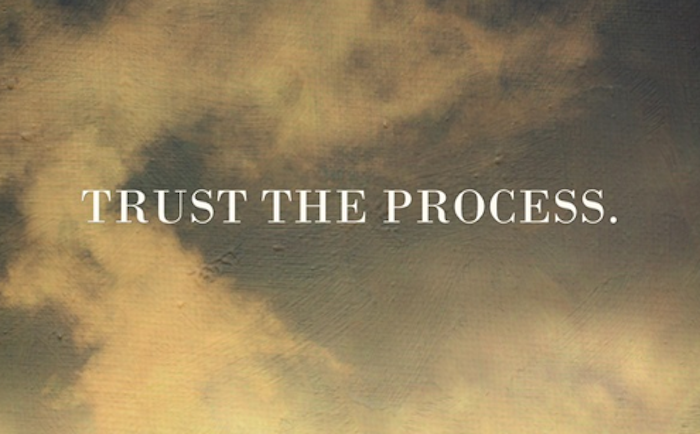
This is probably my favorite writing mantra. It’s both practical and spiritual, which pretty sums up my experience of the act of writing.
There is prep-writing (brainstorming, research, generating plot elements, developing characters, story structure, scene breakdowns, outline), then there is page-writing (type FADE IN and continue writing until you type FADE OUT). Those two components represent the practical part of the process, but out of that ‘grunt work,’ a more spiritual aspect emerges: suddenly, you hear a character say something to you, or a character may refuse to act the way you planned, or a scene sequence you worked out in advance implodes once you start writing it, or a whole other way of approaching a subplot may leap to mind.
Whatever happens at every step of the way, a writer must learn to trust the process.
For some writers and some stories, the process can be neat and straightforward. For others, the process can be confounding and circuitous.
Every writer is different. Every story is different. Every process is different.
The writer must learn to accept that and trust that they are where they are for some reason.
M. Night Shyamalan supposedly wrote five drafts of The Sixth Sense until he had this startling realization: the Protagonist, Malcom Crowe (Bruce Willis), was dead.
J.R.R. Tolkien finished the first chapter of what would become “The Lord of the Rings” in February, 1938, then didn’t turn in the final manuscript until 1950. On two occasions, after writing hundreds of pages, Tolkien went back to page one and started all over. What if Tolkien had not trusted his creative process? We might never have known one of the world’s most remarkable pieces of literature.
“Trust the process.”
I hit upon that phrase when I was teaching one of my online screenwriting courses in response to a student who was seemingly stuck in their story. A year or so later, I stumbled onto this book, “Trust the Process: An Artist’s Guide to Letting Go”. It’s an excellent read, one I highly recommend, and it raises an interesting point about trust, that second part “letting go.”
Letting go of what?
Often what happens when we get ‘stuck’ in our writing, it’s not so much about the story, it’s about what we bring to the writing process — expectations, plans, fears, doubts. Any time we step out of the story, our active engagement in the writing process, we run the risk of losing ourselves in the day-to-day world as well as our hopes and dreams. For example, we may get caught up in seeing the story as a bridge from our life today to our imagined life in Hollywood as a working screenwriter. To carry that weight of ‘responsibility’ into a writing session, that attachment, can easily encumber our actual writing — and soon we’re stuck, not because of the story, but what we are bringing to the writing.
Trust the process / let go — all very Zen, yes? I guess. It also suggests that we look at the Writer in relation to Story not as an “I — It” relationship, but an “I — You” dynamic, something we explored here.
Trust the process.
Try tacking that mantra up onto the wall where you write…
And then believe it.
Good luck with setting your writing goals… and accomplishing them!