Writing Dialogue
There are many intangibles about the craft of screenwriting. Much of that derives from the fact that story itself is organic. Stories —…

There are many intangibles about the craft of screenwriting. Much of that derives from the fact that story itself is organic. Stories — good ones, at least — are not formulas. They are not widgets. Rather they are living, breathing entities with a heart, soul, and even will of their own. They slip and slide as we develop and write them, creating a series of challenges as we try our best to solve their mysteries.
Perhaps nowhere is this more apparent than with dialogue. When I pose the question, “How do you write dialogue” to professional screenwriters, the most common response is basically this: I don’t know.
Common advice as to how to learn to write good dialogue:
- Listen to real-life conversations to get a sense of how people talk.
- Read scripts and watch movies — or better yet listen to movies — in order to grasp the feel and flow of film characters talking.
- Simply keep writing, that the more you pound out pages and knock out original screenplays, you will develop your ear for dialogue.
All of those are reasonable points. But aren’t there principles and practices we can learn to help bring into focus a writer’s ability to craft compelling, entertaining and effective dialogue?
That was my thinking when I sat down to create the fifth class in the Core curriculum — Core V: Dialogue, which begins Monday, November 1.
As with everything I teach about screenwriting, it starts with character. Isn’t it obvious the more you know and understand about your story’s characters, the more likely their respective voices will emerge into your consciousness?
Beyond that, it’s not just about hearing them, it’s about choosing the most impactful dialogue to support the point of each scene and drive the plot forward.
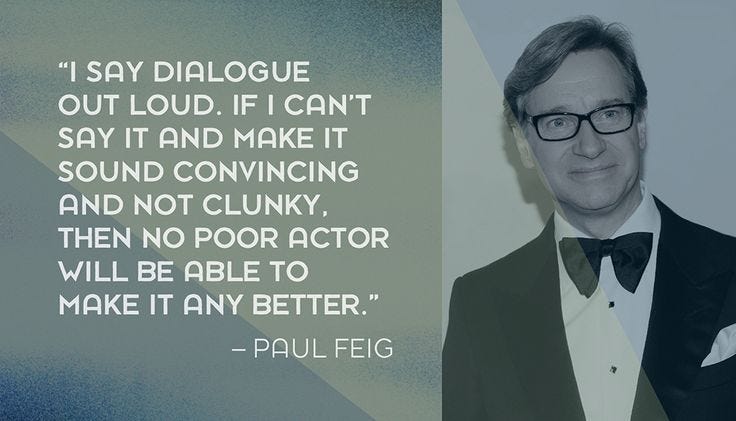
Hence, the fifth Essential Screenwriting Principle: Dialogue = Purpose.
In a screenplay, there is almost zero room for extraneous dialogue, rather every line should tie into the Plotline and/or Themeline.
In Core V: Dialogue, we dig deep into this subject through 6 lectures I have written:
Lecture 1: Introduction to Dialogue
Lecture 2: Finding Your Character’s Voice — Inward Journey
Lecture 3: Finding Your Character’s Voice — Outward Expression
Lecture 4: Subtext
Lecture 5: What Is Not Said
Lecture 6: Realistic Dialogue
In addition there are several Insider Tips, analysis of several movie scripts, opportunities to workshop dialogue in some of your own original scenes, a 75-minute teleconference, and much more.
A testimonial from a writer:
“Scott is so generous with sharing his knowledge and it’s a great blessing to those of us who are just starting off/been doing it for years/need a reminder/need inspiration. I just completed the Core Dialogue course and I can honestly say he delivers back your investment threefold.” — Sabina Giado
There is no right way to write. Every writer is different. Every story is different. And you can learn everything you need to know about the craft of screenwriting by doing three things: Watch movies. Read scripts. Write pages.
However, if you want to explore the subject of dialogue in an immersive fashion and from a distinct character-based perspective, I invite you to join me for this 1-week online class which begins Monday, November 1.
For more information, go here.