Writing and the Creative Life: Structure and Freedom
Words of creative wisdom the great 20th century composer Igor Stravinsky.
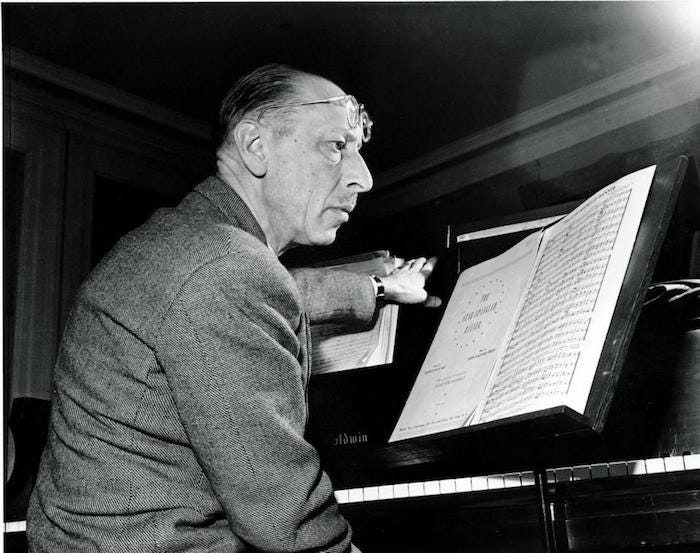
Words of creative wisdom the great 20th century composer Igor Stravinsky.
When I was an undergraduate student at the University of Virginia, I took a music class with a delightful professor from Eastern Europe. His enthusiasm was infectious. And even though it was the only 9AM class I ever took in college, I looked forward to tumbling out of bed, shuffling down Rugby Road to Old Cabell Hall, and sitting in every session of our class together.
The professor was fond of telling anecdotes about his favorite composers. One story he shared about the great Russian composer Igor Stravinsky, I’ve never been able to verify, but it conveys such powerful wisdom, I have accepted it as true. Indeed over the years, I have shared it with friends, acquaintances, and students. Here it is.
It seems Stravinsky, at the height of his fame, was teaching some university level music students. One of them asked the revolutionary composer if he felt “restricted” by being “forced” to compose on a piano, “limited” by its 88 keys.
It should be noted that Stravinsky was famous in part for pushing the boundaries of classical music, embracing dissonance and evolving through several musical iterations including atonality. Stravinsky pushed the envelope in a huge way in terms of musical conventions of the era.
So here is Stravinsky, arguably the greatest musical pioneer of the 20th century, staring into the face of this young, idealistic student who had posed a good question. Stravinsky’s response [paraphrased]:
“Of course not! With these 88 keys, I am given a structure. I do not have to worry about where it begins and where it ends. This is my creative universe. And within those confines, I am free to do whatever I want.”
I have always loved this story. Over the decades, I have been a musician, comedian, screenwriter, and storyteller. And in each of these periods of my life, I have experienced, again and again, how limitations spawn a unique kind of creativity. Forced to make do with the resources at hand requires us to tap into a type of creative inspiration that does not rise to surface in any other circumstance.
Moreover, because screenplays are so structural in nature — famed screenwriter William Goldman has said, “Screenplays are structure” — generally we have no other choice than to accept these fixed perimeters and work within them.
I suspect that most screenwriters embrace those strictures, much like Stravinsky did.
Set up the story quickly. Something big happens that ignites the plot. Off the Protagonist goes, departing their Old World, thrust into a New World on a journey of discovery. Beginning, Middle, End… Three Act Structure. A big reversal at the end of Act Two which we may call All Is Lost. Some sort of Final Struggle in Act Three. Denouement.
During the early-18th to mid-19th centuries, orchestral music in Europe was dominated by sonata form. This approach evolved over a period of many decades as orchestral music in the West moved from the dense counterpoint and fugues of the Baroque era to what is known as the Classical Era wherein lyrical melodies developed and flourished. Mozart is generally perceived to be the first, best talent at using sonata form. For my money, his 40th symphony is the quintessential example of sonata form.
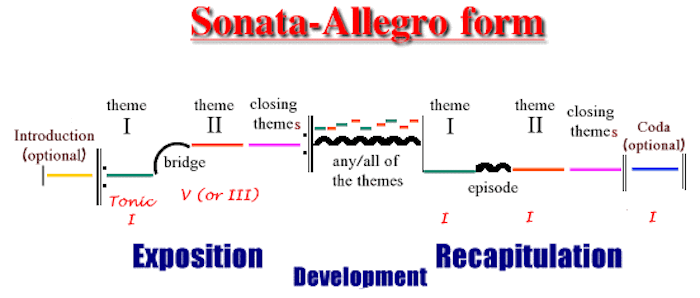
What is sonata form? It involves three sections:
Exposition: Introduces the movement’s main melody in the tonic key, then moves to another key, which may include a number of different melodic themes.
Development: The middle section of the movement develops material from the exposition in a variety of ways, moving through a number of keys.
Recapitulation: This final section restates the melodic themes of the exposition, usually in the same order; the second group is now heard in the tonic key.
Even if you have never studied classical music, I ask you to look at those three sections and ask yourself: don’t they bring to mind 3-Act Structure? There are striking similarities, if you think of:

You can even extend the metaphor further by thinking of Melodies as Characters, and Transitions from one section to the next as major plot points.
Indeed, the core idea of the main melody (Protagonist), set up in the Exposition section (Act I), taken through a series of key changes (twists-and-turns) in the Development section (Act II), usually a sequence with considerable tonal instability, and rhythmic and melodic tension (mucking up the Plotline), then the main melody (Protagonist) brought back ‘home’ in the Recapitulation section (Act III), but played only in the tonic key (the “Protagonist” transformed), you can really see the parallel to 3-act structure:
Music is another means of storytelling, and the fact that master composers such as Mozart, Beethoven, Mahler, Brahms, and many more found creative freedom and expression within the structure of sonata form, that it ruled orchestral music for 150 years, that pieces based upon sonata form are still performed and enjoyed by millions to this day is yet another example of why structural theories about screenplays work — because they reflect a three act/movement pattern which seems to underlie the basics of all stories, all forms of storytelling, all manner of story-crafting.
No matter the lingo or theoretical underpinnings, structure is at the core of a screenplay. But given whatever paradigm or formula we may use as an approach to crafting a script’s structure, that does not mean we have to write a formulaic story. On the contrary, within the confines of a script’s structure, we are free to do whatever we want with our characters and the plot.
The structure is, as Joseph Campbell would claim, “universal.” Yet it is limitless in the ways we can shape it, tweak it, twist it. It provides us the boundaries for what we have to work with. It shapes the chaos of our impulses and ideas into something coherent.
And within that structure, we have the freedom to follow our characters… and see where they take us.
For more Writing and the Creative Life posts, go here.
Writing and the Creative Life is a weekly series in which we explore creativity from the practical to the psychological, the latest in brain science to a spiritual take on the subject. Hopefully the more we understand about our creative self, the better we will become as writers. If you have any good reading material in this vein, please post in comments. If you have a particular observation you think readers will benefit from and you would like to explore in a guest post, email me.