Writing and the Creative Life: Lessons from a book “everyone in Silicon Valley is talking about”
The Hook: Trigger, Action, Variable Reward, Investment.
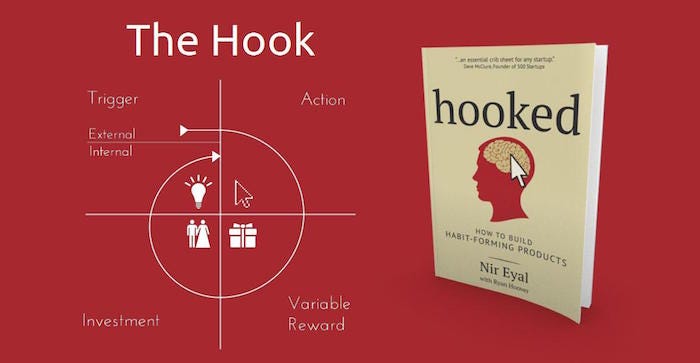
The Hook: Trigger, Action, Variable Reward, Investment.
There’s this book “everyone in Silicon Valley is talking about” or at least that’s the way it’s pitched at the book’s website. Its title: “Hooked: How to Build Habit-Forming Products”.
If you consider movies and TV series to be products, then it stands to reason so, too, are the screenplays we write.
So I checked it out. Here’s a summary of the four points the book makes:
1. Trigger: How does the loop initiate? In the beginning this may be through external triggers (such as an email, notification, icon badge, etc) but through successive loops the user eventually creates internal triggers where a particular thought or emotion will send them back to your product.
2. Action: Once the user is aware they need to use your product (through the trigger), what it the simplest action they can perform to get some kind of reward. For example a Facebook “Like”.
3. Variable reward: How are they rewarded for this behavior? This could be social validation (e.g. “my friends approve!”), collection of material resources (e.g. add a photo to a collection) or personal gratification (e.g. inbox zero). The “variable” part is important — rewards should not always be predictable, encouraging users to repeat the cycle.
4. Investment: Finally, the user needs to put something back in to increase the chance of repeating the loop. This could be content (e.g. a book in your Kindle), user entered data (e.g. profile information or linked accounts), reputation (e.g. something to gain a 5 star seller review), or a learned skill (e.g. I’m now really good at this software program). The investment also sets up the trigger to for the next cycle of the loop.
Okay, let’s work with a scenario applicable to screenwriters. We create the product: Our script. And the buyer? In the script acquisition process, it all starts with the supposed lowly script reader who actually has the first pass at creating an impression of our ‘product’ that follows all the way up the food chain, so in fact they are quite important to us.
In this scenario, it’s a Sunday night. Late. Our script reader — let’s call her Lilah — has been shut in at her cramped North Hollywood apartment all weekend, providing coverage on six screenplays, the proverbial ‘weekend read’. Now she taps out the last words on her final script coverage, checks her watch. Just enough time to catch a drink with some friends before she has to get to sleep for another harried 80 hour work week.
And just as Lilah begins to shut down her laptop… ping. An email. She winces. From her boss. Cover this script for tomorrow morning’s meeting.
That script? Yep, our script. So Lilah hates our script even while knowing NOTHING about it.
[I’m going to fudge this scenario a little bit in this respect: Our script has a logline. That’s normally not the case, but let’s run with that.]
Now back to the book “Hooked”, let’s focus on the four points cited above:
Trigger: How do I “initiate a loop” with poor Lilah? My logline. I’m hoping the central concept, the Protagonist’s situation, and the story’s entertainment potential will ‘trigger’ a response. That response? Read our script with an open mind.
Action: Lilah does, indeed, open our script. Now we’re concerned with this: provide the “simplest action [she] can perform to get some kind of reward”. That’s easy. We want to write an opening set of pages, in fact, a compelling first page to get Lilah to take ‘action’: Turn the page. Well, there’s Lilah who has scrolled to P.2… then P.3. How to keep her turning pages?
Variable Reward: “How are they rewarded for this behavior… The ‘variable’ part is important — rewards should not always be predictable, encouraging users to repeat the cycle.” Fortunately when we wrote our script, we varied multiple narrative elements: scene types, pace, subplots, plot twists and turns, and so forth. Ooh, look at Lilah now. She’s zooming through the script.
Investment: That’s easy. We want her to write coverage that is favorable to our script. And what’s that? OMG! She actually clicked on Recommend which is virtually unheard of.
Good job, folks! We got Lilah hooked on our script!
For more on “Hooked”, here’s a video by the book’s author Nir Eyal:
Writing and the Creative Life is a weekly series in which we explore creativity from the practical to the psychological, the latest in brain science to a spiritual take on the subject. Hopefully the more we understand about our creative self, the better we will become as writers. If you have any good reading material in this vein, please post in comments. If you have a particular observation you think readers will benefit from and you would like to explore in a guest post, email me.
For more Writing and the Creative Life articles, go here.