Writing Action vs. Action Writing
“If we think of what we write in describing what transpires in any given scene as action, we are more likely to lean into the visual…
“If we think of what we write in describing what transpires in any given scene as action, we are more likely to lean into the visual potential of those scenes.”
In one of my recent Screenwriting Master Class courses, the subject came up about writing action vs. action writing. There’s actually a subtle, but important distinction. Here is an excerpt from something I posted on the course site in response to the discussion:
It’s easy to get confused. The word “action” connotes… well… action. Thus, we tend to think of action as in the Action genre. For purposes of our discussion, let’s call that Writing Action. That is, when working on an Action genre screenplay, a good portion of what we do is concern ourselves with writing action scenes. Here are some good examples of writing action from my blog’s Scene Description Spotlight series:
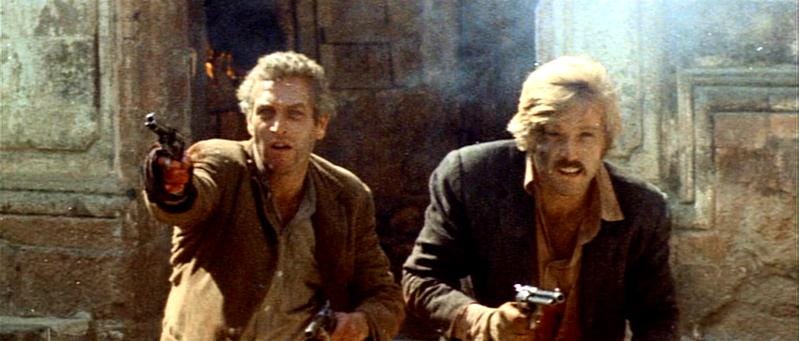
Butch Cassidy and the Sundance Kid
The selection from Butch Cassidy and the Sundance Kid is particularly instructive. Check this out:
CUT TOBUTCH streaking, diving again, then up, and the bullets
landing around him aren’t even close as—CUT TOSUNDANCE, whirling and spinning, continuing to fire and—CUT TOSEVERAL POLICEMEN dropping for safety behind the wall andCUT TO BUTCH really moving now, dodging, diving, up again andCUT TOSUNDANCE flinging away one gun, grabbing another from his
holster, continuing to turn and fire andCUT TOTWO POLICEMEN falling wounded to the ground andCUT TOBUTCH letting out a notch, then launching into another
dive forward andCUT TOSUNDANCE whirling, but you never know which way he’s
going to spin andCUT TOTHE HEAD POLICEMAN cursing, forced to drop for safety
behind the wall andCUT TOBUTCH racing to the mules, and then he is there,
grabbing at the near mule for ammunition andCUT TOSUNDANCE throwing the second gun away, reaching into
his holster for another, continuing to spin and fire
andCUT TOBUTCH and he has the ammunition now andCUT TOANOTHER POLICEMAN screaming as he falls andCUT TOBUTCH, his arms loaded, tearing away from the mules
and they’re still not even coming close to him as
they fire and the mules are behind him now as he
runs and cuts and cuts again, going full out and—CUT TOTHE HEAD POLICEMAN cursing incoherently at what is
happening and—CUT TOSUNDANCE whirling faster than ever andCUT TOBUTCH dodging and cutting and as a pattern of bullets
rips into his body he somersaults and lies there,
pouring blood andCUT TOSUNDANCE running toward him andCUT TOALL THE POLICEMEN rising up behind the wall now, firing andCUT TOSUNDANCE as he falls.
That is a 293 word sentence! Why did Goldman write a 293 word sentence? Because it was the best way possible to convey continuous action. Breathless, non-stop action.
The thing which gets really confusing is what we used to call scene description is now referred to by most screenwriting software programs as Action (in contrast to Scene Heading, Character Name, Dialogue, and so forth). Whenever we talk about writing scene description nowadays — regardless of the genre or type of scene we’re writing — we are engaged in Action Writing. That is we are quite literally writing action as specified by our screenwriting programs.
That’s precisely why I chose the three examples I did for Lecture 6. True Grit, The King’s Speech, and Winter’s Bone are not action movies, and yet, the screenwriters did engage in effective and visual action writing every time they wrote scene description. Here is an example from the opening scenes of The King’s Speech:
INT. BBC BROADCASTING STUDIO — DAY 5
A gentleman in a tuxedo, carnation in boutonniere, is gargling
while a TECHNICIAN holds a porcelain bowl and a towel at the
ready. The man in the tuxedo is a BBC NEWS READER. He
expectorates discreetly into the bowl, wipes his mouth
fastidiously, and signals to ANOTHER TECHNICIAN who produces an
atomizer. The Reader opens his mouth, squeezes the rubber bulb,
and sprays his inner throat. Now, he’s ready. He looks to the
control room.
The FLOOR MANAGER begins a count-down: five… four… three…
two…
BBC NEWS READER
Ladies and Gentlemen: good afternoon. This
is the BBC National and World Programmes
taking you to Wembley Stadium.
He speaks in flawless pear-shaped tones. There’s no higher
creature in the vocal world.
Contrast to Bertie attempting to make his speech:
Bertie moves forward diffidently, without an ounce of
confidence, knowing deep within he’s doomed. His stomach knots,
chest muscles contract, constricting his breath.
BERTIE
Luh-luh-lords, la-la-ladies, gen-tell-men.
It is a shock to realize this is a man with a profound stutter.
A man who cannot speak in public.
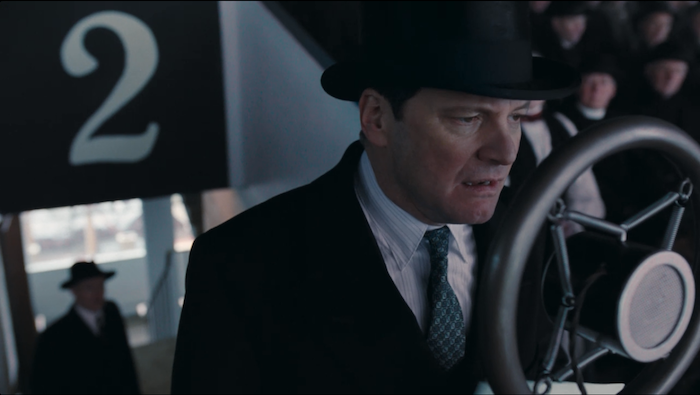
The torturous scene ends with this action writing:
Bertie stands frozen, his mouth agape, jaw muscles locked. He
knows he’s considered by all, especially himself, unfit for
public life.
Notice the careful word choices: doomed, knots, contracting, constricting, frozen, agape, locked. It’s not an action scene, but the action writing is visceral and combines with the dialogue to convey Bertie’s inner emotional state… and elicit immediate audience sympathy for the character.
I still tend to use the term scene description because part of my brain is hard-wired that way. I guess I’m just old school. However, there is value in referring to it as action writing for one big reason: It reminds us that movies are primarily a visual medium. If we think of what we write in describing what transpires in any given scene as action, we are more likely to lean into the visual potential of those scenes.
This can be as simple as taking a static talking heads scene — two characters, seated at a table, talking — and putting the scene up on its feet a la Aaron Sorkin’s ‘walk and talk’ approach:
Of more relevance, use strong verbs and vivid descriptors.
So if it’s any help:
- Writing Action refers to working on material which is in the Action genre (or features a lot of action within the story).
- Action Writing refers to any type of scene description, regardless of genre.
The latter reminds us to embrace the visual potential of each scene, look to make what transpires more active and more entertaining.