Writers on Characters
Quotes from professional writers about the importance of characters in the story-crafting process.

Quotes from professional writers about the importance of characters in the story-crafting process.
Over the years, I have aggregated 100s of writers on writing quotes. I was browsing through them recently and noticed a recurring theme: How many quotes are about working with and the importance of characters. Here is a selection of choice quotes on the subject.
Arash Amel: “Almost any story becomes a visual enactment of the psychological dilemmas faced by the lead character.”
Nikole Beckwith: “If you’re inviting people into a story, invite them into all parts of it. Inhabit each character as fully as possible.”
James Scott Bell: “Here is one simple rule to remember: Characters carry theme.”
Mark Bomback: “I try my very best in every film I’m working on to make you fall in love with those characters.”
Craig Borten: “It’s the characters. That’s what I spend most of my time with. Once I’ve done that, character will speak to plot and story.”
Elizabeth Bowen: “Characters are not created by writers. They pre-exist and have to be found.”
Ray Bradbury: “Plot is no more than footprints left in the snow after your characters have run by on their way to incredible destinations.”
Po Bronson: “Think of your main characters as dinner guests. Would your friends want to spend ten hours with the characters you’ve created? Your characters can be loveable, or they can be evil, but they’d better be compelling.”
Rita Mae Brown: “Character is destiny. Change, growing from within and forced from without, is the mainspring of character development.”
Anthony Burgess: “A character has to be ignorant of the future, unsure about the past, and not at all sure what he’s supposed to be doing.”
Elijah Bynum: “It’s not until you really throw your character into the story that you can genuinely understand who they are.”
Ethan Canin: “Don’t write about a character. Become that character, and then write your story.”
Reid Carolin: “There’s a magic to being present when you’re writing a character. Just spit it out, then go back and edit it later.”
Raymond Chandler: “The character that lasts is an ordinary guy with some extraordinary qualities.”
Ann Charters: “Plot is what keeps you going when you read a story, character is what stays with you.”
Ava DuVernay: “When I write a screenplay, I create an emotional map, where the characters are, where they’re going and where they’ve been.”
William Faulkner: “It begins with a character, all I can do is trot along behind him trying to put down what he says and does.”
Naomi Foner: “As the characters become alive to me, there are things they refuse to do, so I have to let them tell me where they’re going.”
Bob Gale: “The three things that matter most in a story are characters, characters and characters.”
John Gardner: “Plot exists so the character can discover what he is really like, forcing the character to choice and action.”
John Gary: “What keeps people reading is a desire to spend time with the characters you’re presenting on the page.”
Gail Godwin: “The characters I create are parts of myself and I send them on little missions to find out what I don’t know yet.”
William James: “What is either a picture or a novel that is NOT character?”
Barry Jenkins: “It’s important to stay in the world of the characters. Once you enter that space, you gotta just stay in it.”
William Kennedy: “When I write, I live with my characters… to define the nuances of everything that’s happening with them and to find the element of their lives that is fascinating enough to record. That takes a lot of doing.”
Callie Khouri: “Part of being a writer is getting yourself quiet enough and out of the way enough that the character can just speak.”
Anne Lamott: “Plot grows out of character. If you focus on who the people in your story are, something is bound to happen.”
Dennis Lehane: “You create a bunch of characters and let them start bouncing into one another. That’s how a good story happens.”
Yiyun Li: “Your characters are like children. You give birth to these children, but you have to send them into the world and then they have to live their own lives.
Donald Maas: “The more complex you make your secondary characters, the more lifelike and involving your story will be.”
Francis Marion: “Character exists in emotions and sensations. Without it, he no more represents a living person than a fleshless skeleton.”
W. Somerset Maugham: “You can never know enough about your characters.”
Chris McCoy: “Good dialogue comes from character development. The better you know your character, the more specific the dialogue will feel.”
Flannery O’Connor: “If there is no possibility for change in a character, we have no interest in him.”
Eleanor Perry: “Character IS plot. Character IS story.”
Todd Phillips: “The nature of movies with great characters is to make us ask, ‘Why am I rooting for them?’”
Nicholas Winding Refn: “I’ve always liked characters where it’s inevitable… what they end up becoming is what they were meant to be.”
Terry Rossio: “Plot problems are always character solutions.”
Patrick Ryan: “My starting point is always the character. Person + event + reaction = what next? If something like setting or plot or a line of dialogue happens to be the spark, it’s not the kindling. Character is always the kindling.”
Alvin Sargent: “I think too many people are too organized; they’ve got it all worked out, instead of hearing their characters first. Get the goop out first, then organize.”
Martin Scorsese: “The films I constantly revisit have held up for me over the years not because of plot but because of character.”
Chris Sparling: “Create a compelling character, give them a problem they must overcome, then remove all possible solutions except one.”
Sol Stein: “Characters make your story. If the people come alive, what they do becomes the story.”
Whit Stillman: “You write bad stuff… until eventually you get the voice and autonomy of the characters, the characters have personality, and they pick up the weight and put it on their shoulders. That’s when it becomes more fun.”
Sam Sykes: “Characters are story. And how two people feel about each other is plot, even if they don’t have a sword fight.”
Robert Towne: “The single most important question one must ask one’s self about a character is what are they really afraid of?”
William Trevor: “By the end, you should be inside your character, actually operating from within somebody else.”
Ivan Turgenev: “I never started from ideas but always from character.”
Sarah Waters: “Respect your characters, even the minor ones. In art, as in life, everyone is the hero of their own particular story. It’s worth thinking about what your minor characters’ stories are, even though they may intersect only slightly with your protagonist.”
Chuck Wendig: “Storytelling is an act of cruelty. We are cruel to our characters because to be kind is to invite boredom.”
Billy Wilder: “Just have good characters and good scenes and something that plays.”
August Wilson: “Once I learned to value and respect my characters, I could really hear them. I let them start talking.”
Jenny Wingfield: “You’ve got to have characters you can identify with, and there’d better be trouble brewing somewhere. Whatever these people’s lives have been before, they’re about to change in a big way. That’s what stories are all about.”
To which, I’ll add my own thoughts:
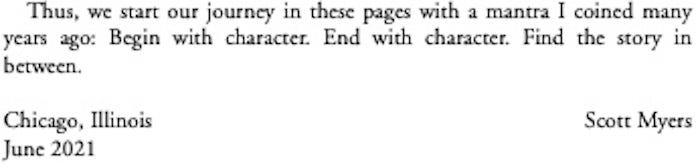
This is the ending of the preface to my book The Protagonist’s Journey: An Introduction to Character-Driven Screenwriting and Storytelling.
I truly believe this: The best writing is character writing.