Would studios return to the ‘Singles and Doubles’ approach to making movies?
Neil Turitz points to Screen Gems as an alternate to mega-budget blockbusters.
Neil Turitz points to Screen Gems as an alternate to mega-budget blockbusters.
In a recent article titled “How One Film Division’s Business Plan Should Be Required Learning For Everyone In Hollywood”, journalist Neil Turitz makes some good points:
I have a long-running argument with a fellow journalist friend of mine. Well, more of a discussion, really. A disagreement about the business and where it’s going and how healthy it is. It revolves around the idea of box office versus profit, with his side being that tent poles are the only way for the studios to really make money anymore, and with mine that this is absolute and total poppycock. It’s one of those things for which, when it happens, I’d think it would be fun to be a fly on the wall, as along as that fly was interested in deeply inside baseball conversations between a pair of wannabe quants who spend their time in immersive discourse about the wonky side of Hollywood.
When we sat down for a cup of coffee a couple weeks ago, we inevitably got into it again. His refrain of “Tent poles today, tent poles tomorrow, tent poles forever!” was as tiresome as it was derivative, while I kept coming back to the thing about which I have spent several thousand words in this space complaining: that the business is broken and needs fixing. Additionally, I had armed myself with a little research on this one to attack his core beliefs (because hitting someone where they live so as to break their heart and destroy their spirit is always more fun), and had come to the conclusion that I could not understand why more people didn’t A) understand it and, B) do something about it.
That item was this simple truth: that the most successful movies being made today, the ones that actually generate the most profit, are not the tent poles that crowd the box office, but rather the high concept movies made for a certain price and which end up tripling, quadrupling, quintupling their budgets, if not more.
These movies are the kind you can pitch in a sentence or two — or even with the title — and which cost anywhere from $5 million to $25 million, might or might not feature a genuine star, and rely on a standard marketing plan that doesn’t have any product placement tie-ins or merchandising deals.
Movies like Bad Moms, Don’t Breathe, The Purge: Election Year, 10 Cloverfield Lane, Lights Out, and The Shallows, just to name a handful of films that saw the light this year. All six of those films fit snugly into that aforementioned category, and all of them brought in at least five times their budgets, and as much as 30.
Turitz points to Screen Gems as a company which is following this business model:
That division has put out three movies this year, costing $48 million, and bringing in $200 million worldwide. Last year, it put out two, costing $35 million and grossing $140 million. The year before that, four movies costing $80 million and grossing over $260 million.
I’d have to do some deep diving into the blog archives, but trust me, I posted about this very subject 5 or 6 years ago. The thing is, this is not a new idea. Indeed it was pretty much standard operational procedure 25 years ago, what Jeffrey Katzenburg referred to in his famous 1991 memo as the “Singles and Doubles philosophy”.
What is the Singles and Doubles philosophy?
Using baseball as a metaphor, there are five types of hits: Single, Double, Triple, Home Run, and Grand Slam. In the past, one way studios would think about their annual production and marketing budgets was to spread the dollars between projects which had varying costs and projected revenues. Lower budget movies likely to be Singles or Doubles in terms of income. Middle budget movies targeting Doubles and Triples. And big budget movies going after Home Runs and Grand Slam money.
There are some favorable aspects to the Singles and Doubles approach:
- A company’s risk is considerably lower with movies in the $5–10M range than the $100–200M big budget arena.
- If the movie project has a strong story concept which the marketing department can exploit through social media and generate BWOM (By Word Of Mouth), then marketing costs can be minimized.
- And while some lower budget movies can generate Singles or Doubles revenues, others can hit a sweet spot and reach Triple, Home Run, and even Grand Slam territory.
Turitz mentions a classic example of the low budget Grand Slam: Lights Out. The feature length movie was based on this short film:
Scary, right? And you get the story concept right away: Person turns lights out. Creepy figure appears. Hell, the title sells it. Here’s the movie’s trailer:
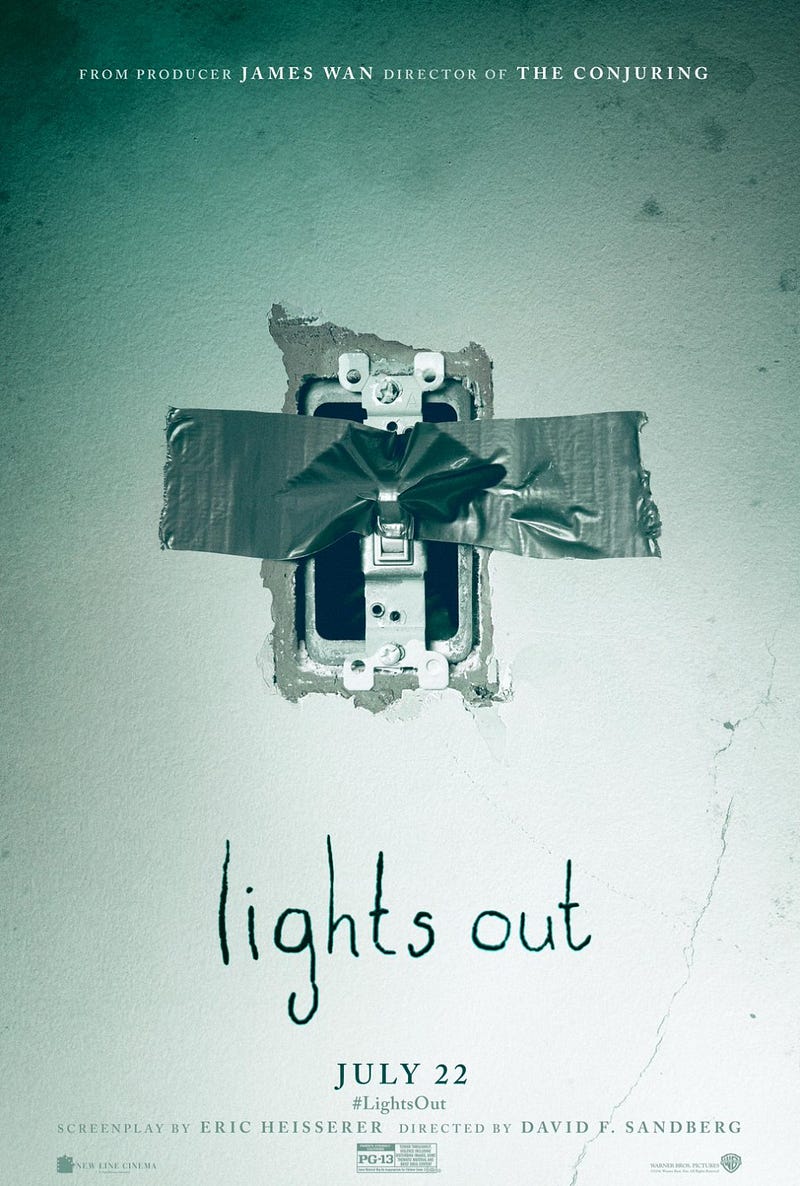
Here’s the one-sheet:
That’s awesome. Why is the switch taped to the ON position? The cracks in the wall? Arouses your curiosity, right? Combined with “James Wan / The Conjuring”, we know it’s a horror movie and…
What happens when the lights go out?
The movie’s production budget is $4.9M, a figure I confirmed with its screenwriter Eric Heisserer. Guess how much box office revenues Lights Out generated both domestically and internationally?
Using my expert math skills, I figure the ROI on the movie to be…
A shit-ton of money!
Lights Out is a movie made on a Singles budget that hit a Grand Slam. In fact, the studio greenlit a sequel within days of the movie’s release.
So if, as Turwitz suggests, “the ones that generate the most profit,” are lower budget, high concept movies, why aren’t the major studios adopting this Singles and Doubles approach, especially since, as I’ve noted, it’s nothing new, they used to do it.
This is where conventional wisdom diverts from the Singles and Doubles strategy because current thinking in Hollywood is that the movies which produce the biggest profits are, in fact, mega-budget franchise films. I haven’t ever seen them, but there are supposed ‘studies’ which have been done which, I’m told, prove this point.
We need look no further than Buena Vista / Disney as witness to Hollywood’s fealty to this belief.
When I first broke into the business, Buena Vista was known as the ‘Sleeping Giant’. Great brand recognition. No debt. Ton of operating capital. But a moribund movie division.
Cut to the Eisner-Katzenberg regime of the mid-80s forward and Disney, along with its Touchstone and Hollywood Pictures divisions, became the #1 studio in box office revenues. At their apex of production, they were making 30–35 movies per year, most of them Singles and Doubles.
In fact, as recently as 2000, the first year Box Office Mojo tracked movies, Buena Vista produced 21 movies. In 2016, they are down to 12: One Pixar, one Lucas Films, two Marvel, three remakes, one sequel, two animation, and a few live-action originals which by the way did the worst in terms of box office.
This is the new standard operational procedure for the major movie studios, where they may lob a few dollars at a Singles project, but their fixation is on swinging for the fences, a slate of Grand Slams.
And this helps us understand why Disney spent upward to $20 billion to acquire Marvel, Pixar, and Lucas Films. Big budget movies. Big profits.
However this does not negate the validity of the Singles and Doubles approach. Mini-majors like Screen Gems along with other production companies and financiers can and do work with slates of movies budgeted in the $2–$20M range, and can make decent bank doing that.
The two can coexist: Low budget / High budget. Indeed the major studios have been doing this little cha-cha-cha with low budget divisions over the last decade — starting them, dropping them, starting them back up — because who wouldn’t want to own the IP for a franchise like Paranormal Activity which with an aggregate production budget of $28.5M for all the movies has grossed $878M in worldwide box office revenues.
What does this all mean for screenwriters? I’m a big advocate for aspiring screenwriters to select low-budget writing projects, at least at first. If you write a spec which translates into a $100M budget, there are 6 buyers: The major studios. If you write a spec with a $5M budget, there are dozens of potential buyers.
For the rest of Turitz’s article, go here.
For my 16 part series on the 1991 Katzenberg memo, go here.
[Originally published December 2, 2016]