Why the Black List?
Thoughts from the Black List founder and CEO Franklin Leonard.
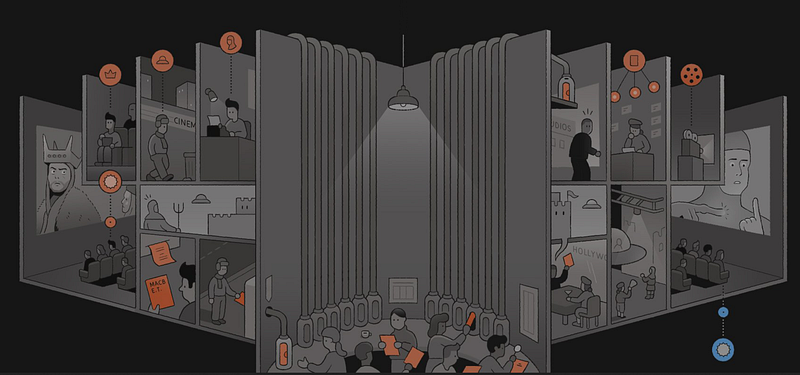
Thoughts from the Black List founder and CEO Franklin Leonard.
The Black List website has gone through a recent renovation. Franklin Leonard took the opportunity to offer his reflections on this question:
Why the Black List?
An extended excerpt from Franklin’s comments.
Dear Visitor,
Welcome to the Black List!
Thanks for visiting. Our mission is to radically improve the way writers and their stories are discovered and valued within film, television, and theater. Here’s a few things that I believe and why the Black List exists as it does as a result.
Stories profoundly matter, and we, collectively, underestimate their significance. Whether they’re bedtime stories, religious narratives, news, or the stories we tell on stage and screen, stories define how their audiences see the world, who they perceive as having value and not, who the heroes and villains are, and where and how heroes and villains can be found in our lives beyond the screens and stages. While the individual effects may be hard to measure, the collective influence on billions of global viewers is undeniable.
Quality is the best business plan, but evaluating art is fundamentally subjective. Successful storytellers thrive because they captivate their audiences–however small or however niche–prompting them to share their enthusiasm with others. But those people, of course, may not share that enthusiasm, and neither party is necessarily wrong.
Fundamentally, art is subjective. The business challenge that follows: How to most efficiently find material that when made finds an audience large enough to justify the high price of its production and distribution.
Writing is the best early indicator of story value and writers are undervalued relative to their contributions to its success. Stories well told on the page attract top talent. Together they attract financial resources, and eventually, audiences, ticket sales, viewership, and advertising revenue. Writing is the currency of the realm.
The success of screenplays on the annual Black List validates this thesis. Movies made from these scripts have grossed more than $30B in worldwide box office. They’ve been nominated for 223 Academy Awards and won 60, including four Best Pictures and 13 screenwriting Oscars since 2007.
A 2019 Harvard Business School working paper also found that Black-Listed scripts “did better at theaters, with movies of the same budget generating 90 percent more revenue at the box office.” Said Associate Professor Hong Luo, who led the study, “the annual Black List can help to further differentiate quality among observably similar ideas in a notoriously difficult-to-predict industry.”
Contrary to William Goldman’s assertion that “nobody knows anything,” some things can be known. And first among them, which I imagine he’d co-sign: Great writing is box office. And writers should be compensated as such.
The industry’s archaic writer discovery processes are exclusionary and inefficient, harming writers and the industry’s creative and financial prospects. For years, the answer to the question “how do I break in as a writer?” was some version of “well, there’s querying, but you’ll probably have to move to Los Angeles or New York, get a job that keeps the lights on and then network incessantly until someone who matters pays attention.”
For writers, that presents innumerable potentially insurmountable obstacles wholly unrelated to their ability to write; and that doesn’t even include the financial barrier of attending a “respectable” university that the industry regards as a reliable guarantor of talent. The industry consistently rewards those who can bypass the cost or impossibility of moving to Los Angeles or New York and subsist until they can penetrate the highest echelons of social and professional networks–networks that are deliberately inaccessible to all but those who were either born into them or could buy their way in.
But where you live, who you know, or who you are shouldn’t determine the opportunities available to you as a writer. When it comes down to it, those opportunities should be determined by your ability to craft compelling stories, collaborate productively, and emotionally engage audiences.
On the industry side, the conventional method of finding talent is akin to the NBA telling aspiring professional basketball players to just play pick-up ball near their midtown Manhattan headquarters until someone takes notice. One can only imagine the negative consequences on the game and the NBA’s financial fortunes if this was the only way.
Because the industry primarily recruits from among the folks who are already here or who have the financial wherewithal to get here, a lot of talent is excluded–leaving potential creative genius and billions of dollars on the table.
Traditional writing contests and contest aggregators are irretrievably broken. A writer submits their work unaware of the qualifications of the readers, how they are assigned, and how much they are paid. They receive feedback months later, if at all, with no recourse if inadequate. By that point, irreversible decisions have been made. Meaningless laurels have been awarded.
Writers who pay for feedback have a right to know the qualifications of the people evaluating their work. They have a right to readers with expertise in the format and genre they read. They have a right to know how those readers are compensated. They have a right to receive their feedback quickly, and they have a right to recourse if that feedback indicates less than a close and unbiased reading of their work.
When writers receive positive feedback, they have a right to get their work circulated widely and immediately within the industry so that they can reap its rewards quickly, and they have a right to real-time information about the effects of that circulation so that they can make informed decisions about the future use of their money.
Further, the opportunities available to writers should be correlated to the quality of their work, not the amount of money they spend.Great writing should reduce the amount of money necessary for a writer to attract the attention of the industry. There shouldn’t exist an incentive structure where writers are encouraged to pay infinitely more for confirmation of their quality.
And there should always be a way for great writers who have no financial resources to certify their talent to the industry on equal footing with those who do.
The near exclusive reliance on personal relationships for writer discovery is a glaring inefficiency begging for modernization. In an age where search engines provide instant answers and countless platforms connect buyers and sellers at scale in nearly every industry, relying solely on personal connections to promote and find work seems archaic. The loss of time, creative energy, and potential profit on both sides of the equation is incalculable.
Ask any industry professional how long it would take them to compile a list of, for example, “action features with an antihero written by a Latina?” The answer might range from hours to weeks when it should take mere seconds.
Industry professionals should be able to generate comprehensive lists of writers, screenplays, pilots, or plays instantly, enabling immediate follow-up or on-the-spot reading. They should be able to search by various criteria, including the writer’s life experience, genre, characters, narrative devices, era, mood, theme, and beyond. Search results should update instantaneously as new information becomes available.
And that’s why the Black List exists.
Although Go Into The Story has been the official screenwriting blog of the Black List for twelve years, apart from small honorariums for my work as a mentor at two feature writers labs, I do not receive any money from them. I note this so when I say that I am enthusiastic supporter of what the Black List does, you know I am not getting paid for my endorsement.
I know Franklin Leonard. I know Megan Halpern and Kate Hagen (senior vice presidents). I know the entire Black List team. They are ultimate professionals who passionately support the company’s mission.
I have interviewed over 60 Black List writers. I have worked with dozens of writers as part of the Black List and Black List/Women In Film feature writer labs. The work of the Black List has touched the lives of hundreds of writers in countless ways like Jason Hallerman.
I look forward to continue working with the Black List and their educational outreach and support of aspiring screenwriters.
You may read the rest of Franklin Leonard’s reflections on “Why the Black List” here.
Here is Franklin doing a TED Talk about the Black List:
You may go to the Black List website here.