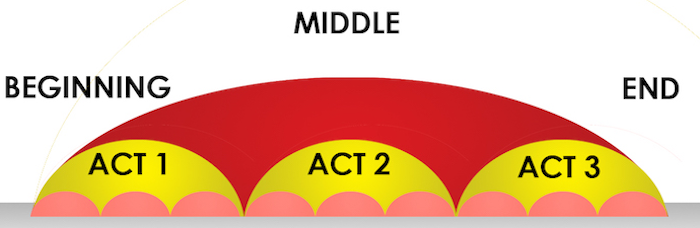
“Why is it three act structure? The cycle of life.”
Story structure and the… stock market? Read on.
Story structure and the… stock market? Read on.
Story structure is a never-ending area of interest for me and judging from previous discussions also for Go Into The Story readers. So I was intrigued when I read this email from Chris:
Hi Scott,
First, thank you for the blog. I’ve been reading for a long time and have really learned a lot from it.
You might say you inspired me to start putting my own thoughts in a blog.
I wrote a post on structure and the stock market. My hope is that it could help writers with structure by looking at it through a different lens.
I would love to know your thoughts.
Here’s a key excerpt from Chris’s post:
Aristotle’s Poetics has long been considered the bible of storytelling. Aristotle applied to stories an absolute truth to all life, there is a beginning, middle, and end. I believe the idea of a life cycle permeates everything known to us in the universe. Alright, this post isn’t going to be a discourse in philosophy, I’ll stick to story.
While some writers, and teachers, of screenwriting will vehemently say you should forget about the concept of three act structure, I believe this would be the greatest mistake any budding writer could make. Three act structure is simply a way to define the life cycle in screenwriting terms. If you remove the cycle of life from your story, you remove any chance of writing a great story.
To prove my premise, I’m going to use my other passion I have mentioned before on this blog, financial markets. The beauty of financial markets is they’re built by humans making them also at the mercy of life cycles. A theory has been created to articulate this called Elliott Wave Theory. Below is an image courtesy of Elliott Wave International that shows standard Uptrend(1) and Correction(2) waves in a market.
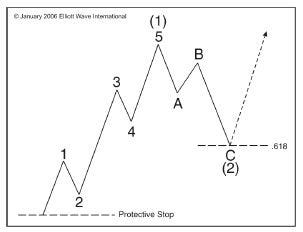
Don’t worry. This isn’t as confusing as it might look. For the purposes of the stock market, each line represents a movement in price. So line 1 is price going higher, line 2 is price going lower, line 3 higher, etc.
For all you number-oriented folks, I think you’ll enjoy Chris’s post. My simple variant is this:
Beginning: You buy a stock.
Middle: You own a stock.
End: You sell a stock, either for a loss (Tragedy) or a gain (Comedy)
No matter all the various structural theories or screenplay paradigms, I still believe in those three movements: Beginning, Middle, End. Here’s an excerpt from one of my earliest lectures for an online screenwriting course from 2002:
Think about the rhythms of life:
Wake up — go to work — come home
Toothpaste on toothbrush — brush — rinse
Foreplay — sex — pass out
Think about sentences:
Subject — Verb — Object
Think about music:
Classical sonata form: Exposition — Development — Recapitulation
Verse/Chorus — Verse/Chorus/Bridge — Verse/Chorus
It’s the “Three Factor.” And it’s everywhere in life. With two, you can’t establish a pattern. But you can with three.
Three strikes, and you’re out.
The Holy Trinity: Father, Son, and Holy Ghost.
Jokes almost always have three: Line, line, punch-line.
The Three Factor, as in Beginning-Middle-End.
Yes, you can have four acts, eight sequences, twenty-seven plot points, however many story beats, and so on. But at the heart of any story there are three passages that I believe are innate to narrative, and something that readers and viewers expect to be there: Beginning, Middle, End.
And per Chris, evidently the stock market is yet another illustration of that pattern.
It seems like every time I post something on story structure, it spawns a lively discussion. So have at it, Go Into The Story readers. What say ye about Beginning, Middle, End?