What is the point of the scene?
Begin the scene-writing process by asking this fundamental question.

Begin the scene-writing process by asking this fundamental question.
What is the point of the scene?
Every single scene in a screenplay should have a purpose, a reason for its existence, a point.
In the External World, the realm of Action and Dialogue, there is a structural goal, something that ties the scene to the Plotline, intersecting with and advancing the narrative in the physical universe.
In the Internal World, the realm of Intention and Subtext, there is an emotional goal, something that ties the scene to the Themeline, intersecting with and advancing the narrative in the psychological universe.
This speaks to the fact that in a scene, something happens… and something else happens. There is the something we see and hear… and the something we feel and intuit.
In The King’s Speech, the opening set of scenes concludes with Bertie poised in front of a microphone amidst a sea of spectators at Empire Stadium:
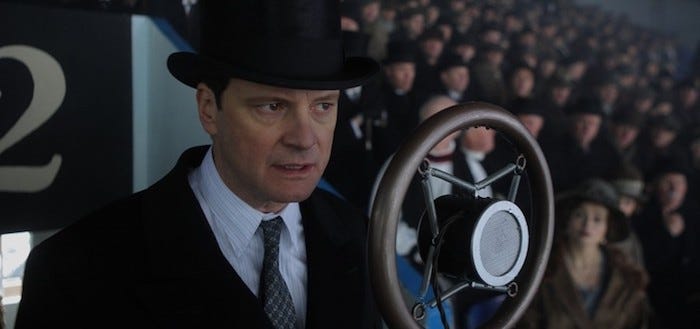
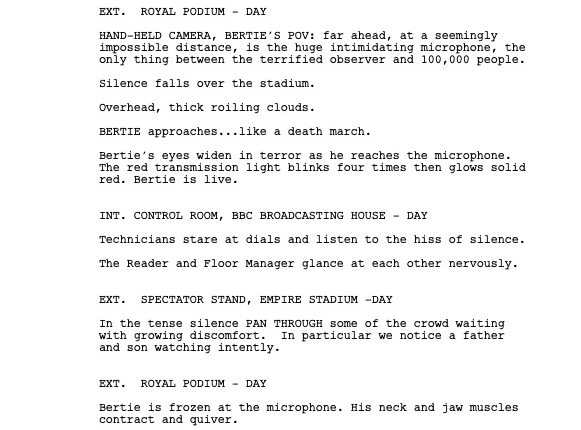
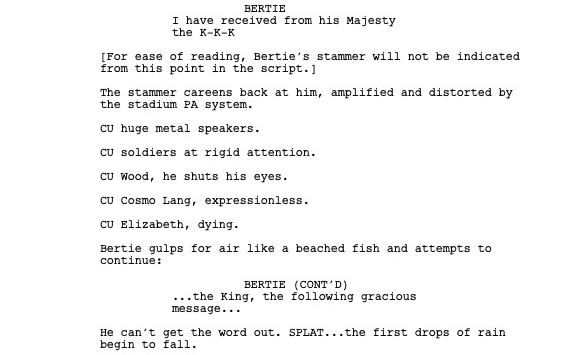
What is the structural goal or narrative point of this scene? Clearly, it is to visualize Bertie’s speech impediment, establish from the very beginning of the movie what is at the root of the story’s central conflict.
What is the emotional goal or psychological point of this scene? Just look at the descriptors in the script: frozen, contract, quiver, gulps. The scene exists to drive home in no uncertain terms the terror Bertie feels when thrust into a circumstance such as this. The impact is made even more powerful by the choice of locating the scene in a highly public setting, intensifying Bertie’s sense of humiliation.
The combination of these two goals combined with what transpires here suggests that this is an action scene. Ironic, isn’t it? An action scene where the point is to personify a character’s inability to act (i.e., speak).
From a writing perspective, the scene is a great way to thrust us into Bertie’s story… and immediately feel great sympathy for him.
Let’s look at an interaction scene from The Shawshank Redemption. After Andy has become established in the prison, the warden [Norton] pays him a visit:
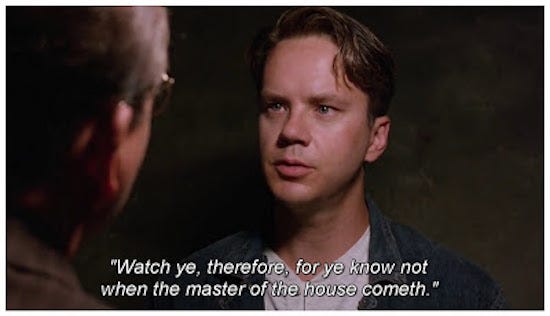
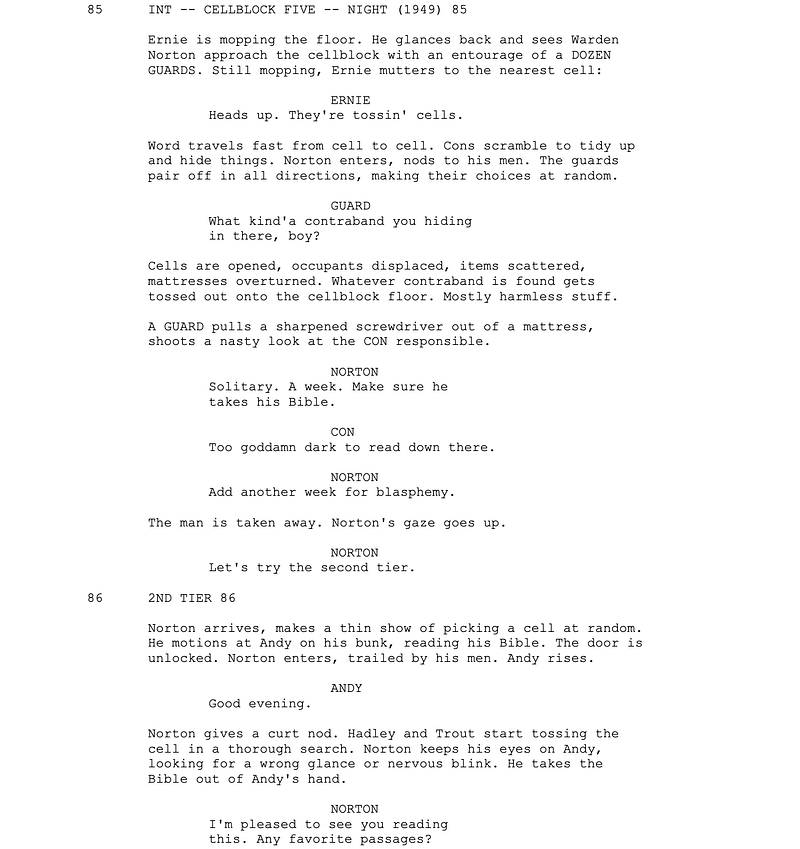
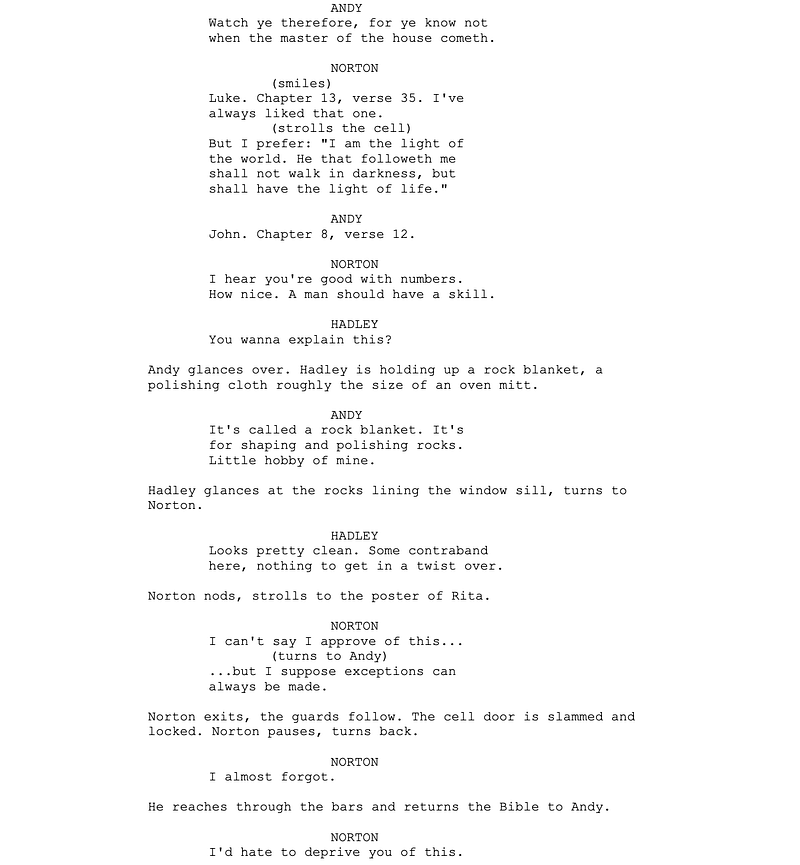

What is the structural goal and narrative point of the scene? For Norton’s men to inspect Andy’s room.
What is the emotional goal and psychological point of the scene? Red answers that question with his V.O. dialogue at the end of the scene:
RED (V.O.)
Tossin’ cells was just an excuse.
Truth is, Norton wanted to size
Andy up.
Hearing that Andy was “good with numbers,” Norton needed to check out the prisoner one on one to see if he would be a good fit for Norton’s extortion racket. Andy is just right for the job — except when he turns out to be horribly wrong for Norton.
Of course, from a writing perspective, the scene has a couple of nice setups for later payoffs: Norton waves off the movie poster on the wall, ignorant of the fact it hides the tunnel Andy has been digging… tells Andy about his Bible, “Salvation lies within,” not knowing it’s there Andy stores his rock hammer. So many setups and payoffs in this movie!
If you want to know the point of a scene, there are keyquestions you need to be asking in order to explore a scene’s layers of meaning.
With every scene you write, start with this question:
What is the point of the scene?