What Is an “Operational Theme” and Why Don’t I Have One?
An excellent article by Javier Grillo-Marxuach whose TV writing-producing credits include Charmed, Boomtown, Lost, Medium, and Cowboy…

An excellent article by Javier Grillo-Marxuach whose TV writing-producing credits include Charmed, Boomtown, Lost, Medium, and Cowboy Bebop.
According to IMDb, Javier Grillo-Marxuach first television writing credits were three episodes of the series Sea Quest 2032 in 1995–1996. Over the course of nearly three decades, he has been a writer or writer-producer on numerous series including Charmed, Boomtown, Lost, Medium, The Chronicle, Helix, Blood & Treasure, and Cowboy Bebop.
Javier has also published two collections of essays about the writing craft and television business: Shoot This One and Shoot That One.
In addition, since 2014, he and fellow TV writer have hosted the popular podcast Children of Tendu.
Suffice to say, Javier knows a lot about writing and in particular … television writing.
The other day on his Twitter account (@OKBJGM), he flagged an article he’d written in 2014 titled: “Finding the Next Lost: What Is an “Operational Theme” and Why Don’t I Have One?”
It’s excellent and I strongly recommend it for writers — particularly those interested in television. Here are some key excerpts:
One of the many perks afforded a journeyman writer/producer in television is receiving scripts for network television pilots as they are being made. It’s like the best possible version of the TV Guide Fall Preview Issue I used to compulsively reread under the covers with a flashlight as a kid. Except that now I have the added thrill: if my agents do their job, if I am good in the interview, if a million other moving parts click in the correct order, I help the people who created these shows realize their vision.
This inside window into the totality of network development puts us journeyman television writers and producers in an interesting position to spot and track trends as they develop, fade, or mature. One trend that persists — almost a decade after its inception — is every broadcaster’s ongoing quest to put on the air the next great serialized high–concept sci–fi show: to find the next Lost.
Of course, it seldom works.
My own modest contribution to the evolution of Lost — and having worked on a number of shows with similar goals in the years since — provides something of a vantage point from which to judge the success — and failure — of these attempts. More often than not, it boils down to the presence or absence of a crucial element I call “the operational theme.”
In high school and college, most of us could pick a lofty word or idea and designate it the “theme” of a play or novel: “power,” “alienation,” “banality of evil,” or (my personal favorite) “the shallowness of modern life.” We could then write a coffee–and–Red–Bull–fueled paper, using choice quotes from the partially–skimmed bit of required reading, and have a pretty good shot at not winding up ashamed to show the report card to our parents in the morning. Sadly, for the professional television writers — even the really astute ones — this is neither enough to create something that will connect with an audience — nor will it survive the production goal of many seasons and possible syndication.
Television is a populist medium with little patience for intellectual phumphering. Hour–long drama is — first and foremost — about creating characters driven by internal forces that, melded to the right situation, can fuel every action, every line, every scene, and every plot for hundreds of successful episodes. This is the operational theme: a situational vector that cleanly delineates the potential variations of action in service of the protagonist’s consistent emotional need. [emphasis added] This is crucial to the success of a television pilot. It is crucial to the successful episodes to come. It is, indeed, what television pilots should see as the first order of business to establish. And yet, it is most often the part that’s missing — especially from the sci–fi shows.
— —
Many big and shiny ideas can tap dance around a lack of an operational theme for a while — the length of a pilot, maybe even a season of decompressed cable–style narrative. But no amount of spectacle can obscure the truth that a protagonist or ensemble with a stark, robust, and recognizable operational theme is the source of all televisual drama. [emphasis added]
Ironically, sci–fi, the genre that most often suffers from underdeveloped characters on TV probably demands more character from its characters than any other genre. Why? Because it is, at the core, a metaphorical exercise. Sci–fi poses a question that extends beyond the easily understandable stakes of the cop, doctor, or lawyer. How are the aliens, robots, mysterious islands, viral outbreaks, and vampires an external manifestation of your main character’s self–concept?
If you are writing a genre pilot and your premise can’t answer that question — while placing your protagonist in a place where the pursuit of their most prescient emotional issue is in consistent, discernible, and direct opposition of those aliens, robots, islands, viral outbreaks, and vampires — then, like any other writer in any other genre, you have to dig deeper.
Compare to this excerpt from my book The Protagonist’s Journey: An Introduction to Character-Driven Screenwriting and Storytelling.
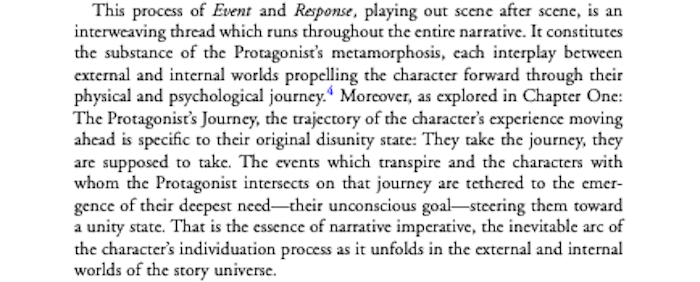
When Javier promotes the concept of “operational theme,” that parallels quite nicely with what I mean by “unconscious goal”: It is a character’s deepest need, the singular reason why the narrative exists. In the case of the Protagonist, it is that operational theme … their unconscious goal … which drives everything. The events that transpire. The other characters with whom the Protagonist intersects. In the case of a TV series, every episode, every storyline, every scene should be a reflection of that operational theme … should be tethered to the Protagonist’s unconscious goal.
That means that one of the most important tasks we have as writers is to dig down into the complex nature of a character and discover that deepest need. As Javier puts it in his article:
“… you have done the hard spade–and–trowel labor of putting an interesting main character on the screen. You must first put your characters in the one, singular (and preferably, for my money, science–fictional!) situation that most challenges their true self.”
Yes, a thousand times yes. Find that unconscious goal … which becomes your story’s operational theme.
To read the entire 2014 article Javier wrote, go here.
Follow him on Twitter (@OKBJGM) and listen to the Children of Tendu podcast. Their latest episode: How is this (WGA) strike different from the last? Through his various public platforms, Javi offers a wealth of knowledge about writing and the business of television … all for free.