What can a writer learn reading a script while watching that movie?
An in-depth analysis of the opening sequence in The Shawshank Redemption demonstrates the value of this learning exercise.
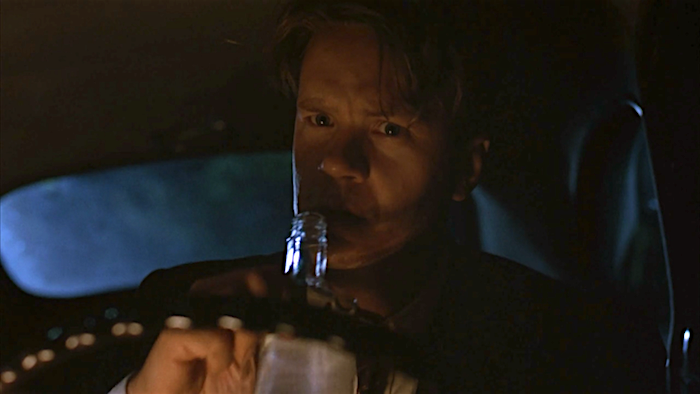
An in-depth analysis of the opening sequence in The Shawshank Redemption demonstrates the value of this learning exercise.
Someone asked me this question recently. Brought to mind this article.
My response: Emerson, this exercise is something I recommend because I’ve been doing it for years and have learned a LOT about the craft in the process. Here are a few benefits:
- One of the constant challenges a screenwriter faces is how much vs. how little description we should write in each scene. By comparing screenplay to movie, you see the connection between the written word and what appears on the screen. This can inform your understanding of writing visually, but also efficiently.
- Whenever the movie has added or cut dialogue, you can try to reverse engineer why the change. Why did the scene need this additional line of dialogue? Why did the scene cut that side? The more you engage in this type of analysis, the better your innate ability to manage your own dialogue.
- Likewise track the if certain action moments are added or cut. Again, you can put on your filmmaker cap and speculate why the change.
- Perhaps the single biggest benefit is to see how the movie is edited differently than the script. Why transpose this scene there? Why cross-cut scenes? Why enter this scene later… exit that scene earlier?
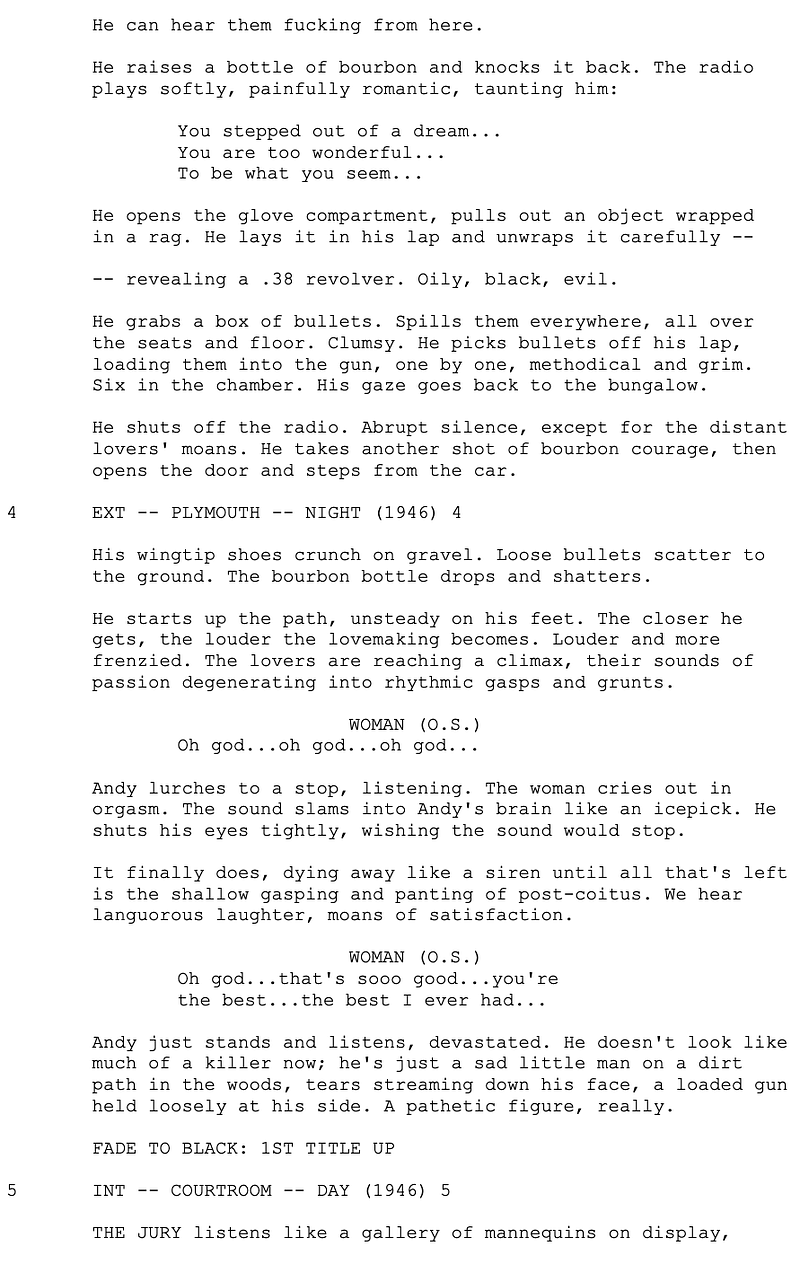
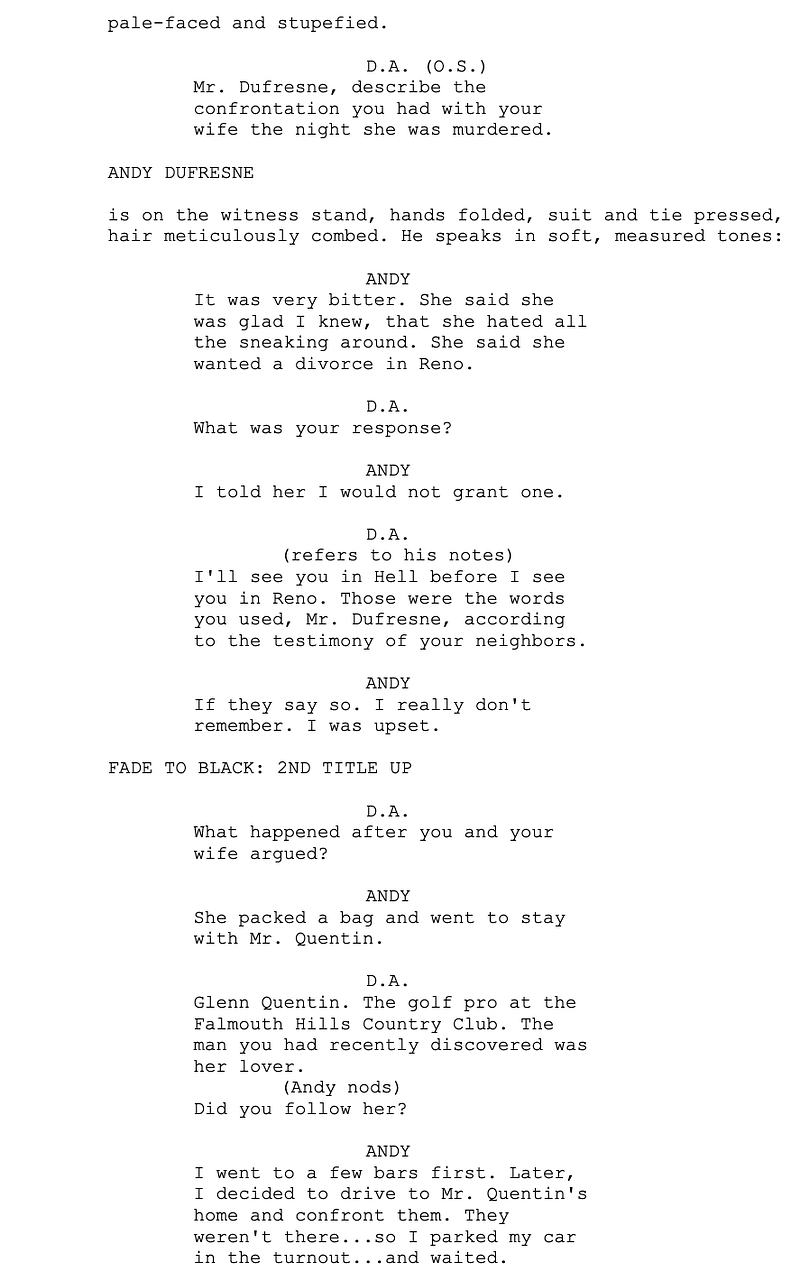
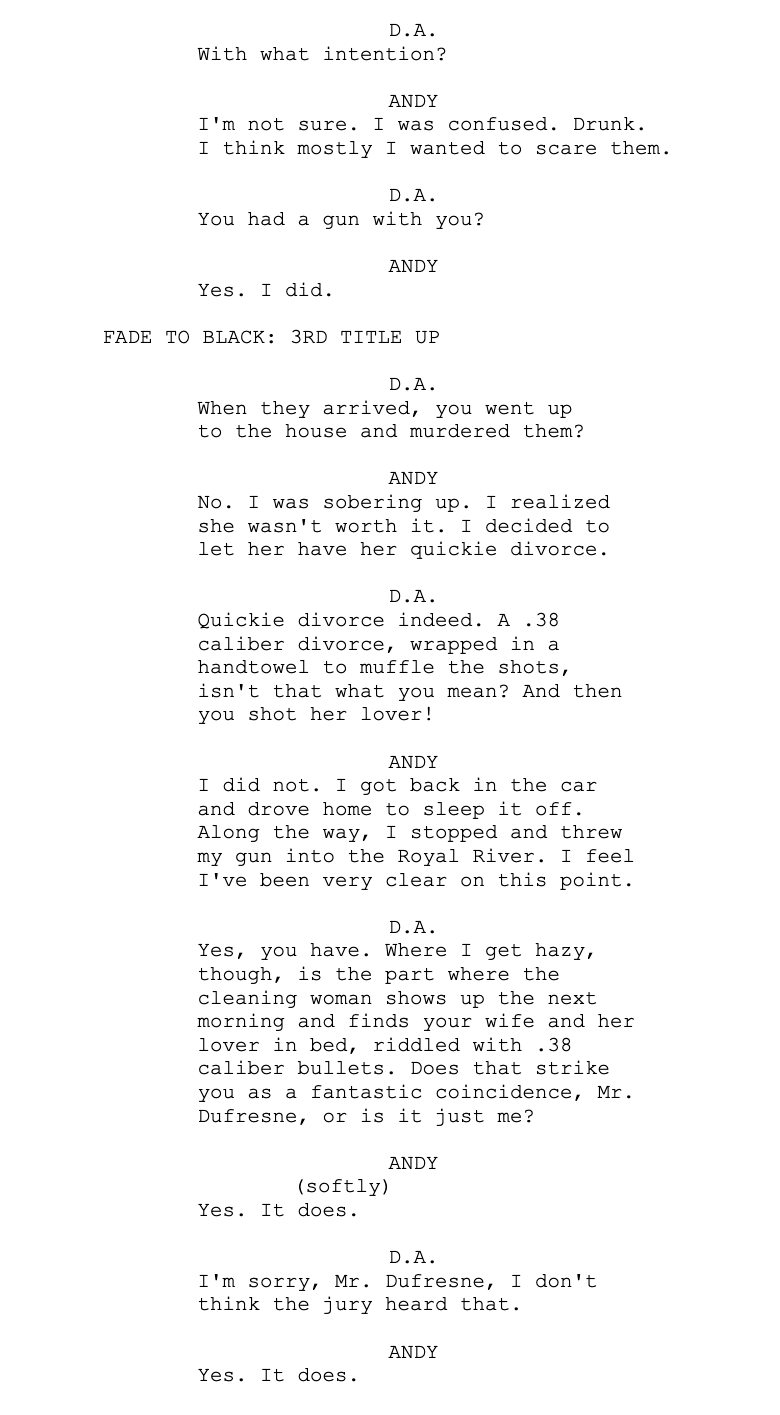
A great example of what I mean is to compare the screenplay to the movie version of the opening scene in The Shawshank Redemption. Here is the screenplay:

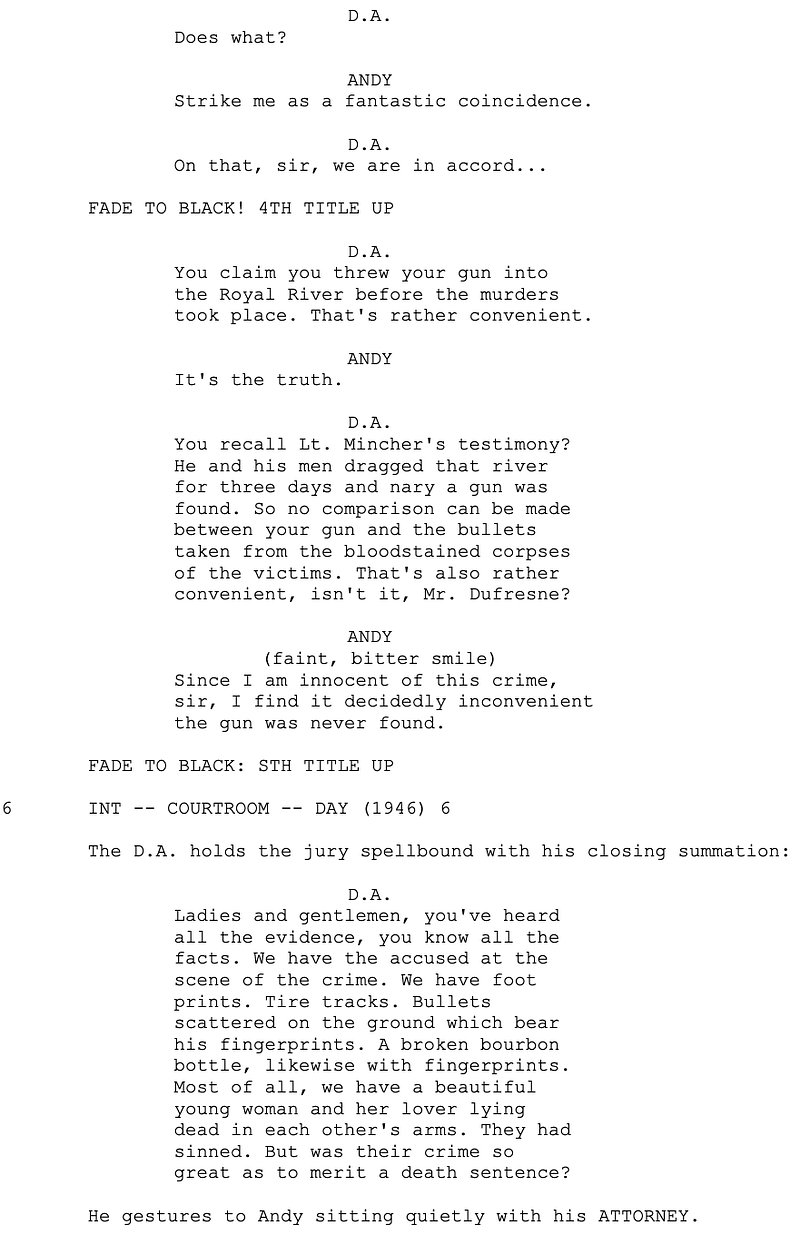
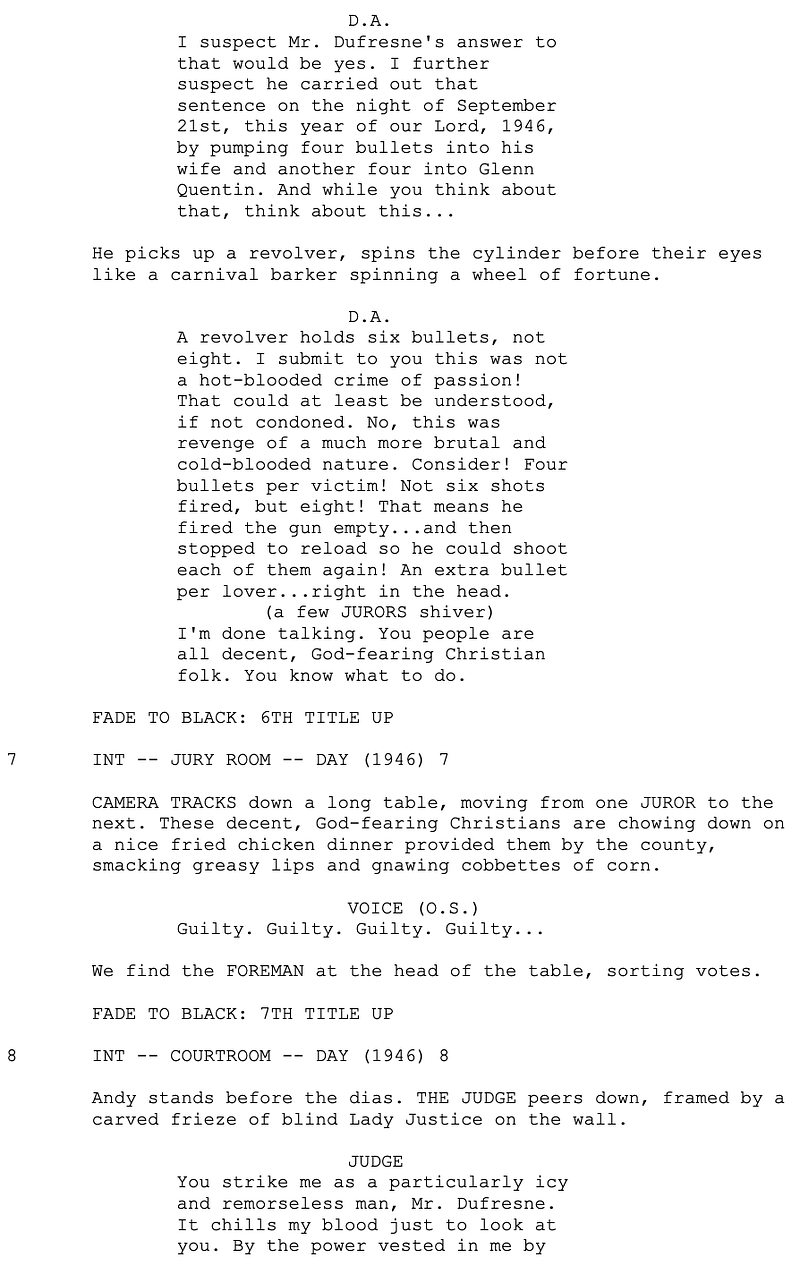
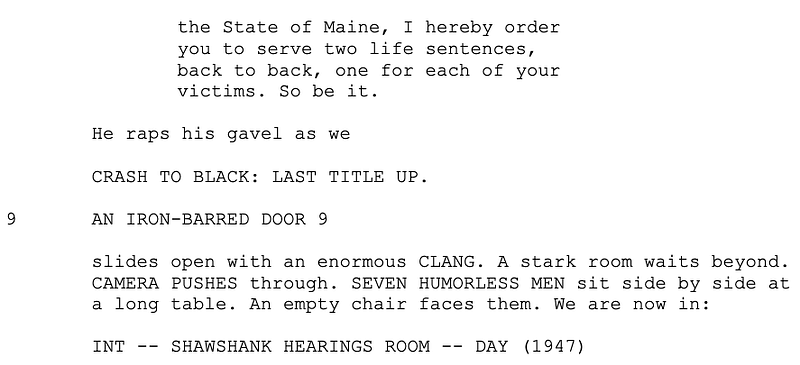
Here is the movie version of the opening sequence:
Straightaway there are two big differences between the script and the movie:
(1) Where the script starts inside the cabin [Scene 1] with Dufresne’s wife and lover already going at it, the movie starts with a shot of the cabin in the woods [Scene 2], then inside Andy’s car [Scene 3].
Why the change? First, by not revealing what’s going on in the cabin upfront, the movie creates a question for the viewer: Why are we here?. Then when Andy pulls out the pistol, the situation shifts into a full-blown mystery: What the hell is going on? I’m guessing the movie’s writer-director Frank Darabont and his editor on the film Richard Francis-Bruce figured the audience is going to find out about Andy’s wife cheating on him soon enough, why not arouse some curiosity first, then pay it off later?
(2) Where the script stays with the action on the night of the murder, at 1:12 in the movie, we hear the V.O. of the District Attorney from the trial: “Mr. Dufresne, describe the…” Then cut to a C.U. of Andy on the witness stand at his murder trial. Thereafter, the scenes are cross cut — from the night of the murder to the trial, back and forth.
This is a huge change and much for the better. First, it doesn’t force the viewer to go through the events twice: The night of the murder, then hear the details again in the trial. By cross-cutting the two sequences, the viewer experiences the night’s events one time — so no wasted exposition.
Speaking of exposition, in the script, there are 34 sides of dialogue in Scenes 5–8, where the story cuts in on Andy’s testimony to the judge’s sentencing. That’s a ton of “talking heads.” By cross-cutting between the trial testimony with what was happening on the night of the murder, inside and outside the cabin, the exposition transforms into commentary on the action, the words “connected” to visual images — much more cinematic.
Here’s the breakdown of the cuts in the movie version of the opening:
Scene 2 + Scene 3 (partial) — establish the cabin / Andy in car
Scene 5 (partial) — Andy trial testimony: background of the night of the murder
Scene 1 (partial) — Andy and D.A.’s V.O. over visual introducing Andy’s wife and her lover Glenn Quentin as they enter cabin and embrace
Scene 5 (partial) — Andy trial testimony: talks about how he ended up outside the cabin
Scene 3 (partial) — Andy’s V.O. describing his state of mind over visual of him inside his car, loading up gun with bullets
Scene 5 (partial) — Andy and D.A. back and forth about the whereabouts of the gun
Scene 3 (partial), Scene 4, Scene 6 (partial) — D.A. summary argument to the jurors V.O. over visuals of Andy taking a last drink in his car, emerging from the car, and stopping outside the cabin
Scene 6 (partial): D.A. asserts “this was revenge of a much more brutal and cold-blooded nature”
Scene 1 (partial): D.A. V.O. explains how murderer had to reload to fire 8 bullets over visuals of Andy’s wife and lover as “he enters her”
Scene 8: Judge sentences Andy
There’s a saying in Hollywood: You make a movie three times. First when you write the script. Next when you shoot the movie. Third when you edit it.
You can directly compare the screenplay to movie the changes the filmmaker made in post scene by scene, speculate why those changes were made, then apply those insights into your own writing.
Plus, you know what? The practice of reading a script while watching a movie is a cool thing to do.