“We will sell no wine before its time”
How a wine advertisement campaign featuring the famed writer-actor-director Orson Welles is an apt metaphor for the story-crafting process.
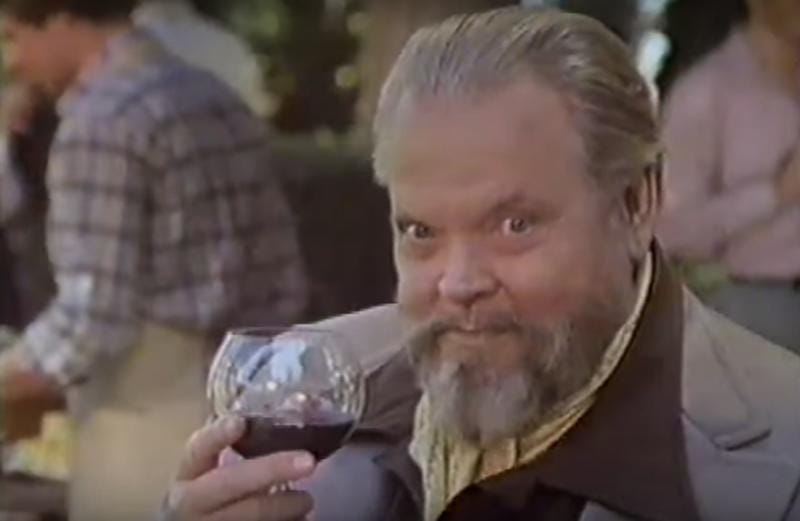
How a wine advertisement campaign featuring the famed writer-actor-director Orson Welles is an apt metaphor for the story-crafting process.
After his astounding success with the movie Citizen Kane when he was all of 25 years old, Orson Welles struggled to get movies made. During the last decade-and-a-half of his life, he was featured in a number of TV and print advertisements in order to raise funds to direct The Other Side of the Wind from his original screenplay: “A Hollywood director emerges from semi-exile with plans to complete work on an innovative motion picture.” Companies for which he served as a spokesperson include Eastern Airlines, Stove Top Stuffing, and Findus Frozen Peas.
Many of his commercials featured alcoholic beverages: Jim Beam, Carlsberg, and Domecq Sherry to name a few. Perhaps it was because he was perceived by the public to be a connoisseur of the finer things in life. Or perhaps he was inclined to do these ads for a baser reason: He liked to drink.
Welles was best known for a series of commercials he did from 1978–1980 for Paul Masson wines. Here is one from 1979:
I write this piece not to critique Orson Welles or Paul Masson wines, but rather to embrace the commercial campaign’s tagline:
We will sell no wine before its time.
I was reminded of this line when talking with a writer friend recently. She was lamenting how the script she was rewriting was taking such a long time to get to the point where she could take it out to the market. In fact, she was rather beating herself up about the laborious path the story-crafting process was taking, many months longer than she felt she should have been working on it.
That’s when the Paul Masson ad campaign suddenly sprang to mind.
We will sell no script before its time.
It is an apt metaphor for the story-crafting process in two ways:
- You should NEVER send out a script to reps or potential buyers before it’s ready for public consumption. I learned my lesson in this regard the hard way witness this Business of Screenwriting article. An original screenplay has to be properly ‘aged’ — story broken, characters developed, drafts written and rewritten subject to critiques by professional readers, then rewritten again — so that it has reached its peak ‘taste’ before you take it out to anybody who is anybody in Hollywood.
- While some stories may lend themselves to being written in an expeditious time-frame, let’s say 10 weeks or less, other stories turn out to be harder to crack. Christopher Nolan is said to have taken a decade from the first draft of Inception to final draft. He didn’t work on it continuously during that time, in fact he set it aside to pursue other film projects, but it took him that much time to understand the story well enough to write the ultimate version of the movie. It took J.R.R. Tolkien some 17 years to write The Lord of the Rings.
The thing is stories are organic. The characters who live within the context of their narrative universe have agency and free will. Living with and getting to know a story’s characters can be a time-consuming challenge. Some stories simply require more time on the ‘vine’ before ripening enough to emerge clearly in our minds.
So one takeaway: Don’t get down on yourself if a story is taking 20, 30, 40 weeks or more to emerge into being. Every writer is different. Every story is different. Some stories may just require more time.
However, another takeaway: Don’t allow Orson Welles’ sonorous intonation of “we will sell no wine before its time” as an excuse for you to dawdle. Push yourself to bring the project to fruition. After all, a wine which ages for too long can go bad.
And THAT reminds me of Maya’s monologue in the 2004 movie Sideways:
I like to think about what was going on the year the grapes were growing; how the sun was shining; if it rained. I like to think about all the people who tended and picked the grapes. And if it’s an old wine, how many of them must be dead by now. I like how wine continues to evolve, like if I opened a bottle of wine today it would taste different than if I’d opened it on any other day, because a bottle of wine is actually alive. And it’s constantly evolving and gaining complexity. That is, until it peaks, like your ’61. And then it begins its steady, inevitable decline.
That’s what you want: Your script to evolve and gain complexity. Get it to the point where it has reached its peak. Then bottle it up and send it out into the marketplace. Don’t wait too long. Don’t let perfectionism and procrastination get in the way of your story-crafting process.
Make sure your script is ready… then uncork it and see if it connects with buyers as a jaunty, yet jujune little number.
Okay, I’ve definitely gone too far with the wine metaphor, but admit it, you’ve learned a bit of cinema history regarding Orson Welles and you’ve had a chance to watch Virginia Madsen crush that side of dialogue from Sideways.
Now… go work on that script.