“We must be willing to get rid of the life we’ve planned”
Wisdom from Joseph Campbell which actually changed my life.
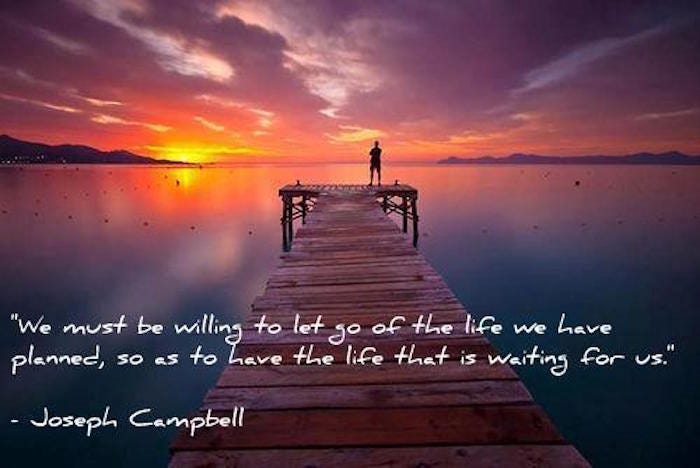
Wisdom from Joseph Campbell which actually changed my life.
Have any of you had a significant shift in your life-plans? I did. Let me share three anecdotes from my own life-journey.
The first takes place in New Haven. It is my final semester at Yale Divinity School, the end of my 7th consecutive year of school at the collegiate or graduate level. I have come here to up my bona fides academically with the goal of getting into a top Ph.D. program and I have done well in that regard, eventually graduating near the top of my class.
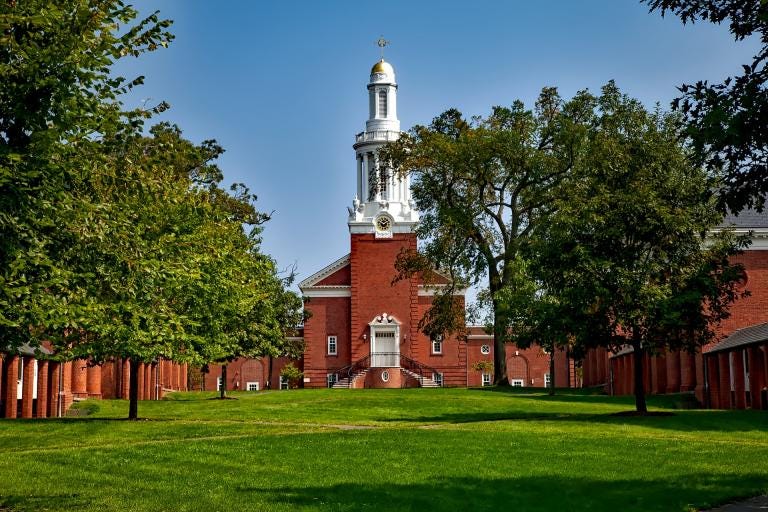
But something is happening: Every day I drive up to the campus at the top of Prospect Street and enter the administration building, I have this feeling in my gut. There’s a heaviness, a weight. Every. Single. Day. I feel the same thing. A physical sensation in my stomach whenever I walk onto the campus.
I talk with my friends. My professors. Finally with the Dean Colin Williams. I explain to him my situation, suggesting that part of what could be going on is my interest in playing music. I started to learn how to play the guitar when I was 14, and have been writing songs and performing ever since. Dean Williams listens to me, then says, “Well, you’ve got to take a year off then, don’t you?” He puts into words what I know is true: If I don’t pursue my music, at least give that a shot, I could very well end up living the wrong life. “Your gut is telling you something, isn’t it?” And he’s absolutely right. Which leads me to the second anecdote.
After I graduate, I take off driving around the country, visiting family and friends. While staying with my brother in Minneapolis, a college buddy of his [Tony] happens to swing by for a visit. That night I play some songs for them. Tony asks me about what I’m doing. I say I’m taking a year off to pursue playing music. “How are you doing that,” he asks. I say, “I don’t know.” He says, “Why don’t you come to Aspen?”
In all honesty, I’d never even heard of Aspen, Colorado. But Tony tells me about the lively music scene there — John Denver, The Eagles, lots of clubs with live music. He should know, he lives there. “Come to Aspen. You’ll learn real quick if you can cut it or not as a musician,” he says. He even offers to let me crash with him for a few weeks. Which leads me to my third anecdote.
It is September, late on a chilly evening. I am driving to Aspen. Having been behind the wheel for several hours, I’m too tired to continue on. I also know I need to stretch my savings, so instead of a motel, I pull into a rest stop off Interstate 70 about forty miles east of Denver. I stretch out in the back seat of my car and go to sleep.
It’s the cold that wakes me up. And here’s the thing: I don’t know what time it is. One of the deals I made with myself when I took the year off was to get rid of my watch. Spontaneous gesture, but symbolically important to me to try to live in the present. At the moment, it’s a pain in the ass because I have no idea what time it is.
So I reach up front, flip the car key to accessory mode, and I’m blasted by the car radio. It’s a news announcer’s voice.
“We’re looking at a record temperature today of 112 degrees in downtown Los Angeles.”
It’s KNX 1070AM radio. So that’s kind of weird, an L.A. radio station while I’m in Colorado, probably one of those early morning radio wave bouncing off the stratosphere things.

And it’s also strange that here I am freezing and this guy’s talking about a heat wave.
But the most bizarre thing of all is this: As soon as I hear that dude’s voice, I am overwhelmed by a sensation. Comes from nowhere, but utterly seizes me. “You’re going to end up in L.A.”
It’s not a voice, rather it’s this conviction, like the truest of all truths I may have ever experienced. That somehow I was going to intersect with Los Angeles.
I spent that year off in Aspen. And another year there. Playing music and doing a volunteer ‘bar ministry’ [true story]. As part of a musical duo known as Myers & O’Flynn, Pat Flynn and I opened for such musical acts as Poco, Richie Havens, John Prine, Taj Mahal, and performed at the Telluride Bluegrass Festival.
Then the musicians in the band I’m playing with in Aspen decide to head home to southern California. I make my way to northern California, home to a few of my Yale buddies, where I spend seven months as a salesman at The Guitar Center in San Francisco. What the hell am I doing? How did I get here? I decide I have to recommit myself to the music.
My ex-bandmates invite me down to Ventura. I end up living there through 1985, playing music, then of all things shifting into stand-up comedy. I meet my wife there. She gets into college at Cal, so we move up to Berkeley. And all the time, I’m wondering, “Did I do the right thing leaving school like I did?”
Then I discover screenwriting. Write K-9. It sells as a spec script. And in January 1987, I finally find my way to Los Angeles. My wife and I move there that summer, and we end up living there for many years. Just like the radio dude on KNX ‘predicted.’
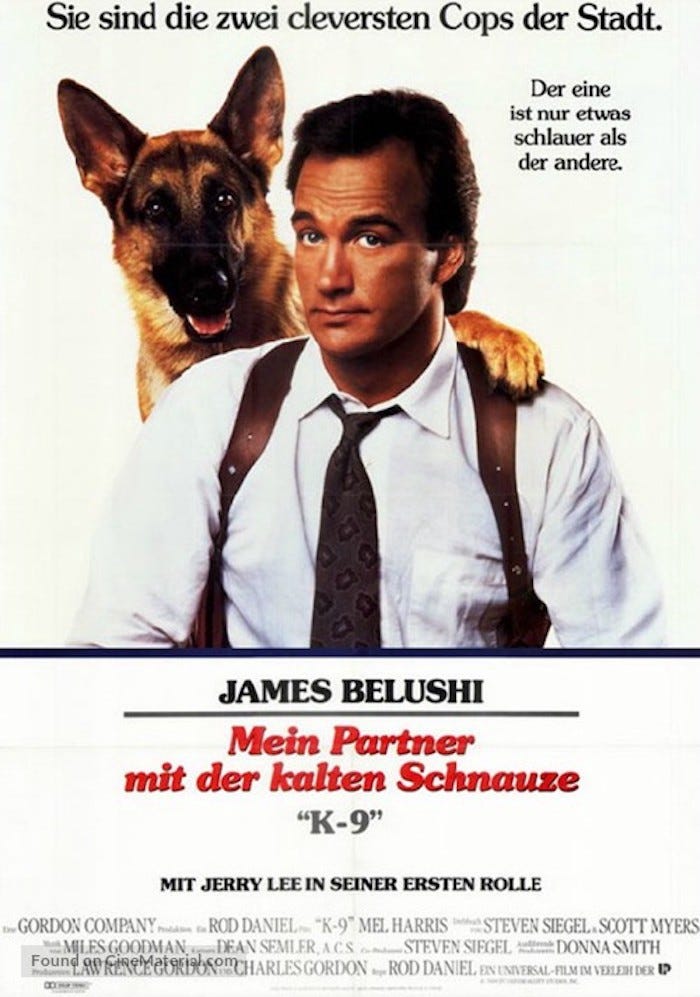
I have made a trillion mistakes in my life, but of the handful of crucial right choices I’ve made, this was one of them: I was willing to get rid of the life I had planned in order to pursue the life waiting for me. I thought it was music. Instead music led to comedy led to screenwriting. Then I thought screenwriting was my life. It still is, but all these other things have entered into it as well. And as I look to the future, I have no idea where it’s all leading. I’m just following my gut.
Now that is a story. Not perhaps a particularly good or well-told one, but it’s a story nonetheless. And it really happened. Each of you has your own story. And I’m willing to bet the house that each of you has experienced in some way the reality of this truth: “We must be willing to get rid of the life we planned, so as to have the life that is waiting for us.” I’d love to hear your stories if you’d care to share them in Comments.
But that is only part of the saga. One of the beauties of Campbell and his observations about life is how applicable they are to what we do as writers. This saying is yet another example.
Think about movie Protagonists. How often do they start off the story with some Big Goal in mind? A promotion, to land a guy, to get into this college, to score that deal, and so on. They begin the story with a sense of their life and plan on how to live it.
Then something happens. A stranger shows up. A visitor. A strange call. An event. Something happens that serves as a sort of herald’s call. It riles things up. Depending upon the Protagonist’s psychological state, they may leap at the opportunity or more likely they may resist it. But by the end of Act One, somehow the Protagonist finds him/herself on a new and different path. And in departing the Old World and entering the New World, whether they even realize it or not, they leave behind the life they had been planning in order to live the life waiting for them.
This dynamic is at the heart of a vast majority of movies. The Protagonist’s journey in the External World is accompanied and influenced by their journey into their Internal World where they get in touch with their Core Essence, their Authentic Self, the foundation of that life that has been waiting for them.
That is a story human beings want to hear. That is a story we need to hear. Because we long to believe in the possibility of change, in the power of metamorphosis, in our ability to transform ourselves and be transformed.
Sometimes in movies, the Protagonist has a negative metamorphosis. Sometimes they refuse to change. Sometimes they act as change agents. Most of the time in films, the Protagonist goes through a positive change, moving from an inauthentic life to an authentic life, from a life they had been planning to a life that has been waiting for them.
There are countless ways to approach this narrative dynamic and endless possibilities to spin these type of stories, but when you tap into this, you are accessing an archetype that runs deep into the human psyche, and in so doing you increase the chance exponentially that what you write will resonate with readers.
So I encourage, even challenge you: If your experience of Joseph Campbell is limited to The Hero’s Journey or frankly if how you approach screenwriting is from a place where your prime directive is to lock down the story structure — plot points, beats, stages, whatever — get rid of that ‘life’ you have planned, and take another path.
Go into your characters. See where they are now, what their goals are, then dig into them to see what is going on in their Internal World, what their Core Essence is about. Follow that. Tell that story. Don’t worry about story structure, trust that the characters will lead you there. Because that story… is waiting for you.
Here are some reflections by Campbell on the dynamic of life:
Takeaway: “We must be willing to get rid of the life we’ve planned, so as to have the life that is waiting for us.”
Damn straight.
Onward!