Walter Murch and The Rule of Six
When this notable figure in cinema talks editing… think screenwriting.
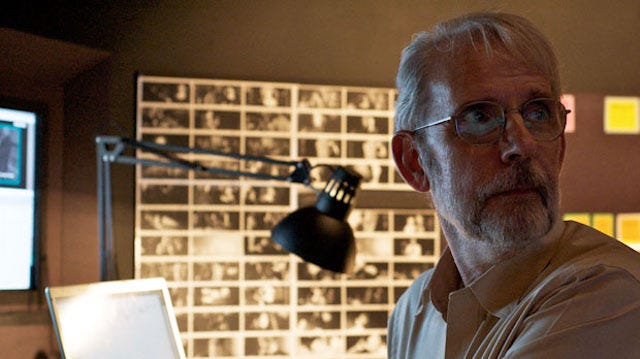
When this notable figure in cinema talks editing… think screenwriting.
Over the years, I have blogged several times about Walter Murch (see links below) whose work as a sound designer and film editor is notable in such movies as Julia, Apocalypse Now, Ghost, The English Patient, and The Talented Mr. Ripley. In my view, Murch has written one of the best screenwriting books — “The Blink of an Eye” — only it’s not about screenwriting, but rather film editing. However since screenwriting is so much about scene construction, perspective, and transitions between scenes, I find Murch’s insights profoundly beneficial to our craft.
Case in point: Murch’s ‘Rule of Six’ for film editing. Check out this short video in which he lays them out:
Here are the six:
- Emotion — How will this cut affect the audience emotionally at this particular moment in the film?
- Story — Does the edit move the story forward in a meaningful way?
- Rhythm — Is the cut at a point that makes rhythmic sense?
- Eye Trace — How does the cut affect the location and movement of the audience’s focus in that particular film?
- Two Dimensional Place of Screen — Is the axis followed properly?
- Three Dimensional Space — Is the cut true to established physical and spacial relationships?
As Murch notes, the first three are tightly interlocked and, as you can see, utterly on point for our task as screenwriters, and instructive to note how EMOTION ranks first in Murch’s list. That puts his film editing POV squarely in the arena of the story’s characters. In fact, from this Video and Filmmaker post, they quote Murch who puts a numeric value on each of the six rules:
1. Emotion (51%)
2. Story (23%)
3. Rhythm (10%)
4. Eye Trace (7%)
5. 2D Place of Screen (5%)
6. 3D Space (4%)
We may tend to think of editing as a highly technical skill — and it is — but good editing, as suggested by Murch, is hugely about Character and Story.
Takeaway: When we consider a scene transition, think Emotion, think Story, and think Rhythm, how does the end of one scene flow into the beginning of the next scene.
Other Go Into The Story posts on Walter Murch:
Walter Murch: “Three Fathers of Cinema”
Reader Question: What is your favorite book about screenwriting?
What do you think about the relationship between editing and screenwriting? Does that grab you at all? Any insights you have on the subject, please head to comments, I’d love to read them.