Video: How Aaron Sorkin Creates Musical Dialogue
This 7-minute video analyzes Sorkin’s dialogue in the opening scene of The Social Network and reveals an interesting dynamic in his…
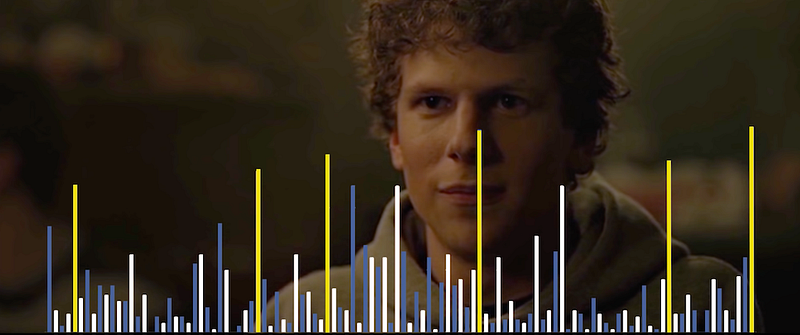
This 7-minute video analyzes Sorkin’s dialogue in the opening scene of The Social Network and reveals an interesting dynamic in his writing: Rhythm.
Recently, this Insider video from 2022 traversed my social media timeline. It’s a really good watch. It goes into great detail analyzing the opening scene in The Social Network and explores linguistic patterns Sorkin uses including:
- Repetition: Using the same or similar word multiple times in conjunctive sides of dialogue.
- Long lines: Varying dialogue from short bursts of a back-and-forth exchange with sides with much longer sentences.
- Iambic meter: Historically, a common form in poetry featuring two syllable words, an unstressed syllable followed by a stressed syllable.
Check it out.
The main writing takeaway: Be mindful of the rhythm of the dialogue you write. Like Sorkin, think of dialogue as music.
“It’s not just that dialogue sounds like music. To me, it actually is music. Any time that you’re speaking out loud for the sake of performance, those words what you’re saying have all of the properties of music. Dialogue has rhythm, pitch, tone, volume, and meter, and it absolutely has all the properties of music.”
— Aaron Sorkin
Of course, dialogue can’t just be all about rhythm, tone, and the rest. Here is an excerpt from a lecture I wrote about dialogue which also explores the same opening scene from The Social Network.
In the story universe of a screenplay, characters convey who they are and what they are feeling in two ways: action and dialogue. Since movies are primarily a visual medium, a screenwriter’s instinct must be to approach any scene thinking action first, dialogue second. In this regard, the old adage is tested, tried, and true: “Show it, don’t say it.”
What then of dialogue? Consider the words of William Goldman, arguably the dean of contemporary American screenwriters, creator of such notable screenplays as Butch Cassidy and the Sundance Kid, All the President’s Men, Marathon Man, and The Princess Bride:
“It’s a terrible thing for a writer to admit, but in terms of screenwriting, dialogue really doesn’t matter as much as in plays and books — because you have the camera.”
Since movies “have the camera,” does that really mean dialogue “doesn’t matter as much” in a screenplay? In one way of looking at it, the fact that there are limits on how much [or little] a screenwriter may rely on dialogue means our choices of when to use and how to handle this narrative element are critically important. In other words, we have to exercise greater care whenever we choose to write dialogue over action.
Thus we start with this acknowledgement: In a screenplay, dialogue is not conversation. It is communication. Communication with a purpose. This leads us to the screenwriting principle:
Dialogue = Purpose
We can look at dialogue as purpose in these four ways:
- Dialogue conveys exposition.
- Dialogue reveals a character’s inner life.
- Dialogue distinguishes one character from another.
- Dialogue moves the plot forward.
In today’s lecture, we will consider these four manifestations of dialogue as purpose by analyzing an extended excerpt from The Social Network, screenplay by Aaron Sorkin, based on a book by Ben Mezrich. Sorkin is such a brilliant wordsmith, one might be tempted to think all he cares about is the sound and rhythm of his dialogue. That perception, as we shall see, is inaccurate.
Dialogue as purpose in The Social Network
The first 8+ pages of The Social Network script would appear to be the very epitome of purposelessness. Apart from introducing two key characters — Mark Zuckerberg (Jesse Eisenberg) and Erica (Rooney Mara) — the dialogue zigs and zags from one topic to the next, a confused quilt of references and observations. Here is a list of topics in the scene:
- People with genius IQs in China
- How to “distinguish yourself” amongst people who got 1600 on SAT’s
- A Capella choir, rowing crew, inventing a “25 dollar PC”
- Final club
- World class athletes rowing crew
- How girls like cowboys
- Exclusivity
- Various final clubs at Harvard with the Porc being the “best of the best”
- Theodore Roosevelt
- Mark’s friend Eduardo made $300,000 betting on oil futures
- Predicting weather and the price of heating oil
- Spat about Erica asking which final club is the “easiest to get into”
- Spat about Erica calling it “finals” club
- Spat about Erica calling Mark “obsessed,” he says he’s “motivated”Mark thinks Erica speaks in “code”
- Mark says “I need to do something substantial” to get the “attention” of the clubs
- Mark: “Because they’re exclusive. And fun and they lead to a better life.”
- Mark: “You should be a lot more supportive,” benefits for her if he was in a club
- She tells him she is no longer his girlfriend
- Mark says Erica used to sleep with the door guy of the club they’re drinking in
- Erica gets angry and says she’s leaving
- Mark tries to apologize
- Erica says dating Mark is “exhausting”
- Mark disparages B.U. (Boston University) where Erica goes to college
- Erica delivers two “stingers” and leaves him
8 plus pages. 111 sides of dialogue. Where is the purpose in this scene?
Dialogue conveys exposition: If we define exposition as information, data, and backstory, we can see how Sorkin laces a lot of it into these pages:
Information: Mark attends Harvard; Erica attends B.U.; the Porcellian is the most exclusive final club at Harvard; Teddy Roosevelt was a Porc.
Data: The number of geniuses in China; Eduardo made $300K last year.
Backstory: Mark got 1600 on his SAT; Mark and Erica have been romantically involved; Mark thinks Erica used to sleep with the door guy.
This exposition is key in establishing the story’s setting (contemporary Harvard) and some of the basics of the Protagonist (Mark) and Attractor (Erica) characters.
Dialogue reveals a character’s inner life: Through text and subtext, Sorkin conveys important aspects of both Mark and Erica’s thoughts and feelings:
Mark: He is looking to distinguish himself; he feels pressure to do “something substantial” with his life; his reaction to Erica’s comment about the easiest final club shows he has personal insecurities; he thinks she should be more supportive of his desire to join a final club; Mark is dismissive of B.U. as an academic institution; his goal is a “better life.”
Erica: She thinks Mark is “obsessed” with final clubs; she has a difficult time following Mark’s way of thinking and talking; she gets angry at Mark’s insensitivity (i.e., door guy accusation, derision of B.U. and by extension her own intellect); she finds being with Mark “exhausting.”
The purpose of this facet of the scene’s dialogue is to go beyond exposition and provide readers a deeper insight into the inner workings of these two pivotal characters.
Dialogue distinguishes one character from another: In what they say and how they say it, Sorkin creates a clear sense of Mark and Erica’s individual identities:
Mark: He is extremely, almost excessively verbal; he is kinetic, his ideas spewing forth; he carries on his own internal conversation that often loses Erica; he is essentially humorless.
Erica: Less intelligent, but smarter socially; she tries to use humor to make points (“You don’t care if side effects may include blindness, okay, just do it,” “What part of Long Island are you from — England”); she is primarily reactive to him; she does not waffle in her decision to break up with him.
There is also this subtle distinction between them. Whereas Erica is actually hurt by Mark’s derisive comments, unintentional though they may be, when Erica dumps him, Mark doesn’t feel distress so much as shock, as if it is unfathomable she would have any reason to terminate their relationship.
At this level of purpose, Sorkin not only distinguishes the two characters in terms of the text of their words, but also the subtext, the deeper emotional meaning under their words.
Dialogue moves the plot forward: Within the realm of a story universe, perhaps the single most important purpose of dialogue is to advance the plot. On the surface this extended exchange between these two characters in The Social Network seems precisely like a conversation with little or no substantive part to play in terms of the narrative. A closer examination reveals the scene moves the plot ahead in two ways: (1) The scene itself has a clear Beginning, Middle and End; (2) Its end point is a critical event that sets into motion everything else that follows in the plot.
Scene structure: The Beginning of the scene revolves around establishing Mark’s powerful desire to get into a final club. The Middle involves Erica calling into question Mark’s obsession while Mark challenges her to support him, and in so doing provides one dismissive comment toward her after another. The Ending centers on Erica breaking up with Mark.
Point of the scene: It’s the break-up and specifically Erica’s final lines to Mark as she leaves [P. 8]:


The point of the scene is two-fold: (1) Erica breaks up with Mark. (2) Erica’s parting shot becomes a verbal talisman to inspire Mark to make something of himself and join a final club. The scene’s ending dialogue caps off this key purpose of the scene tied to the plot.
Dialogue entertains the reader
There is one more layer of purpose tied to dialogue, but as opposed to the four noted above which exist within the story universe itself, this one resides outside the realm of the story and in the domain of the writer’s consciousness: We want our dialogue to entertain readers. Perhaps nothing catches the attention of an agent, manager, producer, or studio executive more quickly than compelling dialogue. Plus it just makes for a better story.
In the opening scene in The Social Network, it’s easy to say the dialogue is entertaining simply because Sorkin is so good writing it, but dig deeper and we see this:
- The characters themselves are interesting: Especially Mark whose dialogue reflects a hyperactive, brilliant mind.
- The characters are presented in a compelling situation: Their last moment together as a couple.
- The couple goes from a starting emotion state — a conversational mood — to a significantly different ending emotion state — the break-up.
Then there’s a writing tip (one of many we will discuss in this course) we discern from Sorkin’s approach, sometimes called serve and volley. If you imagine dialogue as ground strokes in a tennis match, then each line can put the recipient (the character hearing the other’s dialogue) on the defensive. In turn, they can return with their own ‘volley’ (line of dialogue) which may put that character on their heels.
We see this dynamic at work on a micro level in the scene, especially where Mark’s sudden shifts in subject matter throw off Erica. As she says [P. 2]:
“Sometimes, Mark — seriously — you say two things at once and I’m no sure which one we’re talking about.”
For the first 6 pages of the scene, Erica is largely on the defensive in this serve and volley ‘match,’ a fact underscored by the number of lines each has: Mark with 85, Erica with just 63. But then Erica delivers an ace: She breaks up with Mark (“I’m not your girlfriend anymore”). From that point on, she puts Mark in reactive mode, also reflected in the number of lines for each character: Erica with 29, Mark with 18.
So on a macro level as well, the scene has an interesting serve and volley dynamic going on with Mark having Erica on the defensive for the first 6 pages, then a pivot where she turns the tables through the scene’s end.
And all that is entertaining.
Summary
Because screenwriters rely on action over dialogue, whenever we choose to use it, we must be especially mindful of our approach to writing. The foundational principle is this: Dialogue = Purpose.
Within the context of the story universe, we see this principle at work in four ways: dialogue conveys exposition, dialogue reveals a character’s inner life, dialogue distinguishes one character from another, dialogue moves the plot forward.
In terms of the writer’s domain, there is another example of dialogue as purpose: dialogue entertains the reader.
The rhythm of dialogue is absolutely important. A writer’s awareness of it can make the difference between flat dialogue and engaging dialogue. But first and foremost, the dialogue has a purpose. In an ideal world, we bring the two together and create a special kind of music.