Video: Dustin Lance Black
The screenwriter of Milk, J. Edgar, and When We Rise shares insights into his creative process.
The screenwriter of Milk, J. Edgar, and When We Rise shares insights into his creative process.
A few years back, the Academy of Motion Pictures Arts and Sciences ran a terrific series of video interviews called Creative Spark. Here is one featuring Dustin Lance Black (Big Country, J. Edgar, When We Rise, and an Academy Award for Milk).
I was interested to see the table Lance works on because I interviewed him some years ago and we discussed our mutual affection for using note cards.
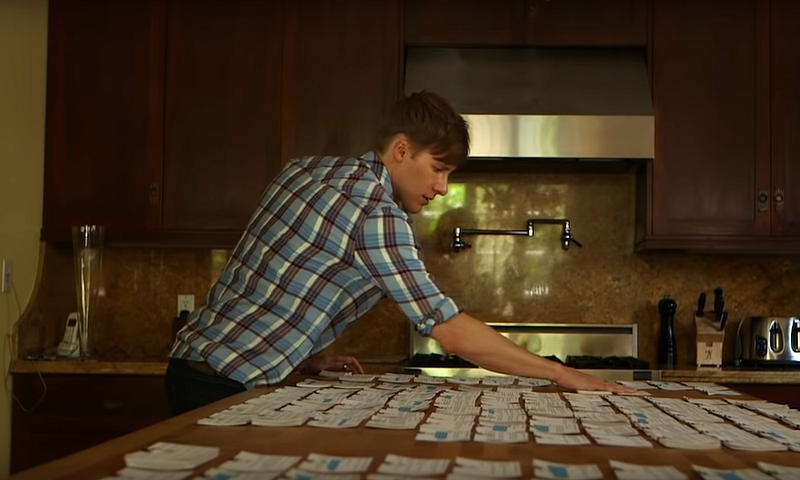
DLB: Then what I do is find the scenes that speak to that, and I put them on note cards. I have this table in my kitchen that’s of a certain size that I think is about two hours. And I start laying out these note cards and if they start to spill over the table, I know I’ve got to cut stuff. I keep doing and doing and doing it, going through it and through it and through it, combining things, telescoping time, combining characters if I have to until these cards fit on this table, then I think, Will this collection of cards communicate the reason for this film? And hopefully do so in a dramatic and entertaining way.
SM: It’s funny that with all the technology available, I talk to so many writers who still like to work with those three-by-five inch index cards. Like we need that tactile experience of working with those cards and seeing the story come into shape.
DLB: You can see it all laying out in front of you. And you’d have to have a massive computer screen to see the entire story. Plus there’s no program I know of, not yet at least, that allows you to take a fine tip Sharpie and scribble something in the corner of a note card that’s already crammed with ideas. It’s collage and art. I don’t know of a program that’s loose enough to accommodate the craft, because it’s still a craft, crafting a screenplay.
Ever since I spoke with Lance, I kept trying to imagine what “certain size” table he has that translates into a two hour movie. Well, there it is in the video. In fact at the 3:40 mark in the video, Lance flat out says about scenes he’s had to cut, “There’s not room. I don’t have any more room on that table.”
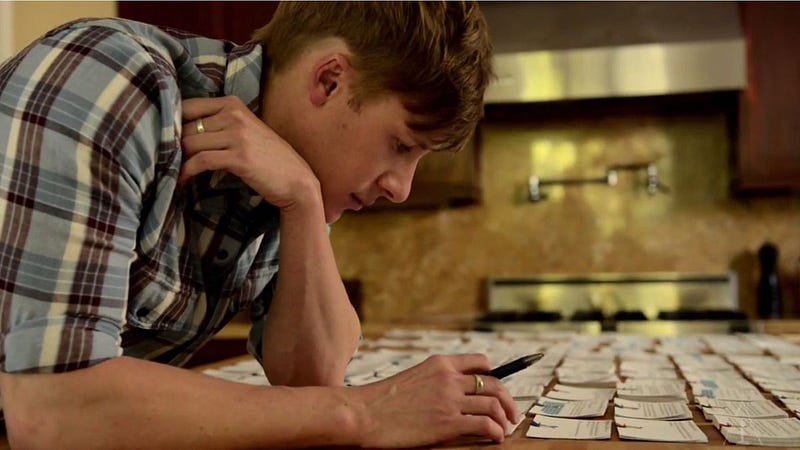
A table that is the length of a feature film screenplay’s note cards. Love it!
It’s fascinating to me that with all the technology out there, writers still rely on note cards to break story. In fact in my book The Protagonist’s Journey: An Introduction to Character-Driven Screenwriting and Storytelling, there is a section in Chapter 20 called Working With Index Cards which details an approach I have taught to over 1,000 writers in my Prep workshop.
While there are programs a writer may use to work with virtual cards, I prefer the tactile experience of the real thing … like Dustin Lance Black.