Video: “Anaphora and Epistrophe”
Another in the terrific screenwriting series Raising the Stakes.
Another in the terrific screenwriting series Raising the Stakes.
Jonathan W. Stokes is a screenwriter with a unique credit to his name: Five of his original screenplays have been named to the annual Black List. That alone should get your attention, but there’s also this: Over the last few years, he has produced an excellent video series called Raising the Stakes.
Recently, Jonathan released Season 3, Episode 5: Anaphora and Epistrophe. I like to think I’m a pretty smart guy. Got a B.A. from the University of Virginia. An M.Div. from Yale. And as I’ve been tracking Jonathan’s excellent video series, I’ve been in the ballpark of the subjects he explores episode to episode.
But this one? Jonathan got me. Before watching this video, if someone had asked me about Anaphora and Epistrophe, I might have thought this was the name of a Greek hip hop group. Or the names of two obnoxious miniature poodles owned by some billionaire blowhard.
Then I dredged through the mush of what remains of my gray matter and recalled some of the classical Greek I took when I was at Yale.
ana: a prefix which means up, against, back
pherein: to carry
So to “carry back.”
epi: a prefix which can mean upon, over, before
strophe: turn
So to “turn back.”
Still, what does this have to do with dialogue? Watch the video and see.
An anaphora is a rhetorical device in which a word or expression is repeated at the beginning of a number of sentences, clauses, or phrases. A well-known example of this may be found in the speech given by Winston Churchill to the House of Commons on June 4th, 1940: “We shall fight in France, we shall fight on the seas and oceans, we shall fight with growing confidence and growing strength in the air…” The anaphora may be contrasted with the epistrophe, which is similar in nature, but describes the repetition of a word which occurs at the end of a phrase, sentence, or clause, rather than the beginning. A famous example of epistrophe is found in Abraham Lincoln’s Gettysburg Address: “…and that government of the people, by the people, for the people, shall not perish from the earth.”
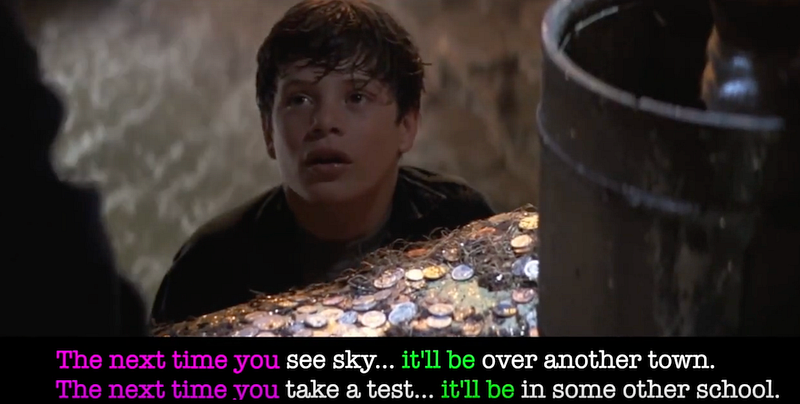
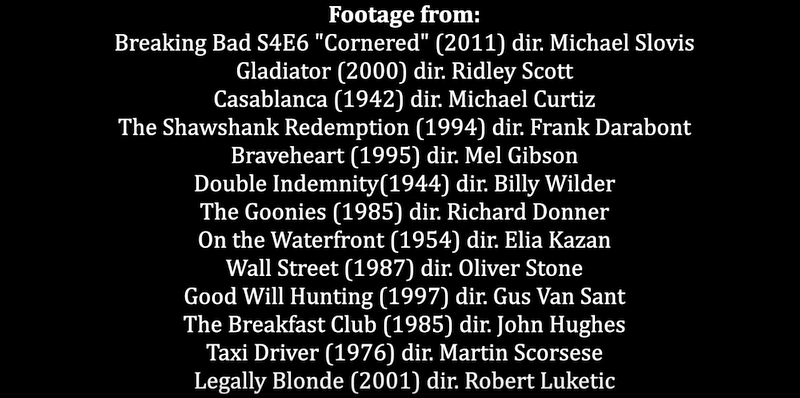
The video shows a bunch of examples in movie dialogue:
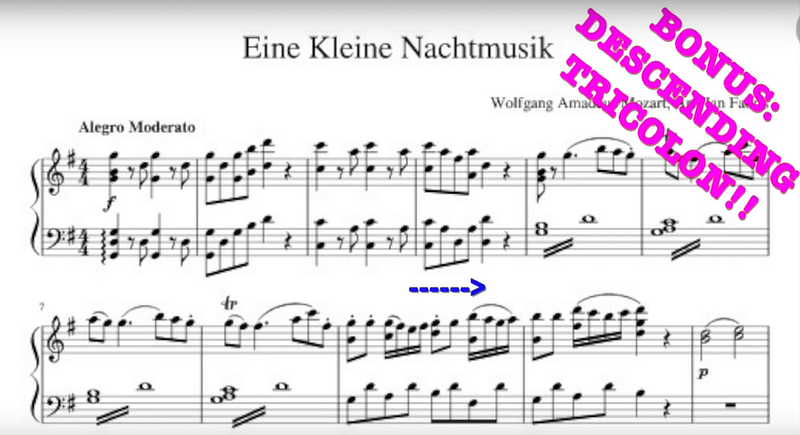
But Jonathon also cites repetition as an example in music:
And that reminded me of Aaron Sorkin:
“My parents started taking me to see plays starting from when I was very little and oftentimes, they were plays that I was too young to understand like ‘Who’s Afraid of Virginia Woolf’ when I was nine years old or something. So I didn’t understand the story lots of times that was going out there, but I loved the sound of dialogue. It sounded like music to me and I wanted to be able to imitate that sound, so it’s always been dialogue that I’ve loved.” [emphasis added]
What Jonathan gets to in zeroing in on the use of anaphora and epistrophe is a reminder that dialogue can have rhythms, dialogue can have patterns, dialogue can have repetitions … just like music.
Fascinating take by Jonathan. Also gave me a chance to amortize the cost of my Yale student loans by resurrecting some of my Greek lessons!
For more videos in Jonathan Stokes’ excellent Raising the Stakes series, go here. While you’re there, why not subscribe? There are more videos to come in S3 and by subscribing, you won’t miss them.
For more background on Jonathan W. Stokes, you can go here.
By the way, I recently interviewed Jonathan. Look for that chat later on this summer.