Video: 10 Screenwriting Tips from Robert Eggers
On how he wrote The Lighthouse and The Northman.
On how he wrote The Lighthouse and The Northman.
From Outstanding Screenplays:
Robert Eggers is an American film director and screenwriter. He is best known for his acclaimed horror films The Witch (2015), The Lighthouse (2019) and his newest film The Northman (2022).
Here is the video:
Here are the 10 tips:
01. Embrace what is uniquely you.
02. Find a harmonious balance of opposites in your writing. Your writing needs both Dionysian and Apollonian aspects.
03. Avoid writer’s block by doing research about things that interest you and research and write in tandem.
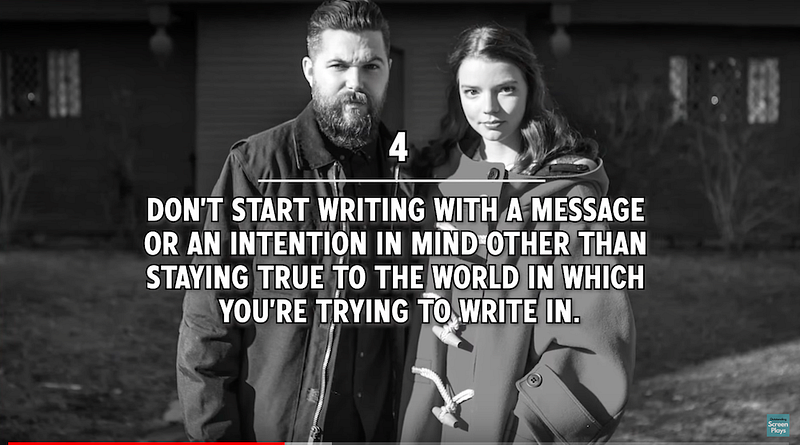
04. Don’t start writing with a message or an intention in mind other than staying true to the world in which you’re trying to write in.
05. It’s absurd to think that how well you follow a traditional structure is what makes you a good storyteller.
06. Wherever and whenever your story is set, the conversations, the arguments and other universal elements need to feel similar and relatable to today.
07. Be extremely meticulous with your writing.
08. Historical accuracy is not important to filmmaking. You can make a great period story without it being accurate.
09. To get your first feature produced, make a proof-of-concept short film that includes some elements similar to the feature you are trying to produce.
10. When writing, don’t think about how you’re going to get it on camera. You have to be blind to the realities of shooting and figure it all out later.
I was particularly interested in his comments about the “Dionysian and Apollonian aspects” of writing. Here’s a quote:
“How do you create a balance of something that is rigorous and structure and clear (i.e., Apollonian / patriarchal), but also has enigma and mystery and atmosphere (i.e., Dionysian / matriarchal).”
That’s an interesting way of framing the screenwriter’s challenge. Because a script is, in effect, a pre-movie, it at some point becomes a blueprint for the actual production of a film. Hence, William Goldman’s observation: “Screenplays are structure.” That’s the Apollonian aspect. Yet, there has to be a kind of spontaneity and vitality which brings the story to life within the context of the screenplay structure.
To me, that’s all about immersing ourselves in the lives of our characters. The key plot elements, even the characters who surround the Protagonist emerge from that brainstorming / engagement process with the characters. As I say with a screenwriting mantra I came up with years ago:
Begin with character. End with character. Find the story in between.
Characters not only lead us to the story’s structure, they also bring that “enigma and mystery and atmosphere” to the story.
For more Outstanding Screenplays videos, go here.
For 100s other interviews with screenwriters and filmmakers, go here.