Tweetstorm: Monica Beletsky on the Establishing POV in a Pilot Script
“Who’s POV are we in? Why do we care? Whose journey are we on?”

Tweetstorm: Monica Beletsky on Establishing POV in a Pilot Script
“Whose POV are we in? Why do we care? Whose journey are we on?”
Twitter can be a gold mine for writers. Case in point, when pro writers generate a tweetstorm about the craft. Last week, writer-producer Monica Beletsky (Parenthood, The Leftovers, Fargo) picked up on a Twitter thread she originally posted in March 2018 to expand on the topic: The importance of establishing a specific POV (Point Of View) in a pilot script. I have combined and adapted those two threads with Monica’s permission.
Something I always look for when I read scripts. What is the main character going through and doing when they’re alone?
I could be wrong about this. If I am, feel free to comment with examples to the contrary. It is very difficult for a reader to invest or care about the characters in your pilot script if most of the scenes are 3 person or more scenes.
I’ve read three scripts this week by emerging writers who all did this and I found myself giving the same note. (This is NOT, I repeat NOT an invite to send me scripts. send me a script=blocked).
Scripts with almost no two person scenes and zero one person scenes have a third person effect on the story that is very distancing. Whose POV are we in? Why do we care? Whose journey are we on? These questions are hard to answer without at least one scene portraying the protagonist alone.
Walter White at the gas pump. Tony Soprano with the ducks. Don Draper at the bar w his napkin (and waiter) then arriving home at the end. This is true in ensembles too. The FNL pilot starts with multiple single POV beats.
Re-upping this thread convo on protagonist POV bc I read scripts by more mentees this week & basically had the same note for everyone in this round that is the same as my last stack. A lack of POV is holding ALL of these scripts back. You guys can write. It’s clear.
But W/O POV, the story is A) too distant B) doesn’t feel like anyone is the protagonist C) Feels like it’s living in between a feature and a pilot bc it’s a lot of characters talking to each other but I am not inside the journey of the main character and/or I’m also not inside the ensemble.
So the read feels like GREY’S without Meredith or THE KNICK without Owen. It’s a world, a genre, a group of character without a center. And if there is a center, they’re doing stuff but I don’t know why you want me to care about them or what they really want.
One practice you could try is to watch the first few acts of a few classic pilots or episodes with strong POV and watch how the story unfolds through the protagonist.
Watch how in a Sayid ep of LOST how even if he’s trekking w Kate and Sawyer, if it’s his episode, those 3 person scenes are still mostly from his POV. Def his flashbacks.
Watch what Don Draper, Tony Soprano, Fleabag, Donald Glover are doing, observing, feeling in their 1st say five scenes of character intro. How do we know what they want, who they care about, what they’re afraid of etc?
And it’s totally cool to switch POVs in the scene, but when you do, it really helps me stick with the read and live inside the script if it’s a shift to feel and live through the other character/s.
Bottom line: If your script is ensemble, make sure you’ve written a character at the center who is the protagonist. And when you write your protagonist make sure you establish in the first 10 pages what they’re going through and why we care.
POV in your writing means scenes are written through someone’s perspective. Not watching them. We are living it THROUGH them. Write like that and I promise your work will be elevated.
This is such a critical subject which is why I asked Monica if I could reprint her observations here. During the first day of every class I teach at the DePaul University School of Cinematic Arts, I make this point: One of the most fundamental functions of a Protagonist character is to provide a conduit into the story universe. Their specific point of view becomes our point of view, i.e., the audience. As Monica says, “We are living it THROUGH them.”
Here is your word for the day: vicarious. Definition: felt through imagined participation in the experience of others.
While there are many other characters in a movie or TV series, it’s critical to give the audience (or script reader) the unique perspective of a single character so they may live vicariously through that individual’s experience.
That character is almost certainly your story’s Protagonist.
Thus, to underscore Monica’s central point: If you are writing an original TV pilot script, know who your Protagonist is and make damn sure you let the reader know who that character as early as possible. That way, you answer a question the reader brings to the read at FADE IN: Who is the Protagonist? In so doing, you provide the necessary frame for the reader to enter into your story universe.
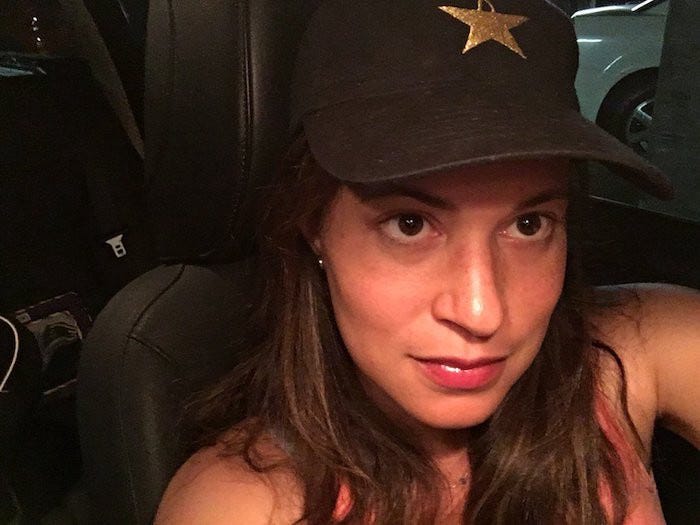
Twitter: @MonicaBeletsky.
For a previous tweetstorm Monica did on her process of writing the one-hour TV drama script, go here.
For more screenwriter tweetstorms, go here.