Trimming Tricks of the Trade
Page count. A screenwriter must be cognizant of it. Even if you don’t subscribe to the theories of screenwriting gurus like Syd Field, who…
Page count. A screenwriter must be cognizant of it. Even if you don’t subscribe to the theories of screenwriting gurus like Syd Field, who asserts that the typical Act I ending plot point falls between P. 25–27 and Act II ending plot point between P. 85–90, the fact is you will run up against those who do subscribe to this thinking — producers, agents, and studio execs who have all been schooled in the mysteries of screenplay paradigms. So if your end of Act I plot point is at P. 40, that is likely to be a subject at a notes meeting a la “Act one feels a little long.”
A screenwriter not only confronts page count per each plot point, but also and importantly with the script’s total page count. Although movies vary widely in terms of budget, one page of a script can translate into a production cost of several hundred thousand dollars. So if your comedy script logs in at 125 pages when a typical comedy movie times out nowadays at 90 minutes, multiply 35 pages times, let’s say, $100K and you get $3.5 million in additional expenditures. That monetary concern could prove to be the difference between a spec script sale and a pass.
Beyond that, there’s always that hugely important Hollywood threshold guardian — the script analyst. I doubt any script reader relishes the prospect of slogging through a 140+ page script.
Plus, you know it’s inevitable: someday you will write a long script. And you will need to cut it down to size.
A long script can be the result of structural issues, so that’s where you should look first: make sure every scene, every character, every subplot is necessary. If not, figure out ways to jettison them.
Next you review every line of dialogue and bit of business within each scene: if the dialogue or action is extraneous, unless it’s hugely entertaining, consider excising it.
Let’s say you’ve done both those things. And you’re still stuck with a 135 page script. You don’t want to hack out whole sides of dialogue, scenes or bits of business, not if they’re intrinsic and important to the script or add to its entertainment value.
That’s where you can look for small edits and stylistic choices you can make which taken together can reduce your page count without messing with your script’s integrity.
Here are Four Trimming Tricks of the Trade to help with your page count.
Lose the Orphans
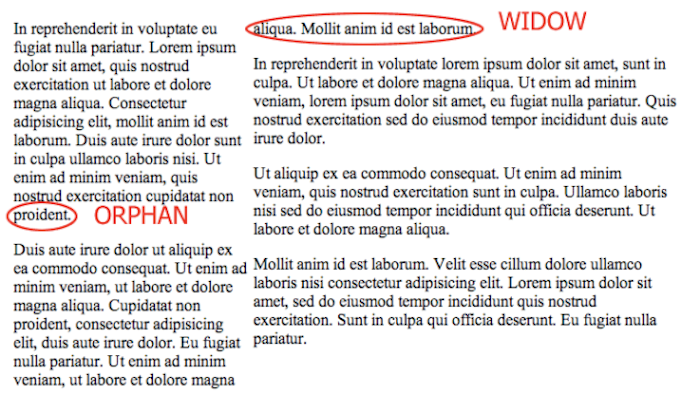
By that, I mean scene description or dialogue which has a line comprised of 1–2 words. Here is an example:
The snow falls harder, it swirls soft, thick. The flakes are
larger.
The word “larger” is an orphan as that one word takes up one whole line of script space. So why not this simple change?
The snow falls harder, swirling soft, thick. Flakes larger.
There. Line saved.
Several scripts ago, during the edit process, I counted the number of 1–2 word orphans in one of my drafts: 98 in all. By editing them, I cut the script by nearly 2 pages (typical page has 52 lines).
In dialogue, the same thing pertains:
UMBRELLA MAN
It’s the rain. You should find an
umbrella.
(urgent)
Quickly.
Four lines of dialogue. You could save a line by writing this:
UMBRELLA MAN
It’s the rain. Find an umbrella.
(urgent)
Quickly.
Actually, you could save two lines by writing it this way:
UMBRELLA MAN
It’s the rain. You should find an umbrella.
Quickly!
By losing an orphan and the parenthetical, you take four lines down to two. And speaking of parentheticals, that’s the subject of tomorrow’s Trimming Tricks of the Trade.
Minimize Parentheticals
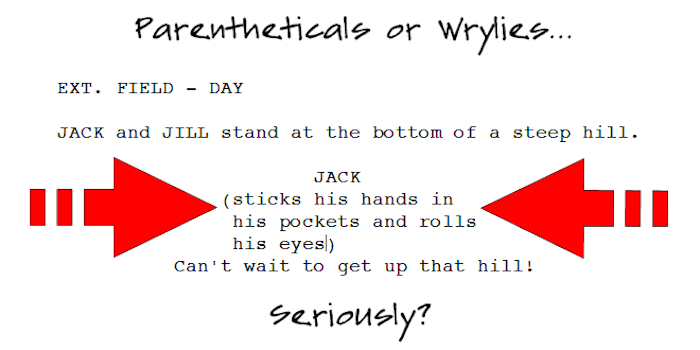
Any of you who have taken my screenwriting classes know I urge writers to use parentheticals sparingly. Not only because they’re typically one or two words — what a waste of a line! — but also because far too often (A) they are intended to direct the actor (which actors don’t like) or (B) what they are conveying is already implied in the dialogue.
In other words, most parentheticals are not only space-wasters, they are unnecessary.
One way to lose parentheticals is to put their content in scene description. Here’s an example:
INT. XRAY DEPARTMENT — DAY
Scattered mobile x-ray units create a high tech maze. Eve
balances a cellphone against her ear as she clutches a
stack of CT films. Pushes toward a light box.
EVE
(into the phone)
I’ve had them stat page Dr.
McCarthy three times. I have a
post aneurism resection with
seizure.
Here’s a little edit which transplants the parenthetical into scene description:
INT. XRAY DEPARTMENT — DAY
Scattered mobile x-ray units create a high tech maze. Eve
balances a cellphone against her ear as she clutches a
stack of CT films. Pushes toward a light box. Into phone:
EVE
I’ve had them stat page McCarthy
three times. I have a post
aneurism resection with seizure.
[Note: I also handled the orphan in the side of dialogue, saving a line there, too].
The worst parentheticals are those that take up more than one line. Paddy Chayefsky, one of the greatest screenwriters ever, loved parentheticals. Here’s an actual example from NETWORK:
HOWARD
(reaching for the bottle of
booze on HUNTER’S desk to
refill his glass)
— let’s do the Lennon deportation
at the end of three —
Three whole lines for what could be one line of scene description:
He reaches for the booze on Hunter’s desk, refills his glass.
Chayefsky started as a playwright at a time when they used parentheticals extensively. But for us mere mortals where page count is critical, there is no excuse to use a parenthetical unless (A) it is absolutely essential and (B) the action it describes is counter to what the dialogue indicates. Such as:
HOWARD
(picks up gun)
Angry? Why would you think that?
So do this: Every time you think about using a parenthetical, ask yourself if you’re willing to waste an entire line for one word? Because, in essence, that is what you are doing.
Cut Transitions
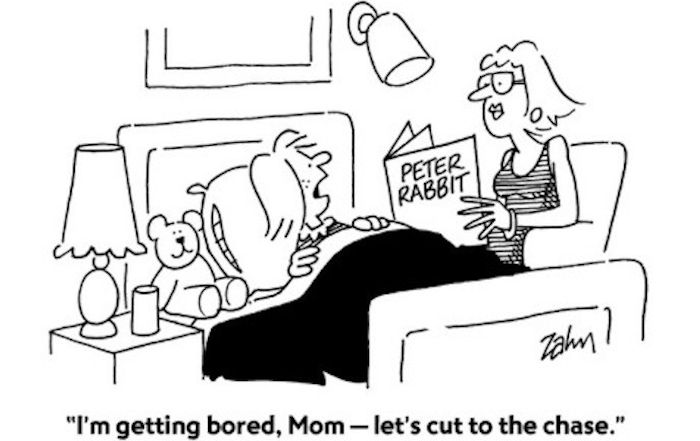
CUT TO: / DISSOLVE TO: / SMASH CUT TO:
These are common transitions, signifying a cut from one scene to another. There are two reasons not to use them. (1) They read ‘scripty’ and since the shift the last two decades has been away from using directing / editing lingo in screenplays toward more of what may be called a literary approach to style, transitions are worth excising (with one exception — see below). (2) They take up 2 lines which means they’re even worse in terms of page count than parentheticals.
The only time you should consider using a CUT TO is if you do a significant jump, either in time, geography or both. To wit:
PEARL HARBOR — DAY (1941)
JAKE stares at the U.S.S. Arizona, listing to the side,
flames belching from the gaping wound in its side –-
CUT TO:
INT. JAKE’S HOUSE — NIGHT (LOS ANGELES, 2011)
Now an old man, JAKE sprawls in a tattered chair, a
crushed can of malt liquor in hand — eyes locked on
flames in the fireplace.
A major time / geographical ellipsis like that may benefit from a transition to alert the reader to the jump. But in almost every other case, you can use a Scene Heading [Primary Slugline] to signify a shift from one scene to the next — that is if you are consistent in using Scene Headings to indicate the beginning of a new scene and use Shots [Secondary Sluglines] to move the action within any given scene. For example:
EXT. SEARS TOWER — NIGHT
The skyscraper pierces the cloudy sky.
INSIDE — LOBBY
A single Guard at the front desk, head bobbing,
nearly asleep.
A pair of HOODED MEN hustle through the empty hallway.
One pulls the pin in a hand grenade. Tosses it into —
AN OFFICE
The grenade bounces, then rolls to a stop —
A thick silence, then —
Boom!
FRONT DESK
The explosion rattles the Guard to his feet.
INT. POLICE STATION — CONTINUOUS
Garrity two finger typing at his computer. One
last finger punch. Hits print. Leans back and
sighs — finally done for the night.
His cellphone chirps. He checks it —
TEXT MESSAGE
“Kaboom.”
The Scene Heading establishes the scene’s primary location, then uses Shots to shift the action to sub-locations.
By using Scene Headings to indicate the beginning of a new scene, you don’t need transitions. And each transition you don’t use, saves two lines. If the average scene is 2 pages long, which means 60 scenes per script, you could use 120 lines just for CUT TO:’s. That’s nearly 2 1/2 pages of wasted space.
Pseudo-Slugs
Technically when you use a Secondary Slugline (or Shot), you need to provide a line-space, then go to scene description. For example:
OUTSIDE THE DOOREve uses her body as a barricade.
In the past, I have gotten away with this:
OUTSIDE THE DOOR – Eve uses her body as a barricade.
Note how that potentially saves 2 lines. I call it a pseudo-slug and it can not only save you lines, it also reads really well in action scenes.
Here’s an example from a script I co-wrote “Stalemate,” optioned several times, but as of yet unproduced:
SNIPER P.O.V. – THROUGH RIFLE CROSSHAIRSFocuses in on Marty… dead center.QUINN dives at Mary, knocking him down. The Sniper SHOOTS.
A bullet bites dust… where Marty was standing.QUINN whips out his Walther. Unloads the magazine at the
Sniper, who swan dives into the dust…The BOXCAR DOOR rolls open… a GUNMAN leaps down, blazing
away with an Ingram machine gun… a trail of slugs at…QUINN AND MARTY who roll apart, bullets RIPPING the ground…TRUMBULL AND DONOVAN shove Sharon into the limo… the Driver
GUNS the engine…MARTY darts behind his Porsche… machine gun fire pierces
the car.THE LIMO spins away…
The beginning of each sentence, when capitalized, gives the same effect as a Shot, but because the scene description begins on the same line as the pseudo-slug, the version above saves about 14 lines of space.
Nowadays the concept of using lines or short paragraphs to ‘direct’ the action, suggesting individual camera shots, is pretty standard, so you don’t even need to cap the object of attention, the line itself can indicate the point of focus, but that’s basically a stylistic choice for the writer.
Granted, all these tips are pretty mundane stuff, but when you’re looking at a script that clocks in at 130 pages and you knew there were tips like these that combined could knock off 7–10 pages without having to change the substance of the story, the mundane transforms into mighty helpful.
I leave you with an editing quote from the aforementioned Paddy Chayefsky:
“If it should occur to you to cut, do so. That’s the first basic rule of cutting. If you’re reading through and stop, something is wrong. Cut it. If something bothers you, then it’s bad. Cut it. If you can cut inside the speech, you’re really cutting most effectively. It’s purifying, it’s refining. Making it precise. Precision is one of the basic elements of poetry. My own rules are very simple. First, cut out all the wisdom; then cut out all the adjectives. I’ve cut some of my favorite stuff. I have no compassion when it comes to cutting. No pity, no sympathy. Some of my dearest and most beloved bits of writing have gone with a very quick slash, slash, slash. Because something was heavy there. Cutting leads to economy, precision, and to a vastly improved script.”
And with that…
CUT!