Trimming Tricks of the Trade: Cut Transitions
Back today with another Trimming Trick of the Trade.
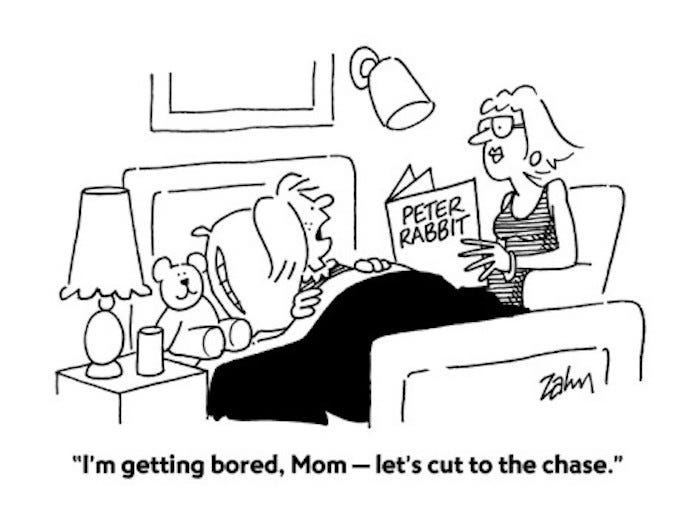
#3: CUT TRANSITIONS
CUT TO: / DISSOLVE TO: / SMASH CUT TO:
These are common transitions, signifying a cut from one scene to another. There are two reasons not to use them. (1) They read ‘scripty’ and since the shift the last two decades has been away from using directing / editing lingo in screenplays toward more of what may be called aliterary approach to style, transitions are worth excising (with one exception — see below). (2) They take up 2 lines which means they’re even worse in terms of page count than parentheticals.
The only time you should consider using a CUT TO is if you do a significant jump, either in time, geography or both. To wit:
PEARL HARBOR — DAY (1941)
JAKE stares at the U.S.S. Arizona, listing to the side,
flames belching from the gaping wound in its side –-
CUT TO:
INT. JAKE’S HOUSE — NIGHT (LOS ANGELES, 2011)
Now an old man, JAKE sprawls in a tattered chair, a
crushed can of malt liquor in hand — eyes locked on
flames in the fireplace.
A major time / geographical ellipsis like that may benefit from a transition to alert the reader to the jump. But in almost every other case, you can use Primary Sluglines [Scene Heading] to signify a shift from one scene to the next — that is if you are consistent in using primary slugs to indicate the beginning of a new scene and use Secondary Sluglines [Shot] to move the action within any given scene. For example:
EXT. SEARS TOWER — NIGHT
The skyscraper pierces the cloudy sky.
INSIDE — LOBBY
A single Guard at the front desk, head bobbing,
nearly asleep.
A pair of HOODED MEN hustle through the empty hallway.
One pulls the pin in a hand grenade. Tosses it into —
AN OFFICE
The grenade bounces, then rolls to a stop —
A thick silence, then —
Boom!
FRONT DESK
The explosion rattles the Guard to his feet.
INT. POLICE STATION — CONTINUOUS
Garrity two finger typing at his computer. One
last finger punch. Hits print. Leans back and
sighs — finally done for the night.
His cellphone chirps. He checks it —
TEXT MESSAGE
“Kaboom.”
The Primary Slugline (Scene Heading) establishes the scene’s primary location, then uses Secondary Slugs (Shots) to shift the action to sub-locations.
By using Primary Sluglines exclusively to indicate the beginning of a new scene, you don’t need transitions. And each transition you don’t use, saves two lines. If the average scene is 2 pages long, which means 60 scenes per script, you could use 120 lines just for CUT TO:’s. That’s nearly 2 1/2 pages of wasted space.
Tomorrow another Trimming Trick of the Trade.
Part 2: Minimize parentheticals
[Originally posted 11/26/2008]