To Write, Stop Thinking
Think character. Think plot. Think theme. But when you sit down to write, don’t think… feel.

Think character. Think plot. Think theme. But when you sit down to write, don’t think… feel.
The Atlantic runs a series called By Heart in which authors share and discuss their all-time favorite passages in literature. Here is one by author Kathryn Harrison:
The line also defines writing, at least writing the way I experience it. For me, writing is a process that demands cerebral effort, but it’s also one informed by the unconscious. My work is directed by the needs of my unconscious. And through that dark, opaque process, I can restore what might otherwise be lost.
— —
It’s funny, I teach writing, and before I taught I never would guessed the thing I say most often is: “Please stop thinking.” But people really write better without thinking, by which I mean without self-consciousness.
I’m not calculating about what I write, which means I have very little control over it. It’s not that I decide what to write and carry it out. It’s more that I grope my way towards something — not even knowing what it is until I’ve arrived. I’ve gotten better over the years at accepting this.
Of course, the intellect wants to kick in — and, in the later drafts, it should. But in the early stages of a book, I deal with potential self-consciousness by literally hushing the critical voices in my head. The voices that tell you: “Oh, those aren’t the words you want,” or “you shouldn’t be working on this part now,” or “why not use the present tense?” — on and on. Anyone who’s ever written anything is familiar with that chorus.
Writing a first draft, you can become paralyzed by these thoughts. So I literally tell the voices to quiet down. I praise them for their perspicacity, and I tell them how much I need them — that I will want them later. But I cannot listen to them right now, because I am confused by them.
And I don’t sit there waiting for that perfect, beautiful sentence, because I know I’m going to sit there forever. So, as I tell students — start out by tripping, why don’t you? Then get up and fall over again. Just as long as you go.
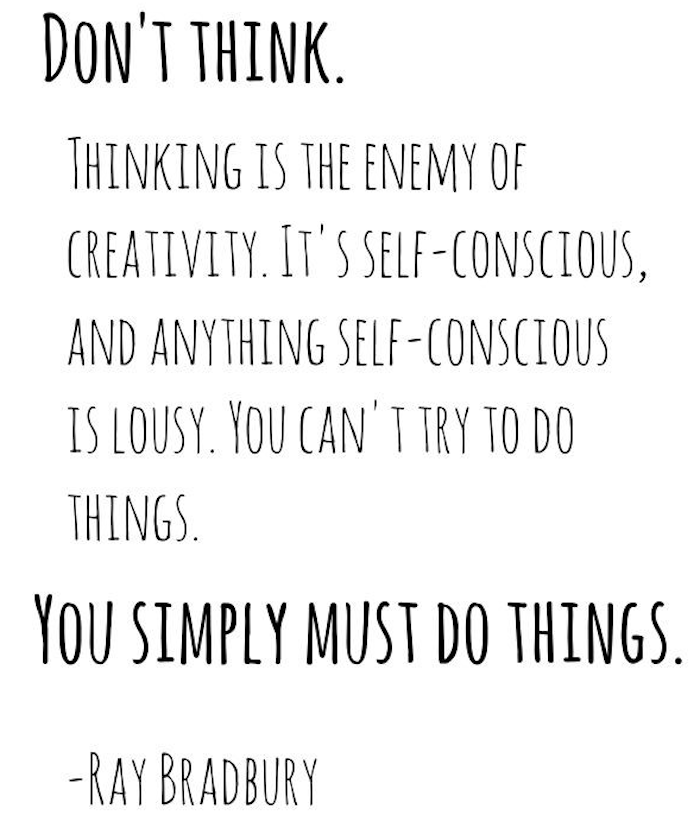
I was struck by how similar this approach is to my own, both writing and teaching. In 2013, I wrote a post called “Don’t Think… Feel” inspired by this quote from Ray Bradbury:
I’ve had a sign over my typewriter for over 25 years now, which reads “Don’t think!” You must never think at the typewriter — you must feel. Your intellect is always buried in that feeling anyway.
Here are some excerpts from that post:
In the ten years or so I’ve been teaching, I have created dozens of classes and taught well over one hundred of them to over a thousand writers. All of that required considerable thinking.
And yet while I’m proud of the approach I have developed which I teach — grounded in solid theory and years of experience working as a professional in Hollywood, not formula, not pap, a comprehensive, character-driven approach to the craft — when I send writers off to write their scripts or accompany them in workshops, I always make a point similar to Bradbury: No matter the books you’ve read or theories you’ve ingested, no matter what you’ve come up with in your prep work, whatever your thinking has brought you to, you must be willing to trust your characters, follow your feelings as you write. Because writing is a journey of discovery no matter how much thought you’ve put into it.
Now I would hasten to add a proviso: Bradbury was a genius. He was destined to be a writer, perhaps even born with a writer’s soul. So it was probably natural and easy for him to ‘cut off’ his intellect and trust his gut when writing. Those of us who exist on a more terrestrial plane may not be so lucky and will have to rely at least somewhat on our intellect as we write.
But it’s that last point that really grabbed me: Your intellect is always buried in that feeling anyway.
Wow. I love that. Because it describes in succinct fashion the very process I try to convey here on the blog, in my teaching, and in my own writing.
Learn the craft as best you can through study and analysis. Immerse yourself in your story universe during prep-writing. Brainstorm. Character development. Plotting. All of it. That should engage both your intellect and your heart.
But when you hit FADE IN, default to your emotions. At the end of the day, you want a script reader to feel something. What better way to ensure that than by feeling something ourselves?
As Harrison notes, there are times when we must bring our critical thinking into the writing process, however when we have a go at our early drafts, when we write, stop thinking … and go with your feelings.
This is an excerpt from my book The Protagonist’s Journey. The final chapter provides advice on how to approach writing the first draft. Here is how I end that chapter … and my book.
Just before you set your fingers on the keyboard, spend time with your story’s most important character: the Protagonist. Since they are at the center of the narrative, everything revolving around them, and they are in the midst of a personal metamorphosis even as change is a challenge, what are they feeling? What emotions do they bring to the start of this scene? What inner dynamics are roiling around in their psyche? What need is emerging from the dark corners of their self? What are they living right now?
Finally, if ever you are confused about your story — and you will be — reach out to your characters. After all, it is their story. No one knows it better than your characters. And always…
Begin with character. End with character. Find the story in between.
The best way to avoid getting wrapped up and trapped by your thoughts is to get in touch with the emotional life of your characters, especially your Protagonist. Let the characters drive the writing process by getting you out of your brain … and into the heart of the story.
For the rest of The Atlantic article, go here.