THR 2025 Writers Roundtable
The Hollywood Reporter’s annual sit-down with six screenwriters with notable films from the previous year.
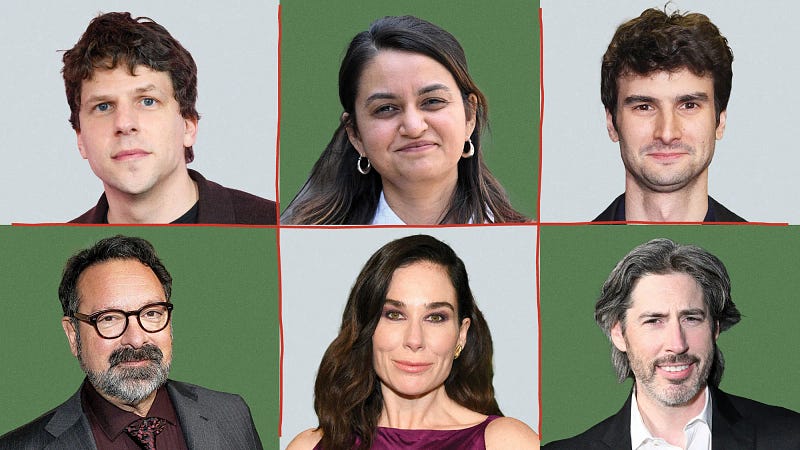
The Hollywood Reporter’s annual sit-down with six screenwriters with notable films from the previous year.
I love interviews with screenwriters. First, I can learn something from pro writers. Second, any time screenwriters are featured in the press is worth noting. All too often with movies, the press covers everybody BUT the writers. So, thanks THR for this annual feature.
This year’s gathering features Jesse Eisenberg (A Real Pain), Payal Kapadia (All We Imagine is Light), Justin Kuritzkes (Challengers), James Mangold (A Complete Unknown), Halina Reijn (Babygirl), and Jason Reitman (Saturday Night).
Here are excerpts from the roundtable in which each participant shares how they got into screenwriting.
Jim, what set you on the path to writing?
JAMES MANGOLD A burning desire to shoot and direct. It was a chore for me early on — extremely painful, which it still is. But for some reason, with age, I’ve come to a kind of respect and appreciation for it.
Jason, your late father, Ivan, was a terrific director but wrote very few of the films that he made.
JASON REITMAN I’m a filmmaker today because I grew up on sets and wanted to be on the trucks and part of the crew. But I realized the only way I was going to get there was if I wrote something for myself. My father later told me that when I was 16 or 17, he realized I could write and decided to treat me like a professional writer, so he was really tough on me. And he never stopped. Up in the Air is a script that I’m proud of to this day, but the first time my father read it, he said, “You know, a movie needs a plot.” (Laughs.)
Halina, what inspired your pivot from acting to screenwriting?
HALINA REIJN I was raised by hippies and wasn’t allowed to watch moving images, because that would be bad for the soul. But we had a babysitter who took us to the cinema when I was 6 to see Annie, and that did change my soul. I thought Annie made that movie, so that’s why I thought, “I’m going to be an actress.” (Laughs.) I also wrote stories and diaries and, at a certain moment in my life, a novel, and it just went from there. But my biggest writing teachers were the plays that I was in, Shakespeare and O’Neill and Ibsen.
Jesse, it’s hard to know what came first for you, acting or writing, because you started doing both so young.
JESSSE EISENBERG Starting out, I was writing little jokes because I was interested in comedy. Then in my late teens, I started writing screenplays of the Adam Sandler ’90s-era style. I figured out the formula, and I could reproduce it. I even had some of these scripts optioned — I’d send them to agents — but nothing would ever get made. I was also acting. When I was 20, I got a part in a movie that Bob Odenkirk was directing, and I gave him my scripts because I knew he was in the comedy world and had worked at SNL, so I thought, “He’ll send them to Adam Sandler.” He took about two weeks to read them and then called and yelled at me for an hour, but in an incredible way. I’ll never forget what he said because it changed my life. He said, “Buddy, why are you writing this? This is something that I’d get hired to write in a weekend. There’d be three of us sitting in a room at Happy Madison doing this. You’re a thoughtful, sensitive guy. Why is this your art?” It killed me because those scripts represented years of my life. But right after that, I went to Poland for a movie and went to visit my family’s house, as we do in A Real Pain. And I came back and wrote a play.
Justin, where did it start for you?
JUSTIN KURITZKES I was always writing, even really young. But there was a playwriting festival at my high school where they’d take student-written plays and other students would direct them. That felt like finding my people.
Payal, you have experience in nonfiction filmmaking, which one can feel in this debut narrative film …
PAYAL KAPADIA I was inspired by experimental films like those by Stan Brakhage and Len Lye, and an experimental filmmaker in India, S.N.S. Sastry. I saw these at film festivals and said, “I want to make films.” Then I went to film school, and that’s where reality hit me: I had to write. I’d never really written a structured script, and I’d constantly get told, “No. Do it again.” I was sometimes at the point of tears. But the redos actually helped me, and my process now is to rewrite so much. My final year, I had to make a “diploma project” of 20 minutes. At the time, I had two family members separately in the hospital. While in the waiting room hanging around — because I was a student [and didn’t yet have a job] — I was thinking, “This is a great mise-en-scène to make a film.” I was observing things; I started making friends with some nurses; and I got used to the rhythm of the hospital, the shifts, who’s going to come, when she’s texting her boyfriend. And I noticed, in a very banal, depressing place, little moments of happiness. Then I did a lot of interviews and realized that 20 minutes wouldn’t be enough. It’s been five years since then.
Here is a clip from the interview:
For the rest of the roundtable conversation, go here.
Ever since I launched my blog, I have featured interviews with screenwriters and filmmakers. You may access 100s of those by going here.