Theme = Meaning
This one-week online class (begins April 8) focuses on theme: what it is, how it functions, and how to use themes to enrich your stories.

This one-week online class (begins April 8) focuses on theme: what it is, how it functions, and how to use themes to enrich your stories.
Starting April 8, I will be teaching Core VII: Theme, one of eight classes in my Core curriculum which focuses on writing theory. On Day One, we consider various takes on how to define theme and end up with my writing principle: Theme = Meaning.
Here is an excerpt from Lecture 1 in which I analyze the Coen brothers’ remake of the movie True Grit:
Generally, I am not a fan of remakes, but what Joel and Ethan Coen did with True Grit represents powerful filmmaking, not the least of which how they interweave the story’s central theme throughout. Indeed, this theme is revealed in the first few seconds of the movie. Over opening credits in the soundtrack, we hear a piano version of the old hymn “Leaning on the Everlasting Arms”.
That melody is repeated over and over again in the movie, underscoring the importance of the emerging dynamic between Mattie Ross and Rooster Cogburn. It is paid off dramatically in the Final Struggle, where Cogburn takes Mattie, who has been bitten by a rattlesnake, on an arduous journey to save her life. On horseback until the horse breaks down, then…
IN HIS ARMS! Carrying her for miles and miles until he finds a house in the wilderness. So she is literally leaning on his (Cogburn’s) everlasting arms.
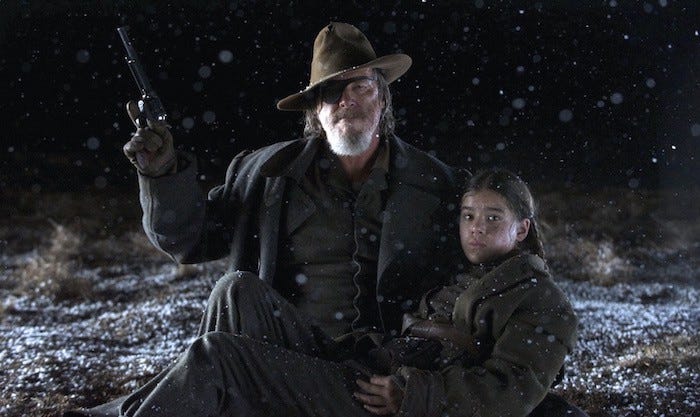
It’s a beautiful end point of Mattie’s innocence-to-experience journey: She starts off cocksure and assertive, lots of head-learning but minimal knowledge of the ‘real’ world. She leaves the Ordinary World of her family’s Arkansas farm and ventures into the New World, represented by the wilderness of the hunt for her father’s killer. Over time she opens up — slowly — to the assistance of others. In the end, she actually needs help, and help she gets from Cogburn who symbolically becomes her surrogate father.
Here are the lyrics of the hymn, which by the way is the song that’s sung when the end credits roll:
What a fellowship, what a joy divine,
leaning on the everlasting arms;
what a blessedness, what a peace is mine,
leaning on the everlasting arms.
Refrain:
Leaning, leaning,
safe and secure from all alarms;
leaning, leaning,
leaning on the everlasting arms.
O how sweet to walk in this pilgrim way,
leaning on the everlasting arms;
O how bright the path grows from day to day,
leaning on the everlasting arms.
(Refrain)
What have I to dread, what have I to fear,
leaning on the everlasting arms?
I have blessed peace with my Lord so near,
leaning on the everlasting arms.
How perfectly those lyrics fit Mattie’s hero’s journey. In the External World (Plotline), she pursues her conscious goal: find and kill Chaney, the man who murdered her father.
In the Internal World (Themeline), Mattie’s journey is about her metamorphosis from fierce independence to dependence on others, going from the disconnect of her existence as an adult-child, separating her from anyone else, to finding a connection, then ultimately trust with Cogburn. In a way, Cogburn becomes the Christ figure of the hymn.
That is why when Cogburn goes to the extraordinary lengths he does to save Mattie’s life at the end of the movie, we see the theme played out not in an intellectual way, but a powerful emotional fashion. During that three-minute series of scenes, there’s hardly any dialogue, almost all visuals, primarily of Mattie leaning into Cogburn’s shoulders (on horseback), then hanging from Cogburn’s arms (on foot).
It is the perfect resolution of this central theme. Here is a lovely video featuring the saga in brief accompanied by the hymn “Leaning on the Everlasting Arms” as sung by Iris DeMent:
The ironic thing is that Mattie, as an adult, does not change, at least discernably. As we see in the Denouement, she is still the fierce, independent woman she was as a 14 year-old. She might well have moved from her position of disconnect to other people to connection had it not been for the fact that her experiences on the trail with Cogburn [especially] as well as LeBouef were so profound, they became these sort of archetypal ideals to which no other humans could possibly compare. Who could she meet in life who could personify wisdom as much as Cogburn (Mentor) or cut as romantic a figure as LeBouef (Attractor), each representing aspects of her own psyche?
For the rest of her life, Mattie need only look at her missing forearm to be reminded every moment of every day of those pivotal experiences, so deeply seared into her consciousness. She had found a connection, all right. It was, however, with two powerful figures who dwarfed everything else that followed in her life.
It’s that type of texture, those kind of multilayered levels of interpretation and emotional meaning we think of as arising from a story’s themes.
We could choose to look at True Grit with the idea of theme as premise. Perhaps this: “Revenge takes a toll.” Or theme as DNA. Maybe this: “Mattie begins as an adult, then becomes a child.” Those are true in their own way.
But at its core, this story is about a relationship between Mattie and Rooster, the metamorphosis arc from their contentious beginning to her salvation as he carries the girl in his everlasting arms. That is a theme rife with emotional meaning.
All too often, writers approach theme as an intellectual exercise whereas it works best when we think of a story’s meaning — and specifically its emotional meaning — the various layers of psychological interplay between characters.
OVERVIEW
What is theme? Story premise? The moral of the story? A story’s DNA? This 1-week online class enables writers to develop a clearer and deeper understanding of theme — what it is, how it functions, and most importantly how to use themes to enrich your stories.
WHAT YOU WILL LEARN
An actionable definition of theme, using theme to expand a story, using theme to focus a story, theme as talisman, theme as motif, theme as moments, and multiple practical ways to enrich your writing by working with themes.
- You will learn a coherent take on theme, how it relates to the overall story, and tips on how to weave thematic material into your scripts.
- You will put to use what you have learned by workshopping some of your own script scenes, developing your ability at working with story themes.
COURSE DETAILS
- Six lectures written by Scott Myers
- Special insider tips
- 24/7 online forum discussions moderated by instructor
- Writing exercises with instructor and class feedback
- 90-minute live teleconference between instructor and class members
- Logline workshop.
WHO SHOULD TAKE THIS COURSE
Screenwriters, TV writers, novelists, and playwrights who want to learn a clear approach to theme and use that understanding to make their stories more resonant with readers.
TESTIMONIAL
“Your ‘Theme’ class for writers is not just helpful… it is essential.”
— Heather Thompson
SPECIAL OFFER: THE CORE PACKAGE
The Core Package gives you immediate access to all eight of Scott Myers’ Core classes for almost 50% off and enables you to go through all of the content on your own time! For more information, go here.
BENEFITS OF THE ONLINE EDUCATIONAL EXPERIENCE
- Access courses anytime and anywhere on your computer, tablet or smartphone.
- Learn the craft amidst a supportive, lively, and fun online community from around the world.
- Receive feedback from instructors who know the business and have a passion for teaching.
If you want to learn much more about the important subject of Theme, consider enrolling in my one-week Core VII: Theme class which begins Monday, April 8.