Theme as Motif
Stories have multiple themes ranging from a Central Theme and Sub-Themes to Talismans and Motifs.
Stories have multiple themes ranging from a Central Theme and Sub-Themes to Talismans and Motifs.
In my current one-week online Core class, we have studied the variety of ways theme can be expressed in a screenplay. One of them is Motifs. Here is an excerpt from my lecture on the subject:
Today we begin with a definition of the word motif: “A recurring subject, theme, or idea, especially in a literary, artistic, or musical work.”
Two examples of motifs: The recurring line “Quoth the raven nevermore” in Edgar Allan Poe’s poem “The Raven” and the first four notes in Beethoven’s 5th symphony.
Whereas a talisman is a physical object that takes on symbolic or emotional meaning, motifs are distinct in relation to screenplays in that they are more conceptual in nature, falling into three categories:
- Dialogue (words)
- Music (sounds)
- Visual (images)
Motifs are not only recurring narrative elements, but also ideas that convey their essence in a compressed form. If they appear as dialogue, they are typically short and to the point. Music, simple and memorable. Visuals, minimal and graphic.
Let’s explore the concept of motifs by looking more closely at each of these categories.
Motif as dialogue
On the one hand, there is dialogue used to convey a story’s central theme such as The Shawshank Redemption [“Get busy living, or get busy dying”].
The other extreme are setups, payoffs, and callbacks like “Parlay” in The Pirates of the Caribbean franchise: good bits of writing business, but not significant enough to qualify as a theme.
Then there is dialogue — recurring motif — that functions as a Sub-Theme or Adjunct Theme.
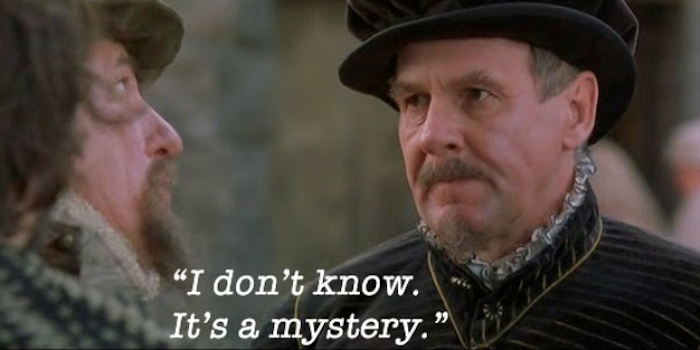
One example of a Sub-Theme occurs in Shakespeare in Love. Here are excerpts from four scenes:
FENNYMAN
So what do we do?HENSLOWE
Nothing. Strangely enough, it all turns out well.FENNYMAN
How?HENSLOWE
I don’t know. It’s a mystery.
Then:
WILL
We are lost.HENSLOWE
No, it will turn out well.WILL
How will it?HENSLOWE
I don't know, it's a mystery.
Then:
HENSLOWE
Juliet does not come on for twenty
pages. It will be all right.WILL
How will it?HENSLOWE
I don't know. It's a mystery.
Finally:
VIOLA
But all ends well.WILL
How does it?VIOLA
I don't know. It's a mystery.
In each occasion, the line — “I don’t know. It’s a mystery.” — has a different impact because of the varying contexts, all leading up to its final usage which drills home the point of this motif: If the central question posed in the story is can Will Shakespeare get his creative act together or not, we learn that all will end well. How? It’s a mystery.
In my view the mystery is best summed up as this: Will had to fall deeply in love, then lose that love to force him from living life on the surface, driving him into his inner self and his feelings of pain and heartache in order for him to become the great writer he has the potential to be. The motif noted above plays to the mystery of love, love lost, and their role in the creative process.
I asked the writers taking the Core: Theme course for other examples of motifs and Ron Drescher came up with a good one:
“In The Apartment the use of the recurring suffix ‘-wise’ is a motif for how the shortspeak in the corporate world degrades humanity. That motif is a great example, analysis-wise.”
My response:
Re the latter, the “-wise” jargon is grounded, as you note, in business-speak. My three favorite instances both involve Fran. In the scene in Bud’s office:
BUD
Miss Kubelik, one doesn't get to be
a second administrative assistant
around here unless he's a pretty
good judge of character -- and as
far as I'm concerned, you're tops.
I mean, decency-wise -- and
otherwise-wise.
Of course, he’s not picking up on how emotionally devastated she is at that precise moment having just learned that Sheldrake is a serial philanderer. Plus, I just love the “otherwise-wise” bit.
Then there’s the scene in which Sheldrake is out with Fran on New Year’s Eve:
SHELDRAKE
I didn't plan it this way, Fran --
actually, it's all Baxter's fault.
FRAN
Baxter?
SHELDRAKE
He wouldn't give me the key to the
apartment.
FRAN
He wouldn't.
SHELDRAKE
Just walked out on me -- quit --
threw that big fat job right in my
face.
FRAN
(a faint smile)
The nerve.
SHELDRAKE
That little punk -- after all I did
for him! He said I couldn't bring
anybody to his apartment --
especially not Miss Kubelik. What's
he got against you, anyway?
FRAN
(a faraway look in
her eye)
I don't know. I guess that's the
way it crumbles -- cookie-wise.
That line is a callback to a previous “cookie-wise” comment:
FRAN
(sleepily)
Why can't I ever fall in love with
somebody nice like you?
BUD
(ruefully)
Yeah. Well -- that's the way it
crumbles, cookie-wise. Go to sleep.
The third instance is in scene description in the very last paragraph of the script:
Bud cuts a card, but doesn't look at it.
BUD
I love you, Miss Kubelik.
FRAN
(cutting a card)
Seven --
(looking at Bud's card)
-- queen.
She hands the deck to Bud.
BUD
Did you hear what I said, Miss
Kubelik? I absolutely adore you.
FRAN
(smiling)
Shut up and deal!
Bud begins to deal, never taking his eyes off her. Fran
removes her coat, starts picking up her cards and arranging
them. Bud, a look of pure joy on his face, deals -- and
deals -- and keeps dealing.
And that's about it. Story-wise.
In all, screenwriters Billy Wilder and I.A.L. “Izzy” Diamond use -wise 24 times in their script including divorce-wise, newspaper-wise, police-wise, gratitude-wise, promotion-wise and gracious-living-wise. It’s a motif which starts as business jargon, but evolves to be used outside the office and in the context of interpersonal relationships, most notably Bud and Fran.
Let’s watch the movie’s ending one more time because it’s so damn good!
Takeaway: Stories have multiple themes. As we work with our characters and scenes start to emerge, make sure to put on your Theme Cap when viewing the material. Is a Central Theme coming into view? Do some of the subplots carry a Sub-Theme? Are there any physical objects — talismans — which carry symbolic or emotional meaning to characters? And look for any motifs which might come into play as recurring lines of dialogue.