Theme as Moments
“It should not be surprising that what we most often and most vividly remember about a movie is its key moments. It should also not be…
“It should not be surprising that what we most often and most vividly remember about a movie are its key moments. It should also not be surprising that moments are almost always imbued with a story’s themes, one of the reasons they are memorable.”
Theme = Meaning
That is the principle I teach in my screenwriting classes. Plot answers the question, What is the story about? Theme answers the question, What does the story mean?
But how to zero in on a story’s themes?
Sometimes we need to think about theme in a simple way, narrow the field of possibilities, clear away the clutter, and allow our story to convey to us its essential meanings.
In other words, we need moments.
What is a moment?
In terms of a movie or screenplay, moment has a precise meaning:
A specific point in time, the present time, that is of particular importance in the overall series of events in a story.
Let’s parse that out:
- A specific point in time: A moment can be constituted by a scene, but most often it is a sliver or slice, if you will, of a scene, a matter of mere seconds.
- The present time: Whereas an entire screenplay is written in the present tense, therefore creating a sense that what is happening is happening now, a moment represents an intensification of that experience. What is happening now is really happening now. Time seems to slow, even stand still for the characters — as well as the reader.
- That is of particular importance in the overall series of events in a story: Why does what is happening in a moment seem to be really happening now? Because what is happening is something significant, something influential, something that impacts character and plot.
It should not be surprising then that what we most often and most vividly remember about a movie is its key moments. It should also not be surprising that moments are almost always imbued with a story’s themes, one of the reasons they are memorable.
Let us consider three movie moments covering a range of genres and moods to see how those moments convey a sharp, clear articulation of the story’s themes.
Raiders of the Lost Ark
In this classic opening scene, we meet Indiana Jones as he enters an ancient temple in a quest to recover a precious golden idol, leading to a pivotal moment in the story:
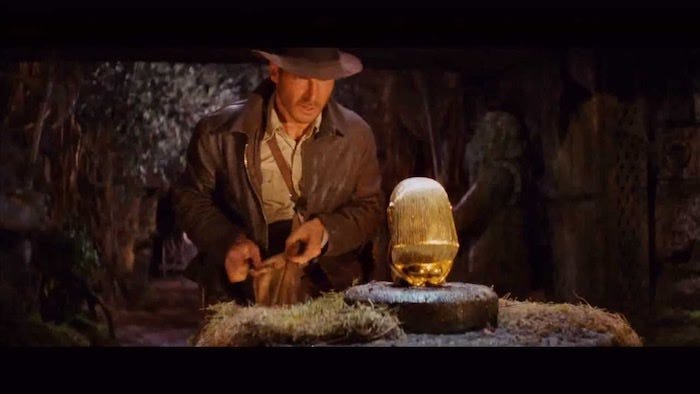
Indy nods, stands and looks around the sanctuary. The entire room is honeycombed with the same kind of hole. Satipo sees it too and is properly impressed.INDY
You wait here.SATIPO
If you insist, senor.Torch in hand, Indy begins his careful walk across the sanctuary. Stepping only on the white tiles, he almost appears to be doing a martial arts kata. Before each big move he waves the torch in front of him head to toe, looking at the flame. Halfway out, he sees something on the floor and kneels to look at it.A dead bird lies on one of the white tiles. Its body is riddled with little deadly darts. This has great significance to Indy and he stands with even greater caution. He waves the torch ahead of him and at waist height an air current whips at the flame. Indy ducks under it and leaves a burn mark on the white tile beneath it.Satipo watches, wide-eyed and mystified.Indy reaches the altar. The tiny idol looks both fierce and beautiful. It rests on a pedestal of polished stone. Indy looks the whole set-up over very carefully. From his jacket he takes a small, canvas drawstring bad. He begins filling it with dirt from around the case of the altar. When he has created a weight that he thinks approximates the weight of the idol, he bounces it a couple times in his palm concentrating. It's clear he wants to replace the idol with the bag as smoothly as possible. His hand seems ready to do that once, when he stops, takes a breath and loosens his shoulder muscles. Now he sets himself again. And makes the switch! The idol is now in his hand, the bag on the pedestal. For a long moment it sits there, then the polished stone beneath the bag drops five inches. This sets off an AURAL CHAIN REACTION of steadily increasing volume as some huge mysterious mechanism rumbles into action deep in the temple.Indy spins and starts his kata back across the sanctuary at four times the speed.Satipo's eyes widen in terror. He turns and runs.
The moment to focus on is when the polished stone drops “five inches,” the “aural chain reaction” and the “huge mysterious mechanism rumbles into action.” For this not only precipitates a series of eye-popping events and one of the most memorable action sequences to start a movie, it also conveys a key theme: Indiana Jones is smart, quick, and brave, but he also gets himself into trouble. We see this over and over with his character, and screenwriter Larry Kasdan sets that theme into motion from the very beginning of the first movie in the Indiana Jones franchise.
Takeaway: If you are having trouble zeroing in on the most fundamental themes in your story, look at the way you introduce your Protagonist. What is going on in the scene, scenes or sequence? What does the action say about the Protagonist? If you have put together a well-crafted opening involving your Protagonist, that should set into motion not only the Plotline, but also at least some of the story’s key themes.
Rear Window
Who can forget the moment in this classic Hitchcock film (screenplay by John Michael Hayes) where Jeff [through his apartment’s window ] watches Lisa snooping around in Thorwald’s apartment, only to see Thorwald return and enter through the front door:
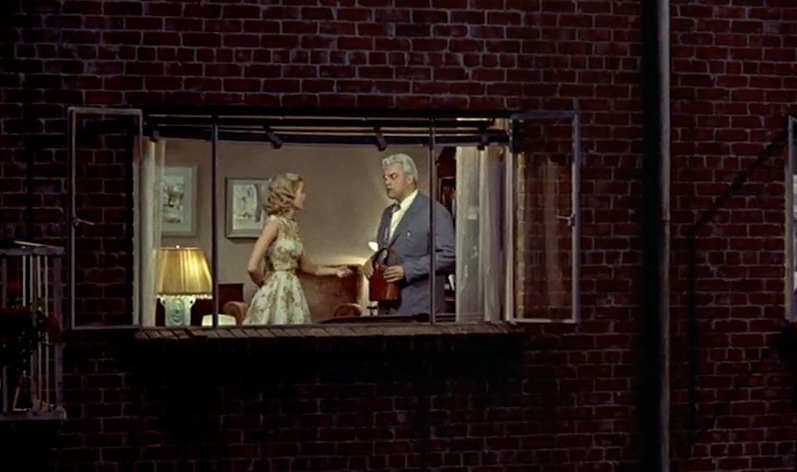
EXT. NEIGHBORHOOD - (NIGHT) - SEMI-LONG SHOTThorwald crosses the living room, and goes into the bedroom. Suddenly he looks onto the bed. He picks up the open alligator handbag. He turns, facing the window, looking down at the bag. He looks up in the direction of the living room. Then suddenly his whole frame stiffens, his head turns a little further around to his right. He is looking directly at Lisa who is out of our sight in the corner of the bedroom. He holds out the bag, and without moving, starts to question the unseen Lisa. He takes a little step forward, and his head begins to turn slightly to the left as Lisa begins to emerge into the living room, backing away slowly. By her gestures, and nervous laughter, she appears to be offering a lame excuse for being found in his apartment. He comes towards her, and enters the living room as well. Lisa edging toward the door, points to it as she apparently argues with him as to the way she came in. He points to the window. She makes one more step toward the door, but Thorwald reaches out quickly and grabs her by the wrist. He twists it brutally, and flings her sideways into the sofa beneath the window. Her head snaps back against the head rest. With his right hand he throws the handbag across the room in anger, and with his left open-palmed he demands something from Lisa. Slowly her right hand comes up and opens.He takes the jewelry from her, looks at it for a surprised moment, puts it into his coat pocket. He reaches down with both hands, and by the wrists jerks her to her feet. He is talking viciously to her. can hear Lisa calling out faintly: "Jeff! Jeff!" Thorwald suddenly looks out at the neighborhood. realizes that somebody might be watching him. He her across the room, reaches up with one arm, and lights go off. The faint light from the bedroom illuminates their struggle, but not clearly.INT. JEFF'S APARTMENT - (NIGHT) - CLOSEUPAn angry Jeff is staring, and trying to penetrate the semi-darkness of Thorwald's room. Then he bends his head forward in despair, and after a brief moment speaks:JEFF
(With deep sincerity)
Stella - what can we do?
One of the key themes of Rear Window is the helplessness Jeff feels cooped up in his apartment with a broken leg, and nowhere is that feeling more palpable than at this precise moment.
Takeaway: If you are having trouble zeroing in on the most fundamental themes in your story, consider the most dramatic or emotionally laden moment in your story. What are the emotions in play there? How are the emotions tied to the Protagonist and other characters? What your characters are feeling in a moment of heightened drama should point you in the direction of key story themes.
Casablanca
It is one of the most memorable moments in cinematic history: This exchange in the climactic airport scene.
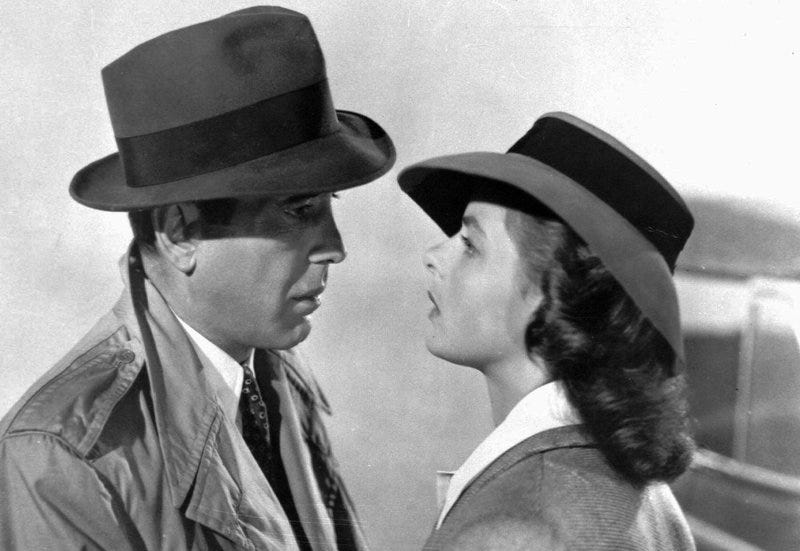
Rick: Last night we said a great many things. You said I was to do the thinking for both of us. Well, I've done a lot of it since then, and it all adds up to one thing: you're getting on that plane with Victor where you belong. Ilsa: But, Richard, no, I... I... Rick: Now, you've got to listen to me! You have any idea what you'd have to look forward to if you stayed here? Nine chances out of ten, we'd both wind up in a concentration camp. Isn't that true, Louie? Captain Renault: I'm afraid Major Strasser would insist. Ilsa: You're saying this only to make me go. Rick: I'm saying it because it's true. Inside of us, we both know you belong with Victor. You're part of his work, the thing that keeps him going. If that plane leaves the ground and you're not with him, you'll regret it. Maybe not today. Maybe not tomorrow, but soon and for the rest of your life. Ilsa: But what about us?
Rick: We'll always have Paris. We didn't have, we, we lost it until you came to Casablanca. We got it back last night.
Ilsa: When I said I would never leave you. Rick: And you never will. But I've got a job to do, too. Where I'm going, you can't follow. What I've got to do, you can't be any part of. Ilsa, I'm no good at being noble, but it doesn't take much to see that the problems of three little people don't amount to a hill of beans in this crazy world. Someday you'll understand that.
[Ilsa lowers her head and begins to cry] Rick: Now, now... [Rick gently places his hand under her chin and raises it so their eyes meet]
Rick: Here's looking at you kid.
This represents the moment where Rick finally commits to getting off the sidelines of life and in so doing rejects his cynicism, reconnects with his idealism, and rejoins the battle for good against injustice. Laszlo says as much later in the scene:
Laszlo: Welcome back to the fight. This time I know our side will win.
In subsuming his want [to be with Ilse] to his need [to reclaim his humanity], this moment serves as a window into Rick’s soul and a magnifying glass on the story’s central theme.
Takeaway: If you are having trouble zeroing in on the most fundamental themes in your story, go to the Final Struggle, specifically the moment where everything hangs in the balance. How does it resolve? What is the Protagonist psychological connection to that resolution? If your story is clearly articulated, the moment should not only work as an effective Plotline point, it should also be a direct conduit into some core thematic material. If the theme is not clear in the moment, perhaps it is a sign you have some more work to do on your characters and plotting.
Summary
A tried and true way to surface a story’s themes is to pick out key moments in time and explore what is going on in them — psychologically and emotionally.