The Weird Part About Looking Glass: All Of It
This is a VERY strange story of the bizarre circuitous route a script written in 1991 (!) has just now made its way into theaters as the…

This is a VERY strange story of the bizarre circuitous route a script written in 1991 (!) has just now made its way into theaters as the movie Looking Glass starring Nicholas Cage.
I’m just going to let my longtime friend Jerry Rapp tell this one.
Dear Scott,
Weird.
In 2012, I wrote to you about the strange similarities between a character in a bullfighting script I had just written, Ole’, and a real-life matador whose life unnervingly mimicked that of the fictional character. Without any prior knowledge that this person shared the same universe, I had somehow tapped into the zeitgeist… or collective unconscious… or just one of the many bajillion ideas existing under the sun. It was a truly mind-bending, art-imitating-life situation.
As it turns out, it was to be one of many such incidents in my career. And the latest is a real doozy:
1991 seems so long ago — because it was. I was in the midst of several life-changing events. I was beginning to — by choice — drift out of the writing factory I had found myself caught up in and gravitate to a more independent, bold and artsy existence. I was drunk on David Lynch, Alex Cox and a lot of other visionaries of the time. My marriage had unspooled and I took it very hard. After the separation, I jumped into the car with my dalmatian and hit the road, circling the country several times, not entirely aimlessly, but long enough to rival John Lennon’s infamous lost weekend.
The routine during this period was to drive until I was tired, find a cheap motel, crash for the night — or in some cases days — then hit the road again. It was lonely, and strange and disconnected, but led to some of the most profound insights and adventures of my life to date. While staying in these hovels — which had three stars only in exceptional cases — I felt like I was taking on the energy of these bizarre, transitory stations, often run by mysterious individuals, and I would sometimes get paranoid. There were a lot of reports at the time about motels with secret passages, peepholes and two-way mirrors, and I was convinced I was occasionally being peered upon — whether true or not. The hysteria was nurtured by my melancholy state, and the only way I could keep myself from spinning out was to write about it.
From this miasma, a screenplay emerged. I postulated what would happen if a character purchased a motel to get away from a tragedy, only to discover they had inherited a place with a murderous legacy. The experience would be fueled by a secret tunnel passage that led to a view from behind the mirror of Room Number 10. I was captivated by the metaphor of a window as a portal into the darker aspects of the psyche, and reflections serving as self-examination.
Throughout this gypsy period, I was voraciously writing, and generated an early version of the story and script, Looking Glass. In it, the story’s protagonist, Ray, discovers a passageway that allows him to spy upon anyone who checks into Room 10. At first this is a provocative escape from the mundane where he witnesses atypical sexual acts, and undertakes a curious study of the guests. But eventually Ray becomes embroiled in the mystery and dangerous secrets of the motel… and questions if he witnessed an actual murder or a macabre play.
Conceived nearly 30 years ago, Looking Glass was one of my first scripts and something I nurtured for many years. On prior occasions, the piece was optioned or otherwise attempted, but, like so many projects and for all kinds of reasons, the stars didn’t align. I didn’t feel in a hurry, as I was always off on other pursuits. I felt like I would wait for some other endeavor to come to fruition, then one day direct Looking Glass myself. Through the years I would revisit the script, tweak and update, as I strategized its time to come. In 2015, I had some interest from a friend who wanted to make the film on a small scale without name actors. I was about to go for it, as the film could, I believed, be a strong festival entry.
But another call came in around this time from a producer colleague who was carving out a name in the indie world. He had recently made connections with financiers who owned several motels and remembered my script. After the project had so many near misses, I was suddenly needing to choose a direction, though each scenario had its pros and cons. The producer had just worked on a film with Nicolas Cage and one day called to casually mention that he had gotten the script to Nic and he was interested. The news tilted that scenario’s pro side substantially, and I went with the opportunity to see one of my favorite actors uttering my words. Nic committed and the journey began. The production started to staff and lock additional funding. One day, texted me this link to an article from the New Yorker. Entitled ‘Gay Talese On The Voyeur’s Motel’, it begins with the following:
“I know a married man and father of two who bought a twenty-one-room motel near Denver many years ago in order to become its resident voyeur. With the assistance of his wife, he cut rectangular holes measuring six by fourteen inches in the ceilings of more than a dozen rooms. Then he covered the openings with aluminum screens that looked like ventilation grilles but were actually observation vents that allowed him, while he knelt in the attic, to see his guests in the rooms below. He watched them for decades, while keeping an exhaustive written record of what he saw and heard. Never once, during all those years, was he caught.”
The article goes on to describe the ‘real-life’ account in which a compulsive voyeur, Gerald Foos, set up an observation walkway in a Colorado motel to watch guests from behind ventilation grills. He sent several journal entries to Talese relating his accounts. He claimed to have witnessed a murder take place inside room number 10.
My jaw was on the floor. I was flipped out for so many reasons. I called the producer to discuss it. If he had any concern he hid it well, but did agree it was all very odd. He knew the long existence of this script, so wasn’t worried about someone thinking I had cranked it out upon reading the Talese account — which hadn’t been known until the article. We joked that at some point I might be trying to, as the colloquialism goes, “steal my own idea back.” That evening I scrounged through some archaic hard backup storage and located all the early drafts and treatments of Looking Glass — stored on floppy discs. I sent him a photo of them. He texted back something like, “What are those?”
The Cage project rumbled forward, with a couple of treacherous passages along the way. Then, one day, my faithful Google alerted me to a Variety article which starts:
“Steven Spielberg is producing a movie version of Gay Talese’s upcoming novel “The Voyeur’s Motel” for DreamWorks with Sam Mendes directing.”
It was all or nothing, Looking Glass now racing against the likes of Spielberg and Mendes. Fortunately our production had a head start, but was navigating a substantial personnel shift and changes from the original script. If anyone lost their footing, the project could have stalled. And if the adaptation became embossed as the mainstream ‘voyeur film,’ Looking Glass, no matter how long ago conceived, might have a hard time not being perceived as a ‘knock off.’ It was a nagging few months, and it became necessary to keep it in the back of my mind. Then, another twist:
“The movie adaptation of the Gay Talese book The Voyeur’s Motel that Sam Mendes planned to direct and produce with Steven Spielberg at DreamWorks has just been killed.”
The article reports that Mendes and adapting screenwriter Krysty Wilson-Cairns, and for that matter, Dreamworks, were blindsided by the existence of a documentary by filmmakers Myles Kane and Josh Koury, entitled Voyeur.
In the film, Kane and Koury document a dispute of credibility between Talese and Foos. The filmmakers were anxious for festival and distributor consideration. Mendes felt that he could no longer make the film he envisioned and the project lost steam. Later, Talese would dispute Mendes’ account, and maintain that the documentary mainly chronicled the dispute but didn’t tell Foos’ story, whether real or fabricated.
Meanwhile, Looking Glass found all its pistons, completed filming last February in Utah and debuts almost exactly a year later. It was a thrill to watch an iconic actor whose sticker image of Sailor Ripley had once been on my guitar case traipse through sets and words from my imagination, supported by a small but mighty crew and helmed by the maker of The River’s Edge. Nic had fashioned his character as a bearded fellow with retro glasses and receding hairline. Someone you might find to be creepy if sitting behind the wheel of a van outside your house. Or behind the desk of a motel. Or behind a mirror. Someone whose appearance would more than suggest there’s something being hidden.
I reel over this for all the reasons that any writer toe-tapping into the zeitgeist can relate to: You get struck with something, start to conceive it, and somewhere along the chain of atomic particles, mixed with timely relevance, someone else, somewhere, thinks of similar notions… or vice versa. I also know I checked into a lot of off-the-beaten path places during my wanderings, while Looking Glass was bubbling through me. I sometimes wonder if I might have inadvertently been a guest in the real-life counterpart of my story, in the form of the Manor House. Sometimes I really wish I had kept all my receipts from back then.
As of this writing, I have neither read “The Voyeur’s Motel” nor have seen the documentary, although both are intriguing the hell out of me. I’m momentarily avoiding both, I think, because the subject matter is surrounded with so much past and present strange energy which continues to unfold, and the saga has reached something of a personal nadir. But as soon as Looking Glass is available to the public, I plan to catch up on some long anticipated viewing and reading.
As a parting observation, and adding to the uncanny of it all, note the appearance of the character of Ray, relayed by Mr. Cage, and Gerald Foos, relayed by Mr. Talese:
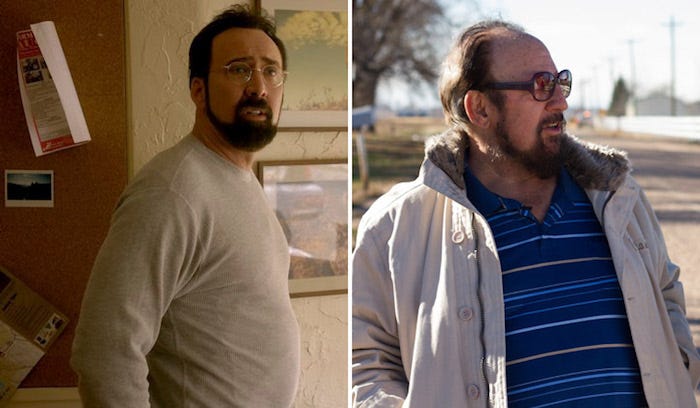
Can you tell them apart?
Okay, but still… weird, huh?
Apart from the weird twists and turns the movie took getting produced, here’s a big takeaway: A completed screenplay is an asset, even if it doesn’t sell. Because even if you wrote something nearly 30 years ago, it can get produced… just like Looking Glass.
Here is the trailer for the movie:
The Tao of Nicolas Cage: Voyeurism and Murder Wait Behind the ‘Looking Glass’ (Film School Rejects).
Looking Glass, co-written by Jerry Rapp, is directed by Tim Hunter and stars Nicolas Cage and Robin Tunney. It opens February 16 in select theaters and on demand.