The Virtues of Non-Linear Writing
If you’re stuck with a story, try this: Write whatever scenes you want.
If you’re stuck with a story, try this: Write whatever scenes you want.
If you hear the phrase “non-linear storytelling” in reference to movies, you’ll probably think of this:
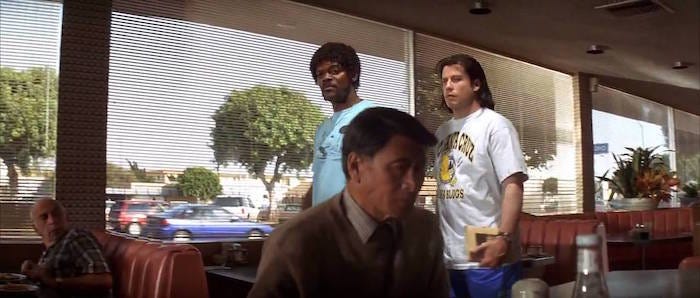
Pulp Fiction, one of the most famous non-linear stories in cinema history. This is a shot from the last scene, but of course we know that Vincent, the character played by John Travolta, is ALREADY dead. Why? Because the story is told out of chronological order. This has led to a slew of analyses complete with graphs and charts like this:
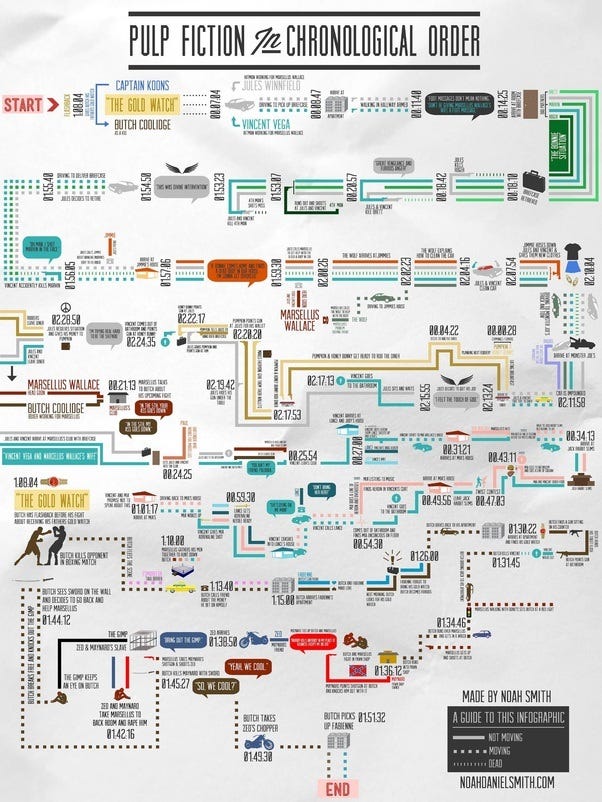
I don’t want to talk about non-linear storytelling in Pulp Fiction (if you’re interested, you can read my analysis of the movie here). What I’d like to get into in this post is the concept of non-linear writing.
The subject arose in a Pages I: Writing the First Draft online workshop. One of the writers in the group turned in pages the first couple of weeks, but the writing was not hitting the mark creatively. It felt forced and with the exception of a few scenes rather uninspired.
In one of our early weekly teleconferences, I inquired about his process and he admitted he wasn’t really ‘feeling it’ with the pages he had produced. After awhile of talking it out, I suggested this:
Why don’t you just write whatever scenes you WANT to write? Don’t worry about the order, don’t be concerned with the story’s chronology. Pick out your favorite scene, write that, see how that feels. Then go to the next scene you feel like doing and write that.
It took a bit of convincing, but off he went. After a week, he turned in a set of scenes which jumped all over the story’s chronology. But you know what? Those scenes SANG! They were vibrant, flush with feeling, colorful and cinematic. In that next teleconference, the writer said he felt so much better as he was connected to each of the scenes he wrote. So I said:
Keep doing it.
He did. The pages he produced nailed the tone, tenor, and feel of the script. He went on to finish that script… and this is something he’s been trying to write for at least 2 years.
There’s no RULE saying you HAVE to write a story in linear fashion. I’m not talking about non-linear structure, rather about the order of scenes we write. It makes a certain amount of sense — especially as you begin a writing project — to start with scenes you KNOW, scenes you are EXCITED about, scenes you really WANT to write. That gets the writing process off to a strong start. Good energy. Plus, it’s more likely you tap into the essence of the story and our emotional connection to it.
Obviously you need to write the interstitial scenes, the harder ones, the ones for which you may not have as much enthusiasm as for the ones you want to write, but maybe by getting charged up by the other scenes, you can bring some of that positive energy to bear on the rest of story’s content.
So the next time you get stuck writing a story or your writing feels uninspired, maybe you don’t need to keep pounding your head against a virtual wall. Maybe you pick out a favorite scene you’ve yet to write…
And do that!
Anybody here write out of chronological order? If so, would love to hear your thoughts. Click RESPONSE and let us know your impressions.