The Thing With Coincidences in Movies…
If you have more than one, you’ve got to finesse your way around them.
If you have more than one, you’ve got to finesse your way around them.
When I broke into Hollywood as a screenwriter in 1987 selling my spec script K-9 to Universal Studios, I did everything I could to soak up knowledge about the craft. Books. Lectures. Panels. Interviews. Movies. Scripts. Those first few years were the equivalent of my film school education.
Along the way, I hit upon this Hollywood truism: “You’re only allowed one coincidence per movie.” Of course that meant as a screenwriter, I could only count on one coincidence per script. Anything more would prove problematic.
You may ask, “What’s the big deal? Why not two coincidences?”
One coincidence pretty much falls under the umbrella of Fate, the intersection of characters and events which is a natural part of the narrative.
That second coincidence? Since the first coincidence is tethered to Fate, the next one will come across more like writer’s convenience. Instead of flowing organically from the narrative, it will likely come feel like the writer is orchestrating events to make certain things happen. Not the characters. Not the confluence of plot elements. The writer pushing and prodding events to fit the writer’s perception of the story’s plot.
You do not want to be guilty of writer’s convenience for many reasons, not the least of which is it yanks the reader out of the story universe when they swat palm of hand onto forehead and proclaim, “ Writer’s convenience!!!”
This is why an addendum to the original Hollywood adage — “You’re only allowed one coincidence per movie” — is this: “If you’re going to have a coincidence, might as well make it a BIG ONE!”
Case in point: Little Miss Sunshine.
The dysfunctional Hoover family takes off from Arizona to Southern California so Olive can participate in the Little Miss Sunshine beauty pageant. Along the way, they stop at a gas station. Grandpa Edwin Hoover has this exchange with Frank:
Frank, who is gay, heads off to buy some “porn” as requested by Grandpa, who also suggests Frank pick up some “fag rag”.
Background: Frank is recuperating from an attempted suicide. Why did he try to kill himself? Because he discovered that his young lover had rejected Frank for another lover, an academic who was the #1 Proust scholar in the world. Frank is considered to be the #2 Proust scholar.
So what happens in the gas station which is stuck WAY OUT IN THE MIDDLE OF NOWHERE?!?!
A sports car pulls up and while Frank — who AGAIN for the record is gay — pays for Grandpa’s hard core HETEROSEXUAL porn magazine, who should waltz into the convenience store but no other than Frank’s ex-young lover.
HUGE COINCIDENCE!
Moreover who is driving the sports car? None other than the #1 Proust scholar and romantic arch-rival to Frank.
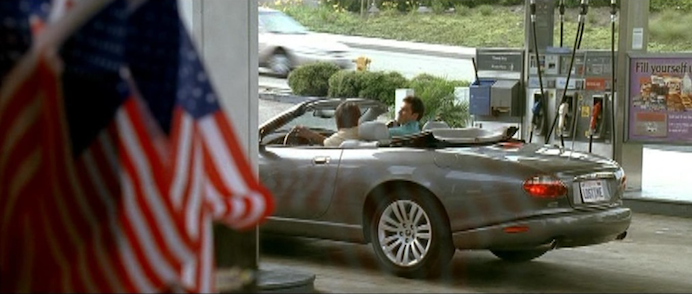
The pair careens away, chortling at Frank who has been awkwardly attempting to hide Grandpa’s busty hetero porno magazines from his former lover and lie about his career choice (he’d been fired, not quit).
So ginormous coincidence. And perhaps the script could have gotten away with it on its own merits, but according to one of my Screenwriting Master Class writers, Arndt has another explanation why this scene works:
It’s a bad coincidence. The intersection of these characters is not a positive event which HELPS Frank, but rather rubs salt in the wound, drives him closer to despair.
That makes total sense: How could a script feel like writer’s convenience if what transpires actually works against the wishes of a key character?
Therefore:
- You are only allowed one coincidence per script
- If you’re going to have a coincidence, might as well make it a big one
- Avoid writer’s coincidence by making it a bad coincidence
But wait, there’s more. According to another one of my Screenwriting Master Class participant, Aaron Sorkin said a writer can get away with coincidences if characters acknowledge they are coincidences. A perfect example:
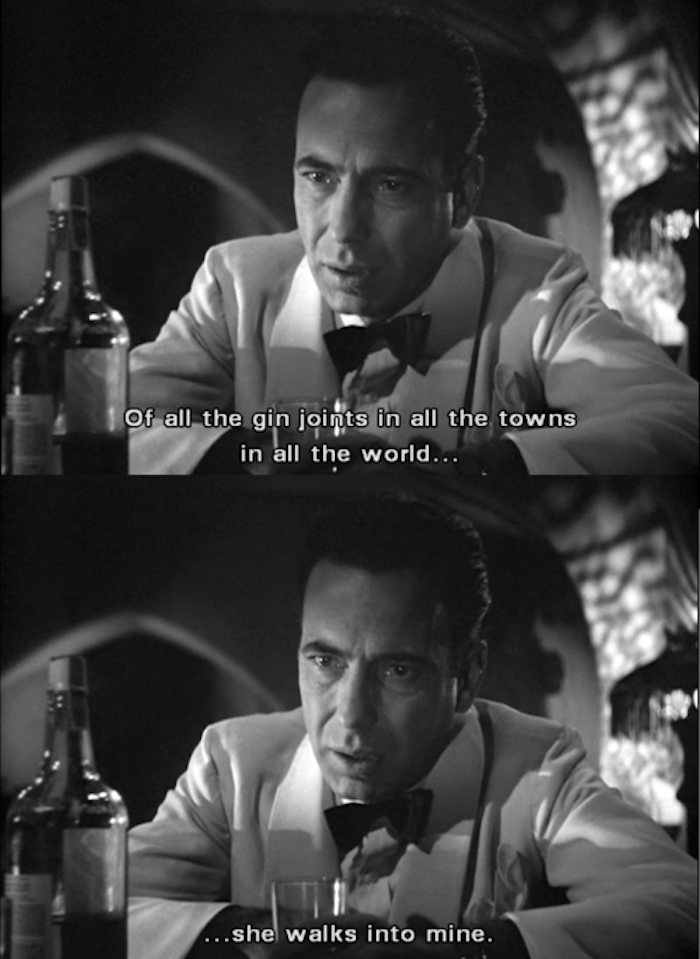
“Of all the gin joints, in all the towns, in all the world, she walks into mine.”
Rick’s lover. Who left him jilted at a Paris train station. Which led him to scurry off to the edge of civilization in Casablanca. Then several years later who should suddenly stride into his bar? Ilse.
Why North Africa? Why Casablanca? Why THIS nightclub?
It’s a HUGE coincidence. But it’s also the only one in the script. And it’s a BAD coincidence, something Rick definitely doesn’t want, which justifies part of the scene’s existence.
But the larger point is this: Rick NEEDS it. It HAS to happen.
Therefore per Sorkin, a character should simply state it in dialogue. Rick’s side acknowledges the ironic nature of Fate. And in so doing minimizes the influence of writers convenience. It’s Rick’s narrative imperative, he HAS to deal with his past which means Ilse MUST appear in his present.
Thus we can add this wisdom:
- You are only allowed one coincidence per script
- If you’re going to have a coincidence, might as well make it a big one
- Avoid writer’s coincidence by making it a bad coincidence
- If you have a coincidence, have a character acknowledge it in dialogue
There you are, advice from Hollywood of old, Michael Arndt, and Aaron Sorkin. That’s not a coincidence…
That’s Fate.