The Theology of Cinema: Hell
“What if we think of Act Two as Hell?”

“What if we think of Act Two as Hell?”
As many of you may know, I have a background in the academic study of theology, a B.A. in religious studies from the University of Virginia and a Masters of Divinity degree from Yale. So it is only natural I bring that perspective to how I view and understand movies and screenwriting.
Let me be clear, when I say theological, I mean it — in this context — in a secular way. How does that make sense?
The word “theology” is a combination of two Greek words: “theos” which means God and “logos” which means word. So theology is words about God. What if for this series we think of God as a metaphor for an explanation for the big questions of life? Thus, theology as words about the meaning of life. Broadly speaking that is one dynamic movies hit on consistently, characters forced to confront their values, behaviors, and world views related to who they are and how they should act.
In this respect, movies and theology wade in very much the same thematic waters. As Andrew Stanton noted about Lawrence of Arabia in this TED Talk, how the central theme of that story is the question asked of the Protagonist “who are you,” that issue exists at the core of perhaps every movie, an existential exploration of a character or characters’ self-identity. So, too, with theology.
Also, movies tend to be about characters at critical junctures in their lives, facing a journey from the Old World into a New World where through a series of challenges and lessons they undergo a significant metamorphosis. Sounds an awful lot like a conversion experience to me.
Thus, it is only natural there will be a lot of crossover of theological themes in movies. But while a theological theme in a movie may have a religious or spiritual connotation, I am more interested in exploring such themes metaphorically to find the widest value possible for screenwriters at large.
By working with this non-religious take on the concept, we can avail ourselves of numerous powerful theological themes in screenwriting regardless of whether our stories are secular or non-secular.
Today: Hell.
When you think of a theological concept of Hell, you may conjure up an image something like this:
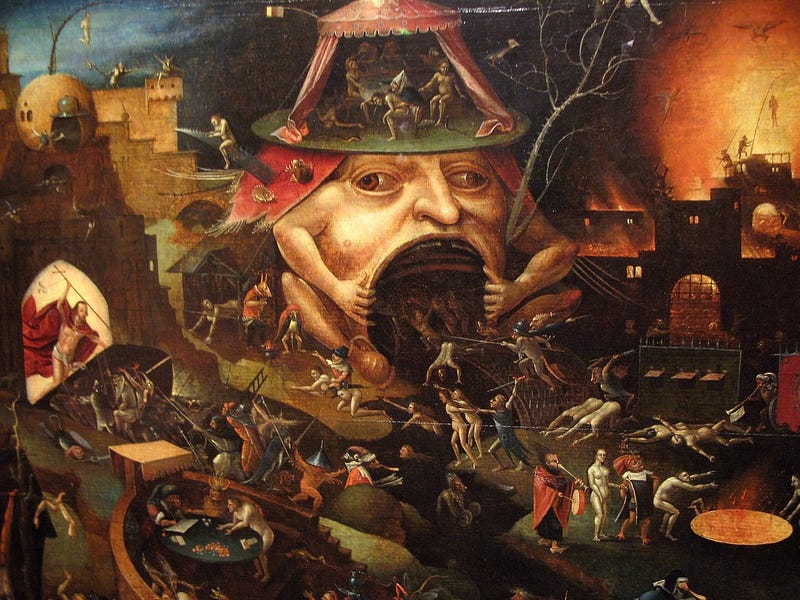
In actuality, Hell has a few meanings in the Judeo-Christian tradition. Whether the Greek Ἅιδης” or the Hebraic term She’ol, both refer to an abode for the dead. Then there are Biblical verses such as Matthew 25:41 which says, “Then He will also say to those on His left, ‘Depart from Me, accursed ones, into the eternal fire which has been prepared for the devil and his angels.” We can extrapolate metaphorical meaning from both of those as it relates to screenwriting.
What if we think of Act Two as Hell?
Consider the broad contours of The Hero’s Journey. Three movements: Separation. Initiation. Return.
The Hero begins in the Old World what screenwriters may think of as the character’s life leading up to FADE IN. The Hero has cobbled together an existence, a combination of beliefs and behaviors, coping skills and defense mechanisms. Whatever one can say about them, psychologically or even spiritually, they are making do, but living an inauthentic life, a state of Disunity because there is a fundamental disconnect between how they are approaching their existence and their Core Essence.
If, as Joseph Campbell suggests, the point of life is to follow your bliss, that part of who we are that is real, vitalizing and empowering, the Protagonist is not doing that in the Old World. Hence the Call To Adventure.
So the Protagonist separates from that Old World [and Old Ways Of Being] and by going on their Journey enters a New World. Symbolically this is an initiation and serves as a process that sheers away behaviors and beliefs, enabling them to get in touch with and eventually [hopefully] embrace their Core Essence which becomes the foundation of their Unity self.
Psychologically speaking that is the function of Act Two, what I call Deconstruction and Reconstruction.
How does Hell tie into this thematically?
Abode for the dead: When a Protagonist enters this New World and experiences trials and tribulations, in effect they put to death their Old Way of being. That life they stitched together leading up to FADE IN is found wanting. Indeed the experiences of this initiation into the New World is the only path through which their Core Of Being can emerge from the depths of their unconscious and emerge into the light of consciousness, thus leading the way toward Unity. So in one respect, Act Two is about putting the Old Self to death.
Fire: There is a verse in Malachi [3:2] which talks about a “refiner’s fire.” Think about that imagery for a moment.

A fire that purifies precious metals. The ‘fires’ of Act Two ‘burn’ away the impurities of a Protagonist’s Old Self allowing the character to see clearly, realize and embrace their Authentic Nature.
Death. Fire. An interesting way to think of the ordeals which a Protagonist must endure in Act Two, and from a writing experience inspire us to make their life a Living Hell.
Consider Arthur Fleck’s experience in the movie Joker.
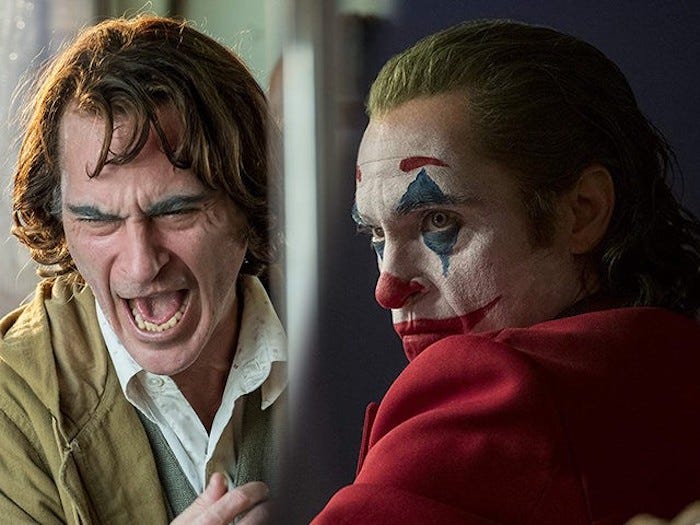
Here is a chronology of the events he endures in Act Two:
- Funding is cut, so Arthur loses access to the social worker who not only provides a listening ear, but also access to his needed prescription drugs.
- He has a disastrous turn at a stand-up comedy open mic appearance.
- He learns from an intercepted letter written by his invalid mother Penny that Thomas Wayne is his father.
- He scuffles with Alfred at the Wayne manor.
- Penny suffers a stroke and ends up in a coma in the hospital.
- Childhood idol and TV late night show host Murray Franklin plays a video of Arthur’s failed stand-up routine, openly mocking Arthur.
- Arthur confronts Thomas Wayne who tells him his mother is psychotic, she has lied about him (Wayne) being Arthur’s father, then punches Arthur in the face.
- Arthur steals his mother’s case file from a state hospital and not only learns she was lying, she failed to stop an ex-boyfriend from physically assaulting Arthur when he was a child.
- Arthur discovers that his supposed romance with Sophie is nothing more than a fantasy.
- Confronting his mother who is still in a coma, Arthur smothers her with a pillow killing her.
- Visited by a former co-worker Randall — who set up Arthur to be fired — Arthur stabs and murders him.
Notice the trajectory of Arthur’s ‘descent into Hell’ and how it leads him directly into his shadow, the powerful, malevolent part of his psyche, laying the groundwork for what transpires in Act Three.
Takeaway: Look at the middle of your story as a series of events which growing in scope increasingly test your Protagonist, stripping away their Old Ways of Being and in the process revealing what lies at the core of the character’s psyche. This is what needs to emerge into the light of consciousness and become the foundation for the Protagonist’s New Self.
For more articles in the Theology of Cinema series, go here.