The Theology of Cinema: Forgiveness
“When someone does something wrong to us, it hurts, but the longer we live in that space, it becomes more like a prison, chained to the…
“When someone does something wrong to us, it hurts, but the longer we live in that space, it becomes more like a prison, chained to the anger and bitterness we harbor against our transgressor. Sometimes the only way to move forward is to forgive.”
As many of you may know, I have a background in the academic study of theology, a B.A. in religious studies from the University of Virginia and a Masters of Divinity degree from Yale. So it is only natural I bring that perspective to how I view and understand movies and screenwriting.
Let me be clear, when I say theological, I mean it — in this context — in a secular way. How does that make sense?
The word “theology” is a combination of two Greek words: “theos” which means God and “logos” which means word. So theology is words about God. What if for this series we think of God as a metaphor for an explanation for the big questions of life? Thus, theology as words about the meaning of life. Broadly speaking that is one dynamic movies hit on consistently, characters forced to confront their values, behaviors, and world views related to who they are and how they should act.
In this respect, movies and theology wade in very much the same thematic waters. As Andrew Stanton noted about Lawrence of Arabia in this TED Talk, how the central theme of that story is the question asked of the Protagonist “who are you,” that issue exists at the core of perhaps every movie, an existential exploration of a character or characters’ self-identity. So, too, with theology.
Also, movies tend to be about characters at critical junctures in their lives, facing a journey from the Old World into a New World where through a series of challenges and lessons they undergo a significant metamorphosis. Sounds an awful lot like a conversion experience to me.
Thus, it is only natural there will be a lot of crossover of theological themes in movies. But while a theological theme in a movie may have a religious or spiritual connotation, I am more interested in exploring such themes metaphorically to find the widest value possible for screenwriters at large.
By working with this non-religious take on the concept, we can avail ourselves of numerous powerful theological themes in screenwriting regardless of whether our stories are secular or non-secular.
Today: Forgiveness.
There is Sin. There is Guilt. But there is also Forgiveness. This idea is right there in the Lord’s Prayer: “Forgive us our sins, as we forgive those who sin against us.”
In Matthew 18:20–22, there is this exchange: “Then Peter came to Jesus and asked, ‘Lord, how many times shall I forgive my brother or sister who sins against me? Up to seven times?’ Jesus answered, ‘I tell you, not seven times, but seventy times seven.’”
Whatever one may think of Jesus, there is a powerful insight in these words. As theologian Frederick Buechner writes in his book “Wishful Thinking”:
When somebody you’ve wronged forgives you, you’re spared the dull and self-diminishing corrosion of bitterness and wounded pride.
When you forgive somebody who has wronged you, you’re spared the dismal corrosion of bitterness and wounded pride.
For both parties, forgiveness means the freedom again to be at peace inside their own skins and to be glad in each other’s presence.
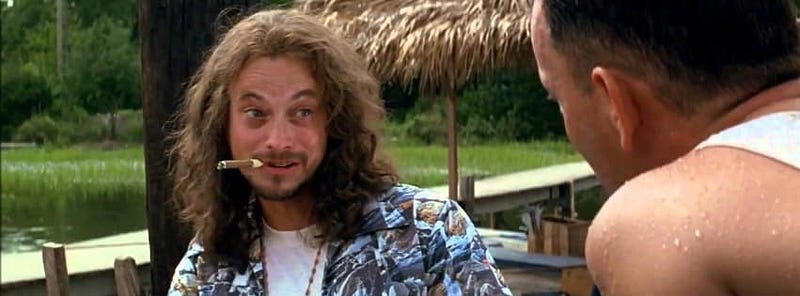
I can think of no greater illustration of this in movies than the relationship of Forrest to Lieutenant Dan in Forrest Gump.
When Forrest is shipped to Vietnam, his commanding officer is Lieutenant Dan Taylor. Upon their first meeting, Forrest notes:
Lieutenant Dan knew his stuff. I felt real lucky he was my lieutenant. He was from a long, great military tradition. Somebody in his family had fought and died in every single American war.
Dan Taylor believed that was his destiny. Yet when gravely wounded, Forrest saves his C.O.’s life. Here is Lieutenant’s response when facing recovery in a hospital after losing his legs:
Soon thereafter Lieutenant Dan confronts Forrest:
Now, you listen to me. We all have a destiny. Nothing just happens. It’s all part of a plan! I should have died out there with my men, but now, I’m nothing but a goddamn cripple, a legless freak! Look. Look! Look at me! You see that? Do you know what it’s like not to be able to use your legs? Did you hear what I said? You cheated me! I had a destiny. I was supposed to die in the field with honor! That was my destiny, and you cheated me out of it!
Much later after a New Year’s Eve when Lieutenant Dan has hit rock bottom, then Forrest has started his shrimping business, this happens:
And then eventually this:
“Forrest, I never thanked you for saving my life.” That is a statement of forgiveness. And in coming to a place — beyond his grief, beyond his rage, beyond his sense of humiliation — where the Lieutenant could utter those words, he found something he had not known since before those terrible days in Vietnam, perhaps never before. As Forrest says:
He never actually said so, but I think he made his peace with God.
When someone does something wrong to us, it hurts. For awhile, it may feel empowering to allow ourselves to embrace that sense of hurt. But the longer we live in that space, it becomes more like a prison, chained to the anger and bitterness we harbor against our transgressor. Sometimes the only way to move forward is to forgive.
A character coming to a place where they can forgive someone else? That has the potential to be a powerful storyline providing a clear arc from beginning to end.
For more Theology of Cinema articles, go here.