The Shawshank Redemption: Red as Protagonist
My take is The Shawshank Redemption is an example of a Dual Protagonist story. Here is an analysis of the movie with Red as a Protagonist…
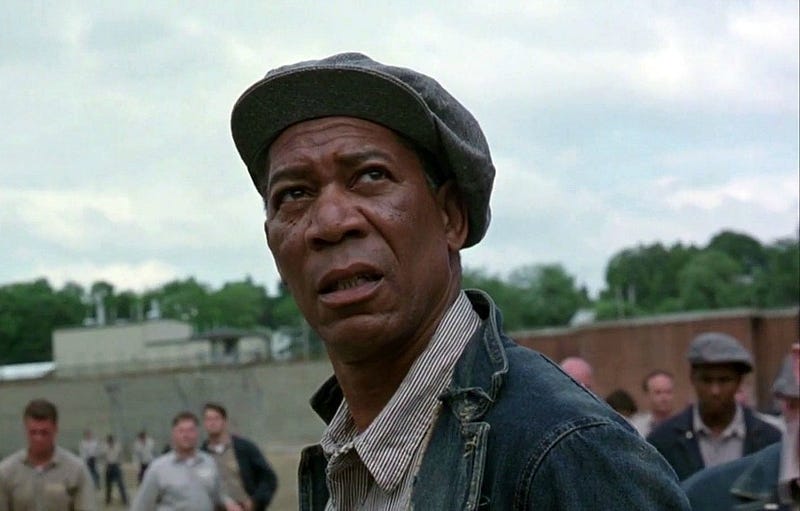
My take is The Shawshank Redemption is an example of a Dual Protagonist story. Here is an analysis of the movie with Red as a Protagonist figure.
I choose to look at Andy and Red as Dual Protagonists. That is you can look at the story through either of their eyes.
Archetype line-up:
Andy
Protagonist = Andy
Nemesis = Warden Norton, The Sisters
Attractor = Tommy
Mentor = Red
Trickster = Captain Hadley
Red
Protagonist = Red
Nemesis = Institutionalization
Attractor = Andy
Mentor (Negative) = Brooks
Trickster = Freedom
Looking at Shawshank through Red’s eyes as the story’s Protagonist shifts everything — including the various character archetype functions.
As a Protagonist, what is Red’s Disunity state? Simple. He has a heart, a brain, a pulse, so in the most basic sense of the word, he is ‘alive,’ but when we meet Red, he is a man who has given up hope. Witness this exchange between Red and Andy after Andy has emerged from solitary confinement after the Mozart opera sequence:
ANDY
That there are things in this world
not carved out of gray stone. That
there's a small place inside of us
they can never lock away, and that
place is called hope.RED
Hope is a dangerous thing. Drive a
man insane. It's got no place here.
Better get used to the idea.
“It’s go no place here.” Red’s Disunity is he’s alive — but hopeless, stringing out his days in prison with no exit strategy other than his eventual demise.
What has squashed Red’s hope? What has turned him into such a cynic? This character is his Nemesis, standing in the way of Red and the goal he shares with all his fellow inmates: Getting the hell out of Shawshank. And who is keeping Red from that goal? Red confesses the truth when he tries to explain why Brooks (James Whitmore) freaked out when told he was being let out of prison:
RED
Believe what you want. These walls
are funny. First you hate 'em, then
you get used to 'em. After long
enough, you get so you depend on
'em. That's "institutionalized."
Institutionalization. That is Red’s Nemesis. The daily grind of trying to survive in prison has forced Red to accommodate himself to his environment. He knows prison life, he knows Norton, Hadley, the prisoners, the very walls of Shawshank; in fact, he knows all of it so well that he is the go-to guy to procure what people need (“a man who knows how to get things”). And the most telling line in his ‘confession’ above is this: “After long enough, you get so you depend on ’em [i.e., the walls].” Does that sound like a man who is taking up the battle against his Nemesis? Instead it feels like Red has given up — or nearly so. The Nemesis — institutionalization — has ground down his hope to the merest wisp of a flicker suppressed deep down inside his dark soul.
Enter Andy — Red’s Attractor. If Red personifies cynicism and hopelessness, Andy determines to cling to hope. So if we were to examine Red’s relationship with Andy, in the External World, Red “liked Andy from the start,” became curious about this most different inmate as he procured his rock hammer and poster of Rita Hayworth, finagled suds on the roof for Red and his fellow inmates, and played Mozart over the prison P.A. system. But in the Internal World, their inter-dynamic is all about hope: Will Red respond to Andy’s clarion call to claim hope, cling to it for everything worth living, or yield to the ever-relentless life-sucking power of Shawshank’s walls and institutionalization? In other words, is Red’s ‘attraction’ to Andy and what he represents (philosophically) greater than Red’s hopelessness?
Into this mix comes Red’s Mentor character: Brooks. Brooks who Red understands, a fellow patient afflicted by insititutionaliztion. Brooks achieves Red’s ostensible goal — freedom. And what does Brooks do? He can not cope with life ‘out there,’ and commits suicide. Why is Brooks Red’s Mentor? Because Brooks carves a path for Red, indeed the very same town, the very same room, and the very same job that Red experiences later when he’s set free. Brooks’ suicide is the act of a Dark Mentor / Wisdom, a projection of Red’s own cynicism — if Red has really given into hopelessness, why not kill himself — offering one way to resolve things.
And Red’s Trickster? Freedom. He finally gets what he wants — leave Shawshank. But like Brooks, he can not handle life outside those damn prison walls. He is tempted to follow Brooks’ path except for one thing:
INT -- RED'S ROOM -- NIGHT 288Red lies smoking in bed. Unable to sleep.RED (V.O.)
Terrible thing, to live in fear.
Brooks Hatlen knew it. Knew it all
too well. All I want is to be back
where things make sense. Where I
won't have to be afraid all the time.He glances up at the ceiling beam. "Brooks Hatlen was here."RED (V.O.)
Only one thing stops me. A promise
I made to Andy.
At that existential pivot point in Red’s life — accept the hopelessness which has been his consort all those years in prison and follow the path of his Dark Mentor Brooks toward death or believe in Andy enough to claim the tiny flicker of hope sputtering inside his soul — Red opts to follow Andy. Freedom provides the ultimate test. And it comes down to: “Get busy livin’, or get busy dyin’.”
Red chooses the way of his Attractor — Andy. He chooses hope. In fact, here are the last lines of dialogue in the movie:
RED (V.O.)
I hope I can make it across the
border. I hope to see my friend
and shake his hand. I hope the
Pacific is as blue as it has been
in my dreams.
(beat)
I hope.
“I hope.” Therein marks the end point of Red’s transformation: From hopelessness to hope. His reunion with Andy on that beach in Mexico signifies the beginning of his Unity state. In a battle for his soul, his Attractor (Andy) helped Red defeat his Nemesis (Institutionalization) and the call of his Negative Mentor (Brooks).
The Shawshank Redemption. The story of two Protagonists. Each with their own transformation arc. Each intertwined together.
And one of the great movies — and screenplays — of all time.
Seriously, I keep trying to excise this movie from the courses I teach, but I keep coming back to it, every time finding new and different depths of meaning.
I provide my analysis of Andy as Protagonist here.