The Protagonist’s Journey: Change Agent
An excerpt from my forthcoming book The Protagonist’s Journey: An Introduction to Character-Driven Screenwriting and Storytelling.
An excerpt from my forthcoming book The Protagonist’s Journey: An Introduction to Character-Driven Screenwriting and Storytelling.
I devoted nearly two years writing The Protagonist’s Journey: An Introduction to Character-Driven Screenwriting and Storytelling. Twenty-one chapters. Three hundred movie and television references. One hundred thousand words. The book has been the most challenging writing project of my life. Scheduled to be published in March by Palgrave Macmillan, here is a taste of what you may expect.
In Chapter Two, I note that while the most common narrative archetype in movies and television is the Unity Arc, there are other Protagonist arcs, among them Refuse Change, Disintegration, and Change Agent. As an example of the latter, I analyze the role of WALL-E in the 2008 Pixar movie.
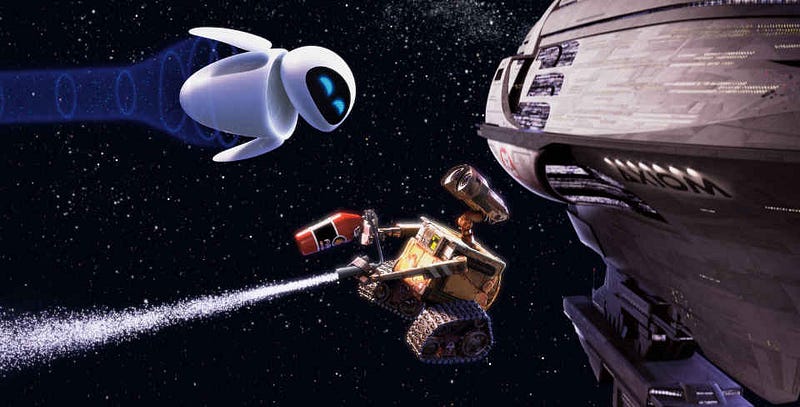
In some stories, the Protagonist does not change, but rather instigates change in others. One example of such a Change Agent is the character WALL-E in the Pixar movie WALL-E (2008). Set seven hundred years in the future, the Protagonist is an endearing little machine, the last remaining active robot designed to clean up garbage. Hence, the character’s name: Waste Allocation Load Lifter: Earth. The planet is an environmental disaster to the point where the entire human race has left to live in outer space aboard luxury spaceships. Every day, WALL-E dutifully trundles out of the transport truck he has transformed into a home to gather junk, compact the refuse into cubes, and stack those cubes onto an endless stretch of scrap skyscrapers the robot has created. He does his job alone and in total solitude save for his buddy, a cockroach.
One might think this thankless task would lead WALL-E into a state of depression, but in fact, he is a cheerful fellow, humming along to songs from the movie Hello, Dolly! He is content to gather curious items he discovers doing his job (e.g., spork, Rubik’s cube, Zippo lighter) which he adds to his collection of keepsakes. Yet as he wistfully watches an old videotape of his favorite musical, it is clear WALL-E is a romantic and his deepest desire is for companionship.
Enter EVE (Extra-terrestrial Vegetation Evaluator) who arrives on Earth in search of plant life, a sign the planet is once again inhabitable. She has the personality of a classic robot, single-minded about her prime directive, cold, even callous toward WALL-E, but that is not how he experiences Eve. In his eyes, “She’s the most beautiful thing he’s ever seen.”
WALL-E does find a plant on Earth which sets off a chain reaction of events: Eve heads back to the spaceship Axiom; WALL-E follows her; he disrupts the sedentary lifestyles of two humans, John and Mary, which ripples out to others; eventually people on the ship act as a collective to save the plant; and the spaceship returns to Earth to commence a recolonization effort — all because of WALL-E’s influence. Plus this: Eve evolves from an emotionless robot into WALL-E’s romantic partner, transformed by the little droid’s human-like passion for life and love. Throughout his journey, WALL-E remains indefatigable and constant in his optimism. His presence impacts everyone with whom he comes into contact and actually changes the course of human history.
The ending of the movie visualizes WALL-E’s influence on others, both global (humans returning to Earth and vegetation taking root as the re-population of the planet begins) to intimate (Eve’s transformation from cold, calculating robot to WALL-E’s romantic partner).
Other examples of Change Agents cited in The Protagonist’s Journey: Forrest Gump in Forrest Gump (1994), Chauncey Gardner in Being There (1979), and R.P. McMurphy in One Flew Over the Cuckoo’s Nest (1975).
I conclude Chapter Two with these observations:
There are other types of stories featuring a variety of character arcs. Stories in which Protagonists sacrifice themselves for the greater good such as contemporary films including Gran Torino (2008), In Bruges (2008), and Dallas Buyers Club (2013), depicting personally positive transformations which result in the character’s demise. Stories wherein multiple characters experience different types of arcs such as the movie Dead Poets Society (1989) and the HBO limited television series Big Little Lies (2017, 2019). Stories in which the Protagonist’s arc ends in a gray area between positive and negative, such as the movies The Graduate (1967), (500) Days of Summer (2008), Her (2013), La La Land (2016), Three Billboards Outside Ebbing, Missouri (2017), and television series The Sopranos (1999–2007), Dexter (2006–2013), Homeland (2011–2020), and Silicon Valley (2014–2019). These stories leave the audience to ask questions: Did the characters really change? Did they actually end up in a better or worse psychological place? Was the change worth it?
The fact that there are so many different types of character arcs reflects the complexity of human experience and opens the door for writers to explore the breadth and depth of what we know as Life.
While the unity arc is predominant in mainstream commercial films and television, the basis of “happy ending” stories, as writers, we should feel unrestrained in exploring the journeys of any and all types of characters.
In fact, it is precisely because there are endless variations on character types due to the specifics of each individual’s unique personal history that no matter what narrative archetype or story paradigm we use, stories can be distinct. It is the characters which give a writer the potential to make any story singular in nature, one of the primary reasons I teach and preach character-driven screenwriting and storytelling.
You may go here to read 30+ endorsements for The Protagonist’s Journey by screenwriters, novelists, and academics.
You may go here to learn more about the content of The Protagonist’s Journey.
You may order the book here:
The Protagonist’s Journey has already generated significant interest on Amazon.
“Scott Myers is an uncommonly sensitive and erudite thinker and writer about the craft of modern screenwriting. I think so many writers at all stages of their careers will find nourishment in his character-forward approach, as well as anyone who is interested in the mysteries of storytelling or just plain loves movies. Great films are about remarkable, compelling, and challenging characters. This book offers both tools and inspiration — it’s a new, yet timeless, lens through which to view the question of how we tell film stories and why.”
— Phil Hay, Crazy/Beautiful, The Invitation, DestroyerI look forward to sharing The Protagonist’s Journey with you.