“The Protagonist’s Journey”: #1 New Release on Amazon
My book is currently in the top position of New Releases in Amazon’s category of Film & Television. You may pre-order it now.
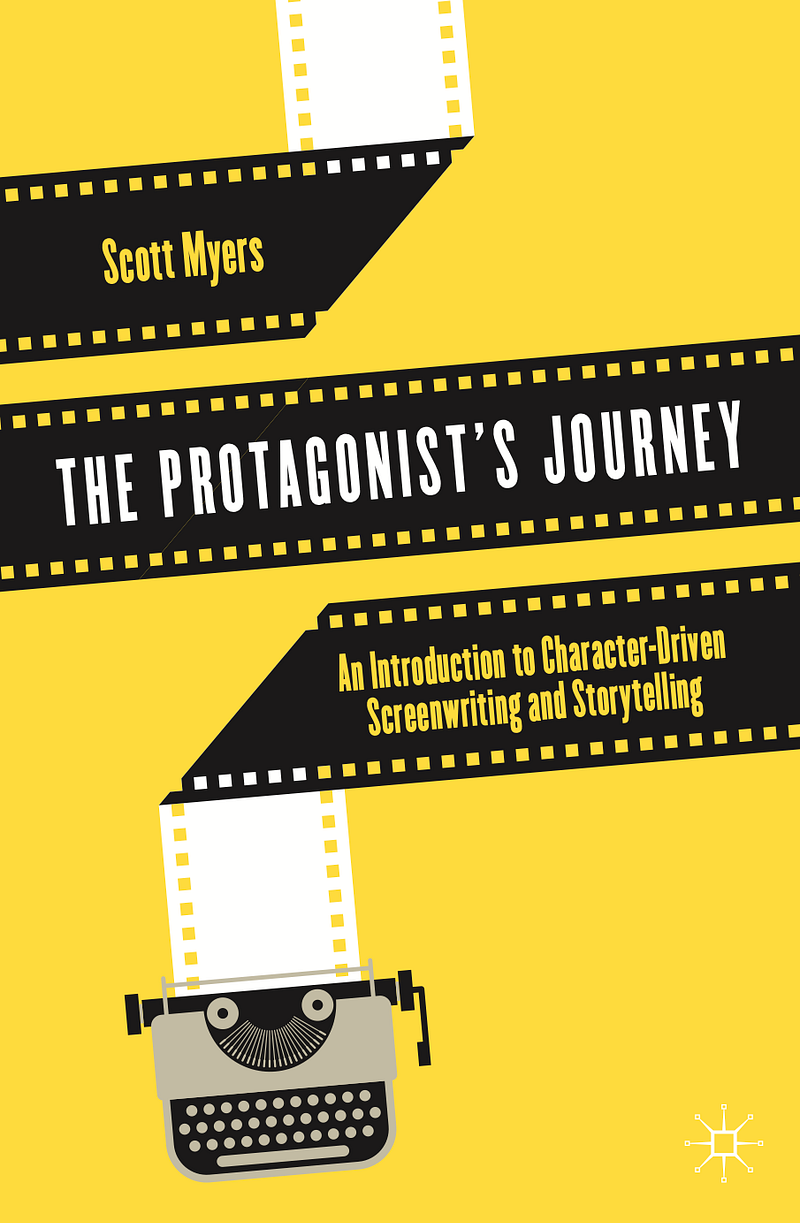
My book is currently in the top position of New Releases in Amazon’s category of Film & Television. You may pre-order it now.

As I write this, The Protagonist’s Journey: An Introduction to Character-Driven Screenwriting and Storytelling is the #1 New Release on Amazon in the category of Film & Television. In addition, it is currently ranked third on the Best Sellers list in the same category.
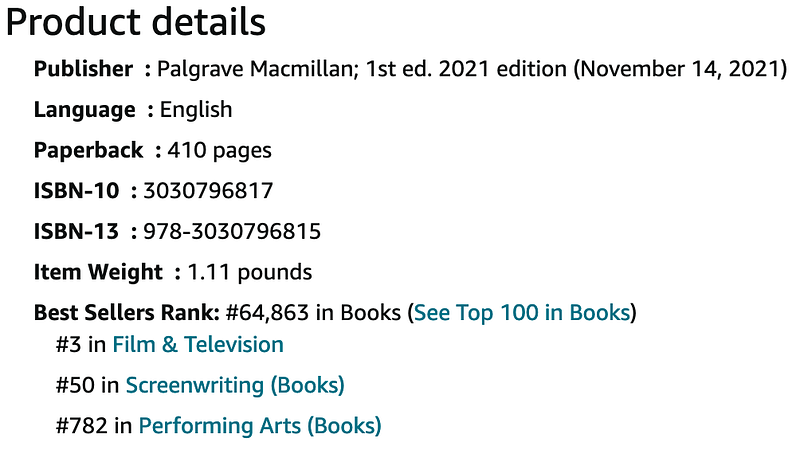
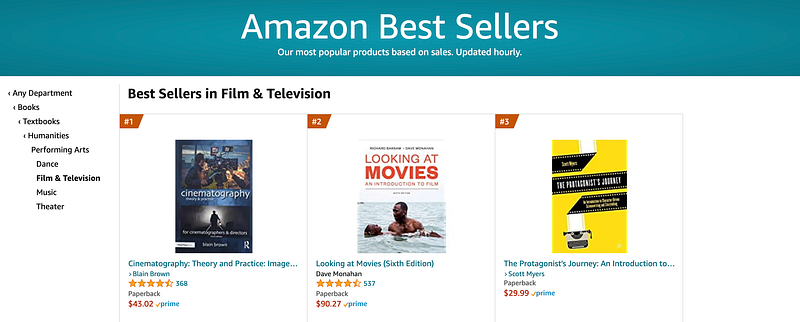
What’s astonishing to me is the book hasn’t even been published yet! It is scheduled for public release on November 14, 2021. That means these numbers are based solely on pre-orders.
Pre-order your copy of The Protagonist’s Journey now!
Amazon (North America)
Amazon (United Kingdom)
I guess I shouldn’t be surprised. I have pretty much been preaching the importance and value of character-driven screenwriting and storytelling since I launched Go Into The Story in 2008. The site averages 2M+ unique visits per year. Combine that with 100K+ followers between Twitter, Medium and Facebook, there’s a great deal of interest in this book which offers a comprehensive take into the subject.
Then there are the 30+ endorsements from professional screenwriters, novelists, and academics which are making the rounds. Their response to the book has been … frankly, quite overwhelming. Here are some examples:
“In his decade of teaching, culminating with this book, Scott has pulled off a remarkable feat. He’s made a complete compendium of the screenwriting craft while continuing to encourage the antithesis of formulaic writing.”
— Peter Craig, The Hunger Games: Mockingjay, Top Gun: Maverick, The Batman
“The Protagonist’s Journey gives you the tools to craft emotional, character-driven stories that are the bread and butter of any professional screenwriter. If you want some genuine screenwriting advice, look no further than Scott’s book.”
— Stephany Folsom, Toy Story 4, Paper Girls
“Whether you’re a seasoned screenwriter or writing ‘fade in’ for the first time, The Protagonist’s Journey: An Introduction to Character-Driven Screenwriting and Storytelling is required reading. The perfect torch to navigate the dark abyss that is crafting a screenplay. A masterclass.”
— David Guggenheim, Safe House, Designated Survivor
“Scott Myers is a canny and thoughtful teacher of the craft of screenwriting, and brings all of his impressive knowledge, insight and experience to The Protagonist’s Journey: this book is full of essential lessons for the novice, and crucial reminders for the professional.”
— Javier Grillo-Marxuach, Writer/Producer, Lost, The Dark Crystal, The Middleman
“Brilliant and energizing, The Protagonist’s Journey is a new bible for writers to take their awesome movie idea and evolve it into a living breathing screenplay. I absolutely loved this book and will be using it as an essential tool for making my next script the best it can be.”
— Kirsten “Kiwi” Smith, Legally Blonde, 10 Things I Hate About You, Trinkets
“The Protagonist’s Journey is foundational for screenwriters, and even certain fiction writers… What a resource this book is! I’m envious of the lucky writer who’s just starting out, with this book on their nightstand.”
— Robin Swicord, Little Women, Matilda, Memoirs of a Geisha, When They See Us
“The Protagonist’s Journey is a superb resource for writers: sharp, engaging, and brimming with insight. Scott Myers illuminates techniques for character development that not only kickstart creativity, but enable writers to deepen their work and to craft gripping, emotionally satisfying stories. A gem.”
— Meg Gardiner, author of the best-selling UNSUB novels
“The Protagonist’s Journey is a nod of respect to the craft of screenwriting. Equal parts contemplative and practical, Myers’ straightforward approach turns dense concepts into readily accessible ideas.”
— T.J. Newman, author of the best-selling novel Falling
“If characters are the lifeblood of stories, The Protagonist’s Journey takes you directly into the heart of the matter. As inspirational as it is informational, Scott Myers has created nothing less than a path for writers to immerse themselves in the lives of their characters and enable them to drive the story-crafting process.”
— Don Winslow, author of the best-selling City on Fire, Broken, The Border, The Force, The Cartel
You may read all of the book’s current endorsements here: Praise for “The Protagonist’s Journey.”
Some background:
- The Protagonist’s Journey is being published by the London-based company Palgrave Macmillan, a world-class publisher in the field of humanities with roots stretching back to its founding in 1843.
- I spent twenty-one months researching, planning, writing, and rewriting The Protagonist’s Journey.
- With over 300 movie and television references, and clocking in at 100,000 words, the Protagonist’s Journey is a comprehensive introduction to a subject near and dear to my creative heart: character-driven storytelling.
The book has three parts, each with seven chapters:
PART I: THE PROTAGONIST’S JOURNEY AS NARRATIVE IMPERATIVE
Chapter One: The Protagonist’s Journey
Chapter Two: Character Arc
Chapter Three: Disunity
Chapter Four: Deconstruction
Chapter Five: Reconstruction
Chapter Six: Unity
Chapter Seven: The Screenplay Universe
Joseph Campbell asserted the entire point of the hero’s journey is transformation: “In the end, the hero is a transformed individual.” Almost without exception, this is the Protagonist’s fate. While there are many different types of character arcs, such as Change Agent, Refuse Change, and Disintegration, the most common one is the Unity Arc. Part I explores how the Protagonist’s inner state of being is intimately connected with the events that occur in the plot and how their deepest need (Unconscious Goal) drives the story toward its inevitable conclusion. As Carl Jung states, “The privilege of a lifetime is to become who you are.”
PART II: THE PROTAGONIST’S JOURNEY AS FAMILY OF CHARACTERS
Chapter Eight: Primary Character Archetypes
Chapter Nine: Nemesis
Chapter Ten: Attractor
Chapter Eleven: Mentor
Chapter Twelve: Trickster
Chapter Thirteen: Subplots
Chapter Fourteen: Character Map
Part II examines how the Protagonist’s journey is not just about what transpires in the plot, but also the characters with whom the Protagonist intersects. Each key Protagonist relationship is a subplot, a mini-story which ties into the central plotline. These are not random figures, but individuals who serve the Protagonist’s psychological metamorphosis in their own specific way, reflecting distinct narrative functions. Represented by one of five common archetypes, a story’s roster of players can be seen as a family of characters, individually and collectively in support of the Protagonist’s journey.
PART III: THE PROTAGONIST’S JOURNEY AS SCREENPLAY
Chapter Fifteen: Breaking Story I — Protagonist Character Treatment
Chapter Sixteen: Breaking Story II — Master Brainstorming List
Chapter Seventeen: Breaking Story III — Four Primary Plotline Points
Chapter Eighteen: Breaking Story IV — Four Themeline Movements
Chapter Nineteen: Breaking Story V — Ten Major Plotline Points
Chapter Twenty: Breaking Story VI — Scene-By-Scene Outline
Chapter Twenty-One: Writing the First Draft
Part III is where the rubber meets the road … or in the case of a writer where pen meets paper. In these chapters, writers learn a character-driven approach to breaking story which takes them from concept all the way to a scene-by-scene outline. While there is no single right way to handle story prep, this process has been road tested thousands of times in classroom and workshop settings, proving that if you do the work … it works. The approach presented here puts flesh on the bones of a writing mantra I came up with over a decade ago: “Begin with character. End with character. Find the story in between.”
The Protagonist’s Journey: An Introduction to Character-Driven Screenwriting and Storytelling is aimed at students of the craft who want to go beyond formulaic approaches which reduce story structure to plot. Plot is essential, but it is only half the story. For it is the world of characters and their inner lives which gives meaning to the events they experience. Indeed, it is by engaging characters, getting curious about them, and following their lead that plot comes to life.
Finally, this. In all the years I have been hosting this blog and my social media feed, giving away content every single day for free, I have never once asked for a personal favor from my readers or students.
I’m asking for one now.
Please spread the word. If you feel so inclined, pre-order the book because that’s the kind of buzz money can buy.
Copy the link to this article or to one of the bookstores listed above and pass it along via your social media platforms.
If you follow me on Twitter and you see a tweet like this:
Please retweet it. And if you have any ideas to help me promote the book, email me: GITSblog@gmail.com.
I am proud of The Protagonist’s Journey and believe it offers a significant contribution to the conversation about the craft of screenwriting. With the world of movies and television going through enormous changes, there is one common thread running through every platform of visual storytelling: The importance and primacy of characters. Hence, the value of character-driven screenwriting and storytelling which is what my book is all about.
Thank you for your interest and support.
UPDATE: The Protagonist’s Journey is now #1 on Amazon in terms of sales in the category of Film & Television and #30 in Screenwriting.
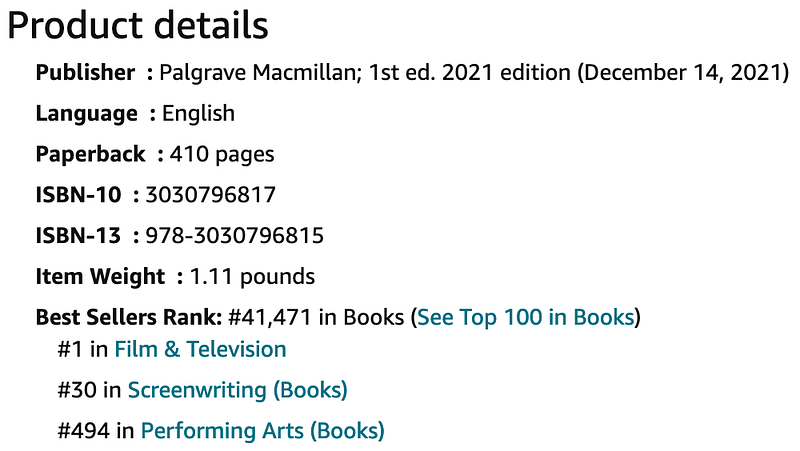
Again, this is BEFORE the book has been published. Amazing.