The Hollywood strike can and must win — for all of us, not just writers and actors
The thousands of strikers are at the frontlines of two key battles: against a future controlled by AI, and against suffocating inequality
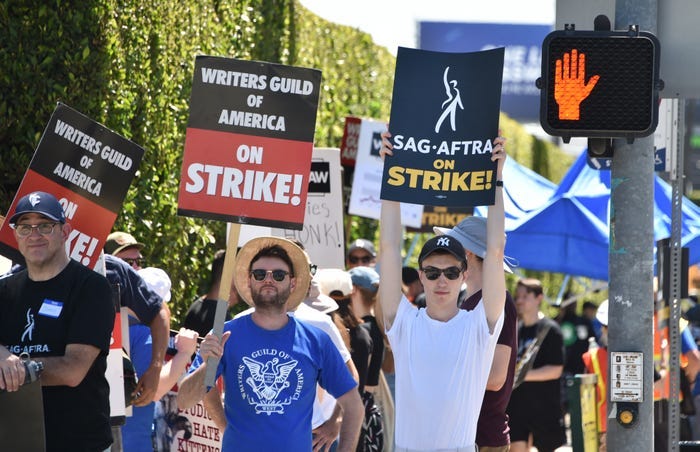
The thousands of strikers are at the frontlines of two key battles: against a future controlled by AI, and against suffocating inequality.
Hamilton Nolan is a writer and member of the Writers Guild of America, East. He wrote an opinion piece in The Guardian which ran yesterday. Here are some excerpts.
It can be tempting to demonize Hollywood as the source of all of society’s ills. The right hates them for being decadent limousine liberals undermining traditional values, and the left hates them for being decadent limousine liberals spreading America’s pernicious capitalist myths worldwide. But what is happening right now should be understood as Hollywood’s redemption.
The thousands of workers engaged in this enormous, multi-union Hollywood strike — something America hasn’t seen since 1960 — represent the frontline of two battles that matter to every single American. You might not naturally pick “writers and actors” to be the backbone of your national defense force, but hey, we go to war with the army we have. In this case, they are well suited to the fight at hand.
The first battle? Humanity versus AI.
What we know for sure is this: if we leave AI wholly in the hands of tech companies and their investors, it is absolutely certain that AI will be used in a way that takes the maximum amount of money out of the pockets of labor and deposits it in the accounts of executives and investment firms. These strikes are happening, in large part, to set the precedent that AI must benefit everyone rather than being a terrifying inequality accelerator that throws millions out of work to enrich a lucky few. Even if you have never been to Hollywood, you have a stake in this fight. AI will come for your own industry soon enough.
The second battle: Class war.
In this sense, the entertainment industry is just like every other industry operating under America’s rather gruff version of capitalism. If left to their own devices, companies will always try to push labor costs towards zero and executive pay towards infinity. The preferred state of every corporation in America is one in which all of its employees earn just enough money to survive and the CEO and investors earn enough money to build private rockets to escape to a private Mars colony for billionaires. The only — the only — thing that stops this process is labor power. That comes from unions. The walls that unions build protect not just their own members, but by extension the entire working class. That is what’s at stake here.
I agree with Hamilton. These two issues — AI and income inequality — are some of the main reasons why WGA and SAG-AFTRA members are so united in this strike. And while people outside Hollywood may think what writers and actors do is a dream job, it’s still a job. A job that requires work.
For writers, sure, that work requires sitting in front of a computer. But how many millions of workers do the same thing at their job? Maybe they work with graphs, spreadsheets, data, programming systems, whatever, but for these type of workers, it’s still ass on chair for hours on end.
I believe that reality is sinking in with the general public. Writers work. Actors work. It’s not easy. There’s a lot of pressure and massive job insecurity. We worry about mortgages and rent. About our children’s well-being. About will there be a future for us with AI breathing down our necks.
So while it may come off as self-aggrandizing, all the talk about this strike being at the forefront of the worker movement which appears to be bubbling up across the country, there is some truth to it.
What the WGA and SAG-AFTRA do here will have an impact on what happens out there miles and miles away from Hollywood.
To read the rest of Hamilton Nolan’s opinion piece in The Guardian, go here.
For the latest updates on the strike and news resources, go here.
Please consider contributing to the Entertainment Community Fund.