The Heroine’s Journey: Part 4
I’m reprising a 4-part series from 2012 on The Heroine’s Journey because it’s as relevant today as it was nearly a decade ago.
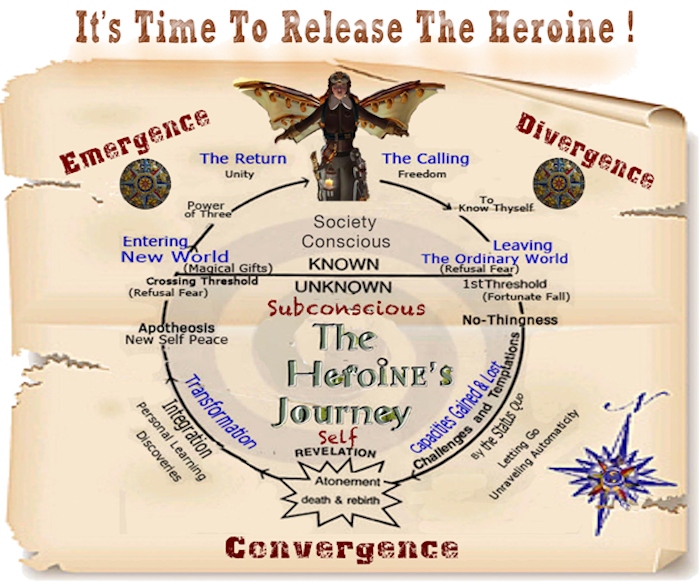
I’m reprising a 4-part series from 2012 on The Heroine’s Journey because it’s as relevant today as it was nearly a decade ago.
In my current 1-week online Core I: Plot class, the second lecture focuses on The Hero’s Journey. One of the writers in the class noted: “As a girl reading it, I had a hard time categorizing myself or my characters in any of them.”
Part of my response: “I absolutely agree that the language and symbolism of the Hero’s Journey may resonate more with a patriarchal world view than matriarchal, that there is value in exploring other language systems such as the Heroine’s Journey or the Virgin’s Journey. Each writer needs to find whatever theoretical framework, metaphors, language they connect with and enlivens their creativity.”
I recommended a 4-part series I had done back in 2012 on The Heroine’s Journey and provided a link. Then I thought, “Hm. Seeing as this subject is as relevant today as it was back then, why not reprise the series?” So here it is.
Be sure to read the archived comments because readers and I got into a fascinating discussion.
We have had an interesting time digging into the idea of a heroine’s journey the last few days. You can check out the posts here:
Part 1: The Heroine’s Journey
Part 2: The Heroine’s Journey
Part 3: The Heroine’s Journey
Be sure to check out the comments as well as there has been a terrific discussion going on there. In fact, I’d like to pull this quote from a comment made by Debbie Moon:
This is a really fascinating idea. I’m starting to wonder if the Virgin’s journey is a model for more character-led dramas, in the same way that the Hero’s journey is for plot-led dramas…
I don’t have time today to dig into the many thoughts I have on the ideas discussed in this series, so I’ll have to come back another time for that. But this idea by Debbie strikes me as having validity.
As most of you know, I am a big fan of Joseph Campbell. I incorporate the Hero’s Journey into my teaching [although not the way it seems to be most typically used]. So Debbie’s idea interests me because this issue comes up a lot: What about stories where there is no Nemesis? Stories that are more about a Protagonist confronting their inner ‘demons’ than a struggle between Protagonist and Nemesis? Or as Debbie puts it “character-led” dramas?
I always start that discussion here. First and most important, almost all stories, and certainly Hollywood movies, feature a Protagonist going through some sort of change. Even though so much emphasis is typically put on the External World of the Hero’s Journey, the 17 or 12 “stages,” the fact is Campbell himself said that the theme of the Hero’s Journey is transformation. Jung’s iteration of that is individuation. When I teach screenwriting, I use the word metamorphosis. They are all saying pretty much the same thing: Things happen in life [stories] that impact a person [character], causing them to get in touch with an authentic part of their Self, moving them toward a state of Unity.
In her comments about the Virgin’s journey, Kim Hudson talked about “authentic nature,” about the Dependent world in which the Protagonist begins their adventure, then through their experiences accessing their Secret world. That all mirrors language with which I’m quite comfortable deriving from Campbell, Jung and a lifetime of watching movies: The Protagonist has a Conscious Goal (Want) and Unconscious Goal (Need), and over the course of their adventure moving from their Ordinary World [life up to FADE IN] into the Extraordinary World, they come to understand and accept their Need. Vamping off Jung, they get in touch with key aspects of their psyche and assemble them into a whole.
The thing is in my view, that happens in movies whether it’s a character-led story or not. Most Hero’s Journey type movies traffic in this type of thing, a reflection of the Protagonist’s metamorphosis. Whether they get there by slaying dragons [metaphorically] or giving up what is keeping them stuck and choosing the light [using language from the Virgin’s journey], the end point insofar as the psychological, emotional and spiritual dimension of the story is the same.
But as to the specific of the process, that is where we may find some interesting new ground. Is the Virgin’s journey a viable path for a writer to look at in terms of more character-oriented stories?
That said movies are primarily a visual medium, therefore whatever internal conflicts a character may experience must in some way be communicated in the External World, either through dialogue or action. So no matter what paradigm or approach a writer may choose to use, they have to figure out ways to physicalize the Protagonist’s psychological journey.
That’s one of the reasons why I think the five character archetypes — Protagonist, Nemesis, Attractor, Mentor, Trickster — can be so helpful as each character can be seen as a narrative function connected to, even a reflection of the Protagonist’s psychological journey. For example, the Nemesis as a reflection of the Protagonist’s shadow, the Attractor as a reflection of the Protagonist’s heart, the Mentor as a reflection of the Protagonist’s brain, the Trickster as a reflection of the Protagonist’s will.
Quite a bit of a ramble there, I wish I had time to be pull my thoughts together more coherently. On the other hand, the discussion seems to be going along just fine, therefore I’ll just trust my gut, post this rather random flow of ideas, and hope it provides some additional food for thought.
The reprise of this series got a strong response from readers. If you have any further thoughts on the subject, why not post them here?
By the way, I found a site of interest: The Heroine’s Journey Project.
Also the new book I mentioned in Part 1: The Heroine with 1,001 Faces by Harvard scholar Maria Tatar.