The Heroine’s Journey: Part 3
I’m reprising a 4-part series from 2012 on The Heroine’s Journey because it’s as relevant today as it was nearly a decade ago.

I’m reprising a 4-part series from 2012 on The Heroine’s Journey because it’s as relevant today as it was nearly a decade ago.
In my current 1-week online Core I: Plot class, the second lecture focuses on The Hero’s Journey. One of the writers in the class noted: “As a girl reading it, I had a hard time categorizing myself or my characters in any of them.”
Part of my response: “I absolutely agree that the language and symbolism of the Hero’s Journey may resonate more with a patriarchal world view than matriarchal, that there is value in exploring other language systems such as the Heroine’s Journey or the Virgin’s Journey. Each writer needs to find whatever theoretical framework, metaphors, language they connect with and enlivens their creativity.”
I recommended a 4-part series I had done back in 2012 on The Heroine’s Journey and provided a link. Then I thought, “Hm. Seeing as this subject is as relevant today as it was back then, why not reprise the series?” So here it is.
Be sure to read the archived comments because readers and I got into a fascinating discussion.
In a continuing series this week exploring The Hero’s Journey and possible variations on that theme from a feminine perspective, author Kim Hudson (“The Virgin’s Promise”) posted a comment the other day I thought worth spotlighting in its entirety:
The Hero’s journey and the Heroine’s are the same thing to me just as we all have a masculine and a feminine side we can all be heroes. The point is we all have a feminine side as well and we re trying to figure out what that looks like. Thanks to Joseph Campbell we have a really good idea of how to write heroes. Ordinary world, call to adventure, refusal of the call and the eventual crossing of the threshold to a foreign land where the adventure begins. This is the quest to push back the boundaries of mortality and know that you can survive in the bigger world. The bigger the challenger the greater your knowledge of your power.
This is all very familiar, however, none of it gets to the feminine power. As others have noted what we generally see is the female as motivation for the Hero to be amazing. What we’re trying to get at is what does it look like when the feminine is being amazing.
This is the journey of the Virgin archetype. The name has been so misrepresented it is like a master plot to keep it from having an identity. The meaning of Virgin survives when we think of a Virgin forest. It means to be of value just for being yourself. The quest of the Virgin, the feminine, is to awaken to the seed of the divine in you, and bring it to life, despite what everyone else wants from you. It usually happens through spiritual, sexual or creative awakening whether you are an female or male. Great Virgin stories with male leads include The King’s Speech, Brokeback Mountain and Billy Elliot. Great female ones include An Education, Shakespeare in Love, Erin Brockovich, and Legally Blond.
This is the interesting part of the book Hunger Games which the movie left out. Katniss learns that she has the ability to connect to nature and be an amazing hunter (the result of her Virgin Journey). She feels alive when she hunts. Which makes the rewards of the games mean nothing to her. So what is the point of the story?
The Virgin’s journey has 13 beats (see The Virgin’s Promise at mwp.com) and is the awakening of your talent, your authentic nature. It starts in a dependent world, as we all do, where she pays a price for her dependence, usually making herself small to belong,until one day she finds an opportunity to taste what it feels like to be true to herself and she takes it. She admits to herself that she wants something more from life. Now she finds a Secret World where she can grow in her understanding of who she is and moves back and forth between her Secret and Dependent worlds. Creative, sexual or spiritual awakening happens here and it can only flourish in an atmosphere where the Virgin feels safe and loved (unlike the Hero who thrives on progressive challenge). When she has grown into her potential she emerges from the cocoon like a butterfly and presents herself. There is a backlash and she has to choose whether she has the right to inconvenience people, to take up some space in the world, or she will go back to conforming. She decides she has to be true to herself and in the end everyone benefits from knowing the gift she has to bring.
There is a feminine story, but it is not a heroine story. That is the female version of the hero. The feminine story is to explore your interior world and bring it to life, the journey of the Virgin.
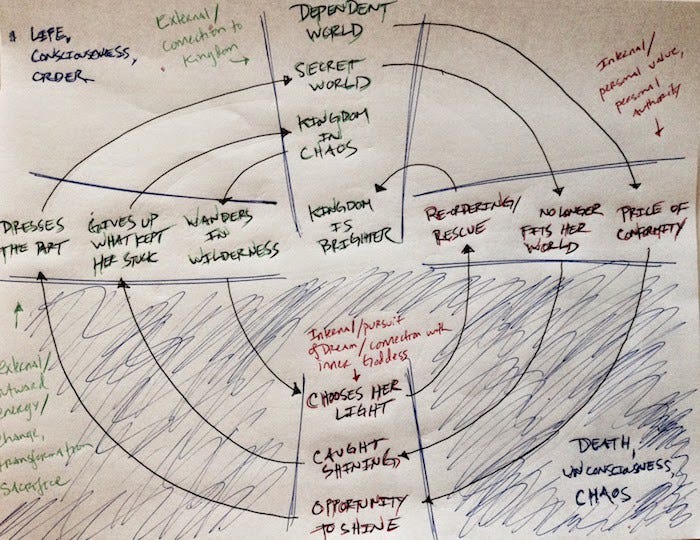
This language is quite familiar to me and if any of you have been paying attention to my various movie analyses and my take on the Protagonist metamorphosis, you will see the parallels. I will pick up on that in a concluding post in this series tomorrow. In the meantime, what are your thoughts about this take: The Virgin’s journey?
Thoughts? Questions? Reactions? See you in comments to continue our conversation.