The Heroine’s Journey: Part 2
I’m reprising a 4-part series from 2012 on The Heroine’s Journey because it’s as relevant today as it was nearly a decade ago.
I’m reprising a 4-part series from 2012 on The Heroine’s Journey because it’s as relevant today as it was nearly a decade ago.
In my current 1-week online Core I: Plot class, the second lecture focuses on The Hero’s Journey. One of the writers in the class noted: “As a girl reading it, I had a hard time categorizing myself or my characters in any of them.”
Part of my response: “I absolutely agree that the language and symbolism of the Hero’s Journey may resonate more with a patriarchal world view than matriarchal, that there is value in exploring other language systems such as the Heroine’s Journey or the Virgin’s Journey. Each writer needs to find whatever theoretical framework, metaphors, language they connect with and enlivens their creativity.”
I recommended a 4-part series I had done back in 2012 on The Heroine’s Journey and provided a link. Then I thought, “Hm. Seeing as this subject is as relevant today as it was back then, why not reprise the series?” So here it is.
Be sure to read the archived comments because readers and I got into a fascinating discussion.
Yesterday I posted this, posing several questions around a central one: If there is The Hero’s Journey, is there also The Heroine’s Journey? The post spawned some terrific responses in comments which is precisely what I was hoping for. I wanted to pull a few excerpts here.
The Bark Bites Back:
In Dramatica, there is a factor of mental sex within the main character: are they male or female in their approaches to problem solving?
Male Mental Sex typically resort to linear problem solving as their choice. This involves setting a goal and the necessary steps to achieving it, then embarking on those steps.
Female Mental Sex are temporal to Male Mental Sex spacial, and prefer holistic methods. They’re more intuitive, needing only a sense of how they want things to be and then work towards that balance.
— —
Female: Looks at motivations — Male: Looks at purpose
Female: Tries to see connections — Male: Tries to gather evidence.
Female: Sets up conditions — Male: Sets up requirements
Female: Seeks fulfillment — Male: Seeks satisfaction
Female: Concentrates Why/When — Male: How/What
Female: Puts issues into context — Male: Argues the issues
Female: Tries to hold it all together — Male: Tries to pull it all together
plinytheelder:
At the risk of sounding self-absorbed, I’m gonna mention the feminist action piece I’ve been writing. In a previous thread I asked about whether I was projecting my fantasies onto characters.
What I meant in that case was not anything of a sexual nature, but rather that I was making my characters behave in the way I thought would be kick-ass and cool (i.e male behavior), rather than letting their behavior emerge naturally from the characterizations.
The thing I “discovered” is that left to their own devices, my female characters would often make decisions and act together as a team and that my mentor characters would also be three or even four characters together, sometimes being both older and younger than the “protagonist” of the moment.
I also discovered that the relationships between these characters naturally forms a “matriarchy” that brings a sense of family between them and that the conflict between the women and men in this piece follows from the women naturally joining together to form that support group and the men being traditional loner, self-supporting types.
Michael McGruther:
Here’s my thoughts — If each human has a unique soul then the female heroes journey should be the same as the males.
That inside change we’re always talking about is really a change of the soul of that character in some way, good or bad — nearer to heaven or farther from it.
Gabe:
I always liked what Campbell said about girls having adulthood thrust upon them (menstruation), and boys needing ritual and journeys in order to learn become adults.
Scott has often used the term individuation. Having that Y chromosome or not must push the hero in a certain direction on their path to individuation. Biology has got to play in here somehow.
Caitlin Podiak:
Women can grow another human inside of their bodies. Men can’t. That’s kind of a major difference that would have to have some effect on one’s path to individuation. And beyond that, women and men’s personalities develop in a world dominated by patriarchy, which objectifies and diminishes the roles of women. How could that fail to impact a male or female character’s journey differently?
jwindh:
As much as we like to think we are all “equal” (aside from a few external things) we absolutely are not. Hormones — testosterone and many others — all have an influence on personality, values, and approach to problem-solving. (I say this after having had some incredibly open and in-depth conversations with a friend who had a male-to-female sex change — the whole thing, operation, hormone therapy… she has lived life hormonally as male and as female, in fact has lived how very few of us ever have, with ZERO testosterone (we females still have some naturally produced testosterone, but she no longer has any organs that produce it — she only has it if she takes supplements, and she said she likes herself and her life best when she has NONE of it!) Her insights, as well as many studies I have read, have really shaped my views about the human brain and gender differences).
So I am wondering, with this idea of The Heroine’s Journey — is not a Heroine pretty much just a female Hero? As opposed to a “female protagonist” who may not necessarily be classified as female Hero or Heroine. So I would totally agree with TBBB’s first comment, and say that Alien’s Ripley and SOTL’s Clarice are very much “male” hero stories where the protagonist is female. I would say mostly the same with Katniss, too — although the maternal feelings she has for her sister are very “feminine” (but still not really any different from any tough male hero who still has a soft spot for protecting “women and children”).
Traci Peterson:
I agree, the journey is the same, but…
For three entire drafts of my RomCom/Action the protagonist (sniper) was male and the “attractor” (burned out spy) was female. A friend read the logline and suggested a gender switch.
That single change heightened the story, the emotion, the humor, the conflict between villain (female) and between secondary/tertiary characters. The journey (goal) stayed the same, but it was more engaging, hilarious, heartfelt, vicious and kick-butt.
Maybe when using female leads the focus is, “It’s not the journey, it’s the getting there that’s good.”
Then there is an interesting take from Kim Hudson, author of “The Virgin’s Promise,” too lengthy to post here, but well worth checking out in comments on yesterday’s post.
Today further food for thought, this from Valerie Estelle Frankel, author of “Buffy and the Heroine’s Journey”:
What is the Heroine’s Journey?
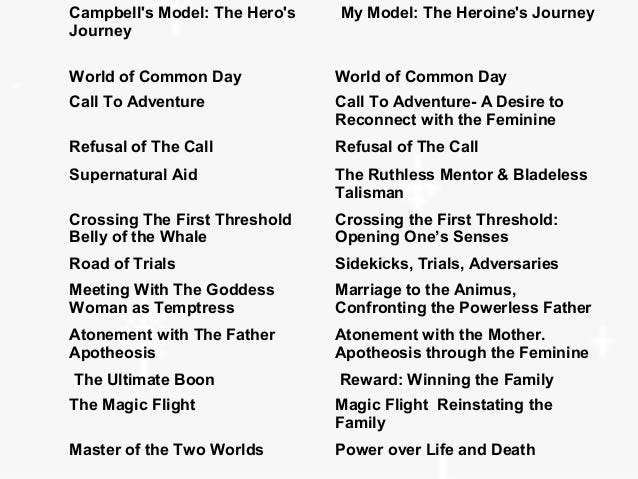
Though scholars often place heroine tales on Campbell’s hero’s journey point by point, the girl has always had a notably different journey than the boy. She quests to rescue her loved ones, not destroy the tyrant as Harry Potter or Luke Skywalker does. The heroine’s friends augment her natural feminine insight with masculine rationality and order, while her lover is a shapeshifting monster of the magical world — a frog prince or beast-husband (or two-faced vampire!). The epic heroine wields a magic charm or prophetic mirror, not a sword. And she destroys murderers and their undead servants as the champion of life. As she struggles against the Patriarchy — the distant or unloving father — she grows into someone who creates her own destiny.
Eventually, she too descends into the underworld in a maiden’s white gown, there to die and be reborn greater than before. Awaiting her is the wicked stepmother or Terrible Mother (as Jung calls her): the White Witch of Narnia or Wicked Witch of the West: slayer of children and figure of sterility and unlife. This brutal matriarch is often her only mentor. The heroine not only defeats her, she grows from the lesson and rejoins the world as young mother, queen, and eternal goddess.
Here’s a visual representation of the Heroine’s Journey:

And a comparison of the Hero’s Journey and Heroine’s Journey:
You can read more about Valerie Estelle Frankel here.
Thoughts? Questions? Reactions? See you in comments to continue our conversation.