The Heroine’s Journey
A four-part series as relevant today as it was when first published in 2012.

A four-part series as relevant today as it was when first published in 2012.
In my current 1-week online Core I: Plot class, the second lecture focuses on The Hero’s Journey. One of the writers in the class noted: “As a girl reading it, I had a hard time categorizing myself or my characters in any of them.”
Part of my response: “I absolutely agree that the language and symbolism of the Hero’s Journey may resonate more with a patriarchal world view than matriarchal, that there is value in exploring other language systems such as the Heroine’s Journey or the Virgin’s Journey. Each writer needs to find whatever theoretical framework, metaphors, language they connect with and enlivens their creativity.”
I recommended a 4-part series I had done back in 2012 on The Heroine’s Journey and provided a link. Then I thought, “Hm. Seeing as this subject is as relevant today as it was back then, why not reprise the series?” So here it is.
Be sure to read the archived comments because readers and I got into a fascinating discussion.
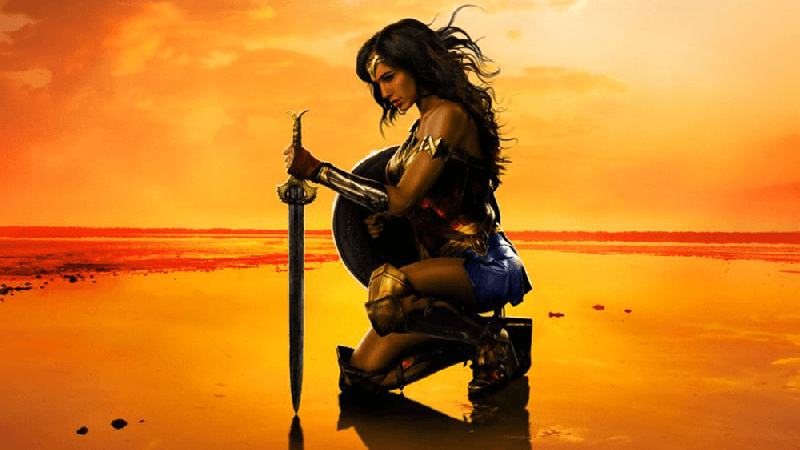
Last week, I posted this, featuring an article by Caroline Heldman in which she made this point:
“The Hunger Games” is Hollywood’s wake-up call that female action hero movies can be successful if the protagonist is portrayed as a complex subject instead of a hyper-sexualized fighting fuck toy (FFT).
Fighting fuck toys are hyper-sexualized female protagonists who are able to “kick ass” (and kill) with the best of them. The FFT appears empowered, but her very existence serves the pleasure of the heterosexual male viewer. In short, the FFT takes female agency, weds it to normalized male violence, and appropriates it for the male gaze.
From an ethical standpoint, Hollywood executives should be concerned about the damage girls and women sustain growing up in a society with ubiquitous images of sex objects, but they’re not. From a business standpoint, Hollywood executives should be concerned about the money they could be making with better female action heroes, but so far, they seem pretty clueless.
Hollywood rolls out FFTs every few years that generally don’t perform well at the box office (think Lara Croft, Elektra, Cat Woman, Sucker Punch), leading executives to wrongly conclude that female action leads aren’t bankable. The problem isn’t their sex. The problem is their portrayal as sex objects, and objects aren’t convincing protagonists. Subjects “act” while objects are “acted upon,” so reducing a female action hero to an object, even sporadically, diminishes her ability to believably carry a storyline. The FFT might have an enviable swagger and do cool stunts, but she’s ultimately a bit of a joke [emphasis added].
In comments, we had an interesting discussion that suggested to me this is a subject worth exploring further. As a self-avowed acolyte of Joseph Campbell and longtime student of “The Hero with a Thousand Faces,” I am well-acquainted with The Hero’s Journey. I am also quite aware of how Campbell’s ideas about it have often been reduced to formula, a trend I attempted to respond to here, here, here, here, and here.
There is also this: It is a hero’s journey. As much as we may prefer to think of that as gender non-specific, there is plenty of literature and commentary on the subject that suggests the masculine identity of the hero is reflected in the details of the journey, but that there is another way to think of hero archetypes — from a female perspective.
A good recent example is an AlterNet article by Lynn Parramore titled: “Heroine With a Thousand Faces: The Rise of the Female Savior”. Some excerpts:
Hard times were made for heroes. In the face of oppression, it’s natural to want a savior — an intermediary to carry our hopes and dreams of overturning The System. From the wreckage of the Great Depression, a slew of caped crusaders rose, like Superman, corruption-busting Batman, Captain America, and The Shadow, who knew “what evil lurks in the hearts of men.”
Male heroes abound in our culture, virile figures who dazzle us with their wits and brawn. But lately, they just don’t seem to be getting the job done. The cowboy is looking ragged. Arnold Schwarzenegger, the action hero turned governor, turns out to be a run-of-the-mill womanizer and cheat. Far from battling global financiers, Barack Obama bends to the will of bankers. As a network of lawless capitalists and their political puppets squeezes and starves the world’s citizens from Cairo to California, Superman seems to have fled the scene.
Somebody else has leapt onstage. And she’s not wearing a codpiece.
In the most familiar dramas, epics and action stories, women play a small part — usually as idols, temptresses and servants. But the phenomenal success of Stieg Larsson’s Millennium trilogy and Suzanne Collins’ The Hunger Games, with their ass-kicking female protagonists, raises the question: Has the era of the female hero arrived? If so, why now? And what is she trying to tell us?
— —
The traditional presentation of the Young Girl in literature can be summed up in the formula She-Who-Waits. Between childhood and adulthood, the young woman must wait for a male liberator to save her from evil. The male is endowed with riches, power, connections, and moral authority, and it is in the best interests of the girl to become his apprentice or love interest.
But what if there aren’t any male heroes to wait for?
The new narratives presented in the Millennium trilogy and The Hunger Games present apocalyptic realms where grief and rage haunt a population crushed by wealthy and malevolent forces. Men in authority positions are mostly corrupt, and the good men have been shorn of their power. Larsson’s Mikael Blomkvist is a down-and-out, middle-aged journalist who has been framed by a powerful financier. In The Hunger Games, Katniss Everdeen’s male reality-show partner Peeta, with his diminutive name, is a beaten-down teenage boy with scant confidence in his physical prowess and mental acumen.
— —
The Young Girl must be transformed if she is to carry the hero’s burden. Larsson’s Lisbeth Salandar is far less a creature of the male gaze than her predecessors. Defiant, gaunt and sporting a spiky mohawk and prickly Goth accessories, she is an open challenge to the fantasy of soft curves and patriarchal expectations of feminine compliance. A computer hacker, she is resistance incarnate. The psychologically complex Lisbeth echoes the resourcefulness and survival instinct of fairy tale women, who often achieve their ends through masquerade and dissimulation.
Lisbeth’s purpose is not only to survive, but to challenge corporate wealth amassed at the expense of the common good. A victim of rapists, she becomes a superhero, a female Robin Hood who plunders plutocrats and outwits corrupt bureaucrats and policemen.
— —
Like Lisbeth Salander, Suzanne Collins’ Katniss Everdeen faces a world in which the state has become corrupted and the people are perceived merely as sources of wealth extraction for elites. Collins, a television writer, is not an overtly political figure in the mold of Larsson, but she has expressed the impact of her father’s service in Vietnam on her view of the brutality and absurdity of war, and she cites his experience of the privations of the Great Depression as inspiration for the survival themes in her books. The Hunger Games appeals to anxieties about government corruption on both the left and the right, manifested in fears of surveillance and a hunger for revolt.
Armed with her Mockingjay emblem — a bird symbol of rebellion that suggests a satirical, subversive stance toward The System — Katniss is tasked with surviving a state-sponsored reality show killing match in which she must rely on both her physical skill and intellect in order to return to her impoverished coal-mining district. Only when Katniss pantomimes compliance before the television camera does she conform to conventional expectations of feminine eroticism. For her, the femininity of curls and frilly dresses is pure artifice — a mask of survival. Her romantic entanglements are equally ambiguous: her life depends on enacting a love affair with Peeta, but while she cares for the hapless boy, she is no lovestruck teenage girl. When she is released into the woods, Katniss is outfitted as Artemis, the hunter — as likely to slay men as to love them.
Both Lisbeth and Katniss extend the limits of what is possible in the stifling worlds they inhabit. Notably, both women display violence — they show, through their physical aggression, the ultimate proof of their subjectivity. They are committed to their own survival — quite the opposite of the martyrdom and physical sacrifice traditionally demanded of female saviors. But they also show openness to collaboration with both men and women that points to the limitations of the lone-cowboy-hero model and the traditional gender dynamic of male dominance/female servitude.
For these female characters, the waiting game of young womanhood is supplanted by active conquest, and the path is opened for independent, strong-willed and admirable heroines. The ethical, intelligent, fearless female becomes the preeminent challenge to sinister, intangible forces. Mold-breaking female protagonists subvert the rules of a rigged game in a way that is all the more thrilling and cathartic for their break with tradition.
There are many layers to this subject and many points of entry to discuss it. Simply looking at it from the perspective of screenwriting, we would be blind not to notice the remarkable success of Lisbeth and Katniss as heroine figures in the Millennium and “Hunger Game” series. At the very least we can probably all agree on this: In a culture of movies, TV series, and books dominated by male Protagonists, there can be something especially interesting approaching a story from the vantage point of a female Protagonist. We have seen male heroes in male hero roles for decades. Starting with a female hero — a S-Hero as they are sometimes called — can provide a unique, even fresh approach to these type of sagas.
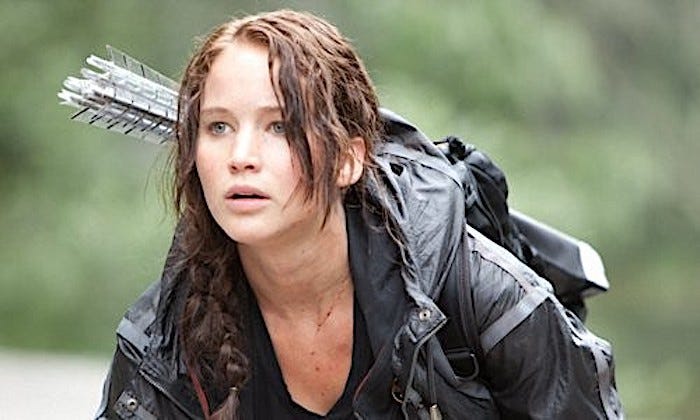
Katniss Everdeen in ‘The Hunger Games’
But there are so many other questions:
- Is The Heroine’s Journey the same as The Hero’s Journey?
- If so, how and what?
- Is a female hero substantively any different from a male hero?
- If a female follows the path of a Hero’s Journey, does that not make them in essence a ‘male’ character?
- Likewise if there is, indeed, an equivalent Heroine’s Journey, if a male followed that path, would that not make them in essence a ‘female’ character?
- Why are most heroes in stories males?
- Are there things writers can learn about writing a male hero by studying female heroes?
- Are there things writers can learn about writing a female hero by studying male heroes?

What I propose to do is open the floor to a discussion of this subject on all fronts. I start with Parramore’s article to frame the discussion, and have several more to use as the centerpiece of posts over the course of this week.
What I’m hoping for is a wide-ranging and beneficial conversation about The Hero’s Journey and The Heroine’s Journey, grounded in a question aimed specifically at writers: Are there unique opportunities in today’s culture to write stories with a female Protagonist?
I ask this question not because I’m trying to be politically correct, rather as noted above, you’d have to be stupid not to see the enormous success of “The Hunger Games” and the Millennium series. Something is going on. Perhaps it’s as simple as Lisbeth and Katniss being two well-drawn Protagonists, regardless of gender. Or maybe there is something more at work, that in the Zeitgeist, there is an opening, even a desire to see stories with female heroes.
If there is, what can we learn this week to help us understand the unique dynamics at play? Are these stories that have to be shaped in a precise way to fly with Hollywood or are we free to cut loose with conventions if we choose to write stories with female heroes?
For the rest of Parramore’s article, go here.
Yesterday I posted this, posing several questions around a central one: If there is The Hero’s Journey, is there also The Heroine’s Journey? The post spawned some terrific responses in comments which is precisely what I was hoping for. I wanted to pull a few excerpts here.
The Bark Bites Back:
In Dramatica, there is a factor of mental sex within the main character: are they male or female in their approaches to problem solving?
Male Mental Sex typically resort to linear problem solving as their choice. This involves setting a goal and the necessary steps to achieving it, then embarking on those steps.
Female Mental Sex are temporal to Male Mental Sex spacial, and prefer holistic methods. They’re more intuitive, needing only a sense of how they want things to be and then work towards that balance.
— —
Female: Looks at motivations — Male: Looks at purpose
Female: Tries to see connections — Male: Tries to gather evidence.
Female: Sets up conditions — Male: Sets up requirements
Female: Seeks fulfillment — Male: Seeks satisfaction
Female: Concentrates Why/When — Male: How/What
Female: Puts issues into context — Male: Argues the issues
Female: Tries to hold it all together — Male: Tries to pull it all together
plinytheelder:
At the risk of sounding self-absorbed, I’m gonna mention the feminist action piece I’ve been writing. In a previous thread I asked about whether I was projecting my fantasies onto characters.
What I meant in that case was not anything of a sexual nature, but rather that I was making my characters behave in the way I thought would be kick-ass and cool (i.e male behavior), rather than letting their behavior emerge naturally from the characterizations.
The thing I “discovered” is that left to their own devices, my female characters would often make decisions and act together as a team and that my mentor characters would also be three or even four characters together, sometimes being both older and younger than the “protagonist” of the moment.
I also discovered that the relationships between these characters naturally forms a “matriarchy” that brings a sense of family between them and that the conflict between the women and men in this piece follows from the women naturally joining together to form that support group and the men being traditional loner, self-supporting types.
Michael McGruther:
Here’s my thoughts — If each human has a unique soul then the female heroes journey should be the same as the males.
That inside change we’re always talking about is really a change of the soul of that character in some way, good or bad — nearer to heaven or farther from it.
Gabe:
I always liked what Campbell said about girls having adulthood thrust upon them (menstruation), and boys needing ritual and journeys in order to learn become adults.
Scott has often used the term individuation. Having that Y chromosome or not must push the hero in a certain direction on their path to individuation. Biology has got to play in here somehow.
Caitlin Podiak:
Women can grow another human inside of their bodies. Men can’t. That’s kind of a major difference that would have to have some effect on one’s path to individuation. And beyond that, women and men’s personalities develop in a world dominated by patriarchy, which objectifies and diminishes the roles of women. How could that fail to impact a male or female character’s journey differently?
jwindh:
As much as we like to think we are all “equal” (aside from a few external things) we absolutely are not. Hormones — testosterone and many others — all have an influence on personality, values, and approach to problem-solving. (I say this after having had some incredibly open and in-depth conversations with a friend who had a male-to-female sex change — the whole thing, operation, hormone therapy… she has lived life hormonally as male and as female, in fact has lived how very few of us ever have, with ZERO testosterone (we females still have some naturally produced testosterone, but she no longer has any organs that produce it — she only has it if she takes supplements, and she said she likes herself and her life best when she has NONE of it!) Her insights, as well as many studies I have read, have really shaped my views about the human brain and gender differences).
So I am wondering, with this idea of The Heroine’s Journey — is not a Heroine pretty much just a female Hero? As opposed to a “female protagonist” who may not necessarily be classified as female Hero or Heroine. So I would totally agree with TBBB’s first comment, and say that Alien’s Ripley and SOTL’s Clarice are very much “male” hero stories where the protagonist is female. I would say mostly the same with Katniss, too — although the maternal feelings she has for her sister are very “feminine” (but still not really any different from any tough male hero who still has a soft spot for protecting “women and children”).
Traci Peterson:
I agree, the journey is the same, but…
For three entire drafts of my RomCom/Action the protagonist (sniper) was male and the “attractor” (burned out spy) was female. A friend read the logline and suggested a gender switch.
That single change heightened the story, the emotion, the humor, the conflict between villain (female) and between secondary/tertiary characters. The journey (goal) stayed the same, but it was more engaging, hilarious, heartfelt, vicious and kick-butt.
Maybe when using female leads the focus is, “It’s not the journey, it’s the getting there that’s good.”
Then there is an interesting take from Kim Hudson, author of “The Virgin’s Promise,” too lengthy to post here, but well worth checking out in comments on yesterday’s post.
Today further food for thought, this from Valerie Estelle Frankel, author of “Buffy and the Heroine’s Journey”:
What is the Heroine’s Journey?
Though scholars often place heroine tales on Campbell’s hero’s journey point by point, the girl has always had a notably different journey than the boy. She quests to rescue her loved ones, not destroy the tyrant as Harry Potter or Luke Skywalker does. The heroine’s friends augment her natural feminine insight with masculine rationality and order, while her lover is a shapeshifting monster of the magical world — a frog prince or beast-husband (or two-faced vampire!). The epic heroine wields a magic charm or prophetic mirror, not a sword. And she destroys murderers and their undead servants as the champion of life. As she struggles against the Patriarchy — the distant or unloving father — she grows into someone who creates her own destiny.
Eventually, she too descends into the underworld in a maiden’s white gown, there to die and be reborn greater than before. Awaiting her is the wicked stepmother or Terrible Mother (as Jung calls her): the White Witch of Narnia or Wicked Witch of the West: slayer of children and figure of sterility and unlife. This brutal matriarch is often her only mentor. The heroine not only defeats her, she grows from the lesson and rejoins the world as young mother, queen, and eternal goddess.
Here’s a visual representation of the Heroine’s Journey:

And a comparison of the Hero’s Journey and Heroine’s Journey:
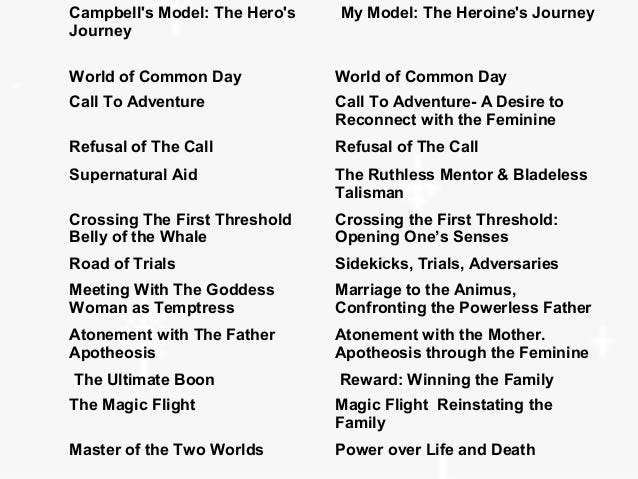
You can read more about Valerie Estelle Frankel here.

In a continuing series this week exploring The Hero’s Journey and possible variations on that theme from a feminine perspective, author Kim Hudson (“The Virgin’s Promise”) posted a comment the other day I thought worth spotlighting in its entirety:
The Hero’s journey and the Heroine’s are the same thing to me just as we all have a masculine and a feminine side we can all be heroes. The point is we all have a feminine side as well and we re trying to figure out what that looks like. Thanks to Joseph Campbell we have a really good idea of how to write heroes. Ordinary world, call to adventure, refusal of the call and the eventual crossing of the threshold to a foreign land where the adventure begins. This is the quest to push back the boundaries of mortality and know that you can survive in the bigger world. The bigger the challenger the greater your knowledge of your power.
This is all very familiar, however, none of it gets to the feminine power. As others have noted what we generally see is the female as motivation for the Hero to be amazing. What we’re trying to get at is what does it look like when the feminine is being amazing.
This is the journey of the Virgin archetype. The name has been so misrepresented it is like a master plot to keep it from having an identity. The meaning of Virgin survives when we think of a Virgin forest. It means to be of value just for being yourself. The quest of the Virgin, the feminine, is to awaken to the seed of the divine in you, and bring it to life, despite what everyone else wants from you. It usually happens through spiritual, sexual or creative awakening whether you are an female or male. Great Virgin stories with male leads include The King’s Speech, Brokeback Mountain and Billy Elliot. Great female ones include An Education, Shakespeare in Love, Erin Brockovich, and Legally Blond.
This is the interesting part of the book Hunger Games which the movie left out. Katniss learns that she has the ability to connect to nature and be an amazing hunter (the result of her Virgin Journey). She feels alive when she hunts. Which makes the rewards of the games mean nothing to her. So what is the point of the story?
The Virgin’s journey has 13 beats (see The Virgin’s Promise at mwp.com) and is the awakening of your talent, your authentic nature. It starts in a dependent world, as we all do, where she pays a price for her dependence, usually making herself small to belong,until one day she finds an opportunity to taste what it feels like to be true to herself and she takes it. She admits to herself that she wants something more from life. Now she finds a Secret World where she can grow in her understanding of who she is and moves back and forth between her Secret and Dependent worlds. Creative, sexual or spiritual awakening happens here and it can only flourish in an atmosphere where the Virgin feels safe and loved (unlike the Hero who thrives on progressive challenge). When she has grown into her potential she emerges from the cocoon like a butterfly and presents herself. There is a backlash and she has to choose whether she has the right to inconvenience people, to take up some space in the world, or she will go back to conforming. She decides she has to be true to herself and in the end everyone benefits from knowing the gift she has to bring.
There is a feminine story, but it is not a heroine story. That is the female version of the hero. The feminine story is to explore your interior world and bring it to life, the journey of the Virgin.
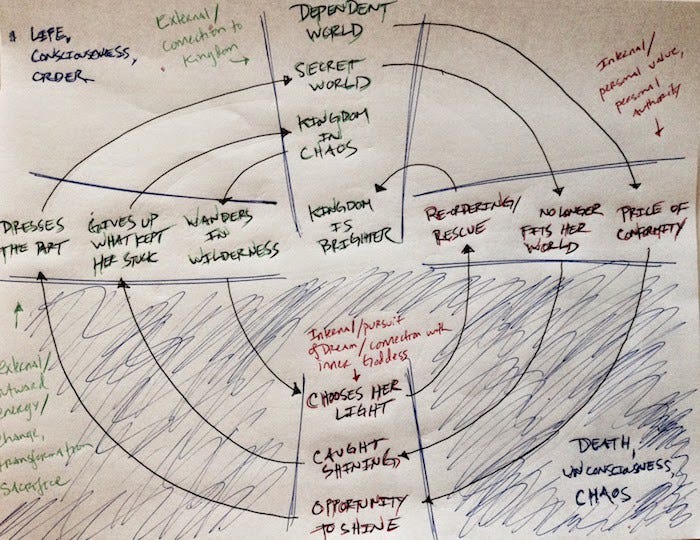
This language is quite familiar to me and if any of you have been paying attention to my various movie analyses and my take on the Protagonist metamorphosis, you will see the parallels. I will pick up on that in a concluding post in this series tomorrow. In the meantime, what are your thoughts about this take: The Virgin’s journey?

In fact, I’d like to pull this quote from a comment made by Debbie Moon:
This is a really fascinating idea. I’m starting to wonder if the Virgin’s journey is a model for more character-led dramas, in the same way that the Hero’s journey is for plot-led dramas…
I don’t have time today to dig into the many thoughts I have on the ideas discussed in this series, so I’ll have to come back another time for that. But this idea by Debbie strikes me as having validity.
As most of you know, I am a big fan of Joseph Campbell. I incorporate the Hero’s Journey into my teaching [although not the way it seems to be most typically used]. So Debbie’s idea interests me because this issue comes up a lot: What about stories where there is no Nemesis? Stories that are more about a Protagonist confronting their inner ‘demons’ than a struggle between Protagonist and Nemesis? Or as Debbie puts it “character-led” dramas?
I always start that discussion here. First and most important, almost all stories, and certainly Hollywood movies, feature a Protagonist going through some sort of change. Even though so much emphasis is typically put on the External World of the Hero’s Journey, the 17 or 12 “stages,” the fact is Campbell himself said that the theme of the Hero’s Journey is transformation. Jung’s iteration of that is individuation. When I teach screenwriting, I use the word metamorphosis. They are all saying pretty much the same thing: Things happen in life [stories] that impact a person [character], causing them to get in touch with an authentic part of their Self, moving them toward a state of Unity.
In her comments about the Virgin’s journey, Kim Hudson talked about “authentic nature,” about the Dependent world in which the Protagonist begins their adventure, then through their experiences accessing their Secret world. That all mirrors language with which I’m quite comfortable deriving from Campbell, Jung and a lifetime of watching movies: The Protagonist has a Conscious Goal (Want) and Unconscious Goal (Need), and over the course of their adventure moving from their Ordinary World [life up to FADE IN] into the Extraordinary World, they come to understand and accept their Need. Vamping off Jung, they get in touch with key aspects of their psyche and assemble them into a whole.
The thing is in my view, that happens in movies whether it’s a character-led story or not. Most Hero’s Journey type movies traffic in this type of thing, a reflection of the Protagonist’s metamorphosis. Whether they get there by slaying dragons [metaphorically] or giving up what is keeping them stuck and choosing the light [using language from the Virgin’s journey], the end point insofar as the psychological, emotional and spiritual dimension of the story is the same.
But as to the specific of the process, that is where we may find some interesting new ground. Is the Virgin’s journey a viable path for a writer to look at in terms of more character-oriented stories?
That said movies are primarily a visual medium, therefore whatever internal conflicts a character may experience must in some way be communicated in the External World, either through dialogue or action. So no matter what paradigm or approach a writer may choose to use, they have to figure out ways to physicalize the Protagonist’s psychological journey.
That’s one of the reasons why I think the five character archetypes — Protagonist, Nemesis, Attractor, Mentor, Trickster — can be so helpful as each character can be seen as a narrative function connected to, even a reflection of the Protagonist’s psychological journey. For example, the Nemesis as a reflection of the Protagonist’s shadow, the Attractor as a reflection of the Protagonist’s heart, the Mentor as a reflection of the Protagonist’s brain, the Trickster as a reflection of the Protagonist’s will.
Quite a bit of a ramble there, I wish I had time to be pull my thoughts together more coherently. On the other hand, the discussion seems to be going along just fine, therefore I’ll just trust my gut, post this rather random flow of ideas, and hope it provides some additional food for thought.
To round things off, I encourage you to check out this book: The Heroine with 1,001 Faces by Harvard scholar Maria Tatar.