The External and Internal Worlds of a Screenplay Universe
When something happens…something *else* happens.
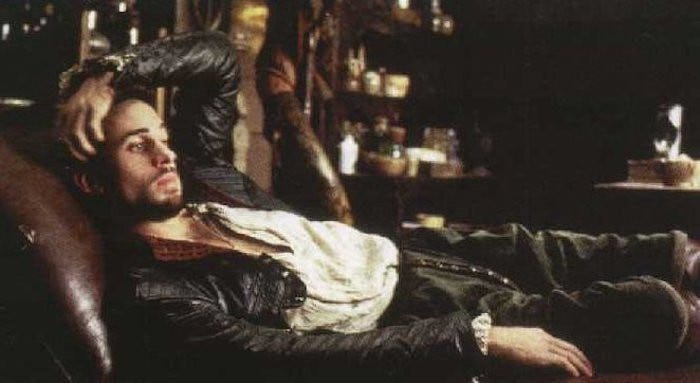
When something happens…something *else* happens.
When a writer creates a screenplay, they conjure up nothing less than a universe. The time and feel of the place. Story concept, genre, and tone. Characters, each with their own distinct backstory, voice, personalities, goals, talents, and imperfections. Dialogue and action. A-plot and subplots. Scenes and sequences. Themes and motifs.
From the first moment after FADE IN to the very last image before FADE OUT, the screenwriter’s task is not only to tell a story, but also to originate an entire screenplay universe into which the reader plunges — and hopefully stays — for 100 pages or more.
As writers, we go into our stories and dig deep into our characters to find big truths, small details, and everything relevant and entertaining in between. In that process, we discover a fundamental truth about the screenplay universe we create:
When something happens…something *else* happens.
Whether we experience the story at a macro level, interpreting seismic shifts in major plot points or stopping to feel what’s occurring in the moment, the dialogue we hear and the actions we see are imbued with a deeper meaning beneath the words and events.
When something happens… something *else* happens.
This is a fact of (a story’s) life. And it is a fact because the screenplay universe is comprised of two realms:
- The External World: A character’s actions and dialogue
- The Internal World: A character’s intentions and subtext
Consider this schematic:
EXTERNAL WORLD>>>>ACTION — DIALOGUE >>>>PLOTLINE
INTERNAL WORLD>>>>INTENTION — SUBTEXT >>>THEMELINE
Every act, sequence, plot point, scene, or beat plays out in these two realms. Ideally we, as screenwriters, dig deep enough into our stories to find the almost magical connections that weave fluidly back and forth between the two aspects of our screenplay universe.
This is where we take the very idea of screenplay structure and breathe life into it — by infusing it with the words, actions, and lives of our story’s characters.
Let’s explore: Plotline and Themeline, Dialogue and Subtext, Action and Intention, the heart and soul of a screenplay’s External and Internal Worlds.
Plotline [External World] / Themeline [Internal World]
The Plotline is where we chart the course of events that happen in the world of sight (Action) and sound (Dialogue), the External World, the story’s Physical domain. However, action and dialogue without emotional depth and layers of meaning is akin to Shakespeare’s line from MacBeth [Act V, Scene V]: “It is a tale told by an idiot, full of sound and fury, signifying nothing.”
That is why as screenwriters, we must also traffic in our story universe’s Internal World — the Themeline, the story’s Psychological domain of Intention and Subtext.
Why call it Themeline? If you think about what function a theme provides, it is at its root an expression of a story’s emotional truth. In other words, a story’s meaning. And so we have this distinction:
The Plotline answers the question: What is the story about?
The Themeline answers the question: What does the story mean?
Since we’ve introduced the Bard of Avon, let’s use as a story example the wonderful 1999 movie Shakespeare in Love, written by Marc Norman and Tom Stoppard, especially resonant for us because it is a tale about a writer.
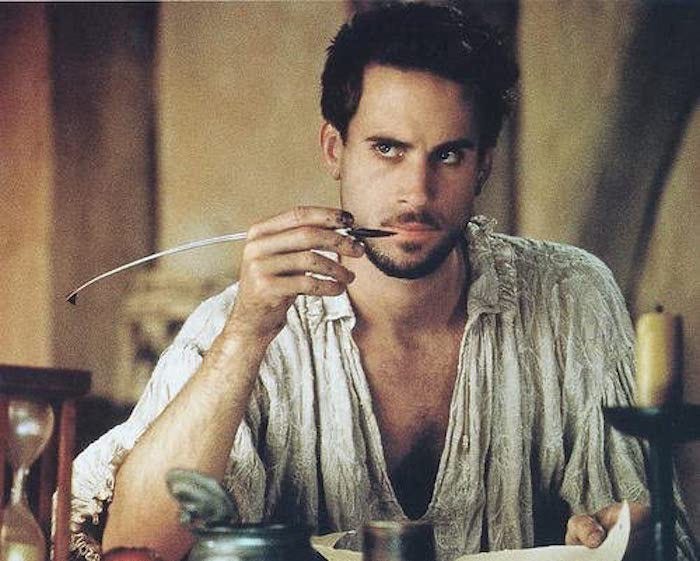
What is the Plotline of Shakespeare in Love? When we meet our Protagonist Will Shakespeare (Ralph Fiennes), he is a writer who can not write. By the end of the story, he has written a truly great play Romeo and Juliet. Thus, the Plotline’s spine is the process of Will writing and producing a play. His conscious goal: To be a great writer and that is what he becomes. That is the answer to the question what is the movie about.
But how does Will become a great writer? Through his love affair with Viola De Lesseps (Gwynneth Paltrow). Not just falling deeply in love with her, but also — and critically — losing her as she is forced to marry Lord Wessex (Colin Firth) and set sail to live in Virginia. In order for Will to become the great writer he has the potential to be, he needs to experience the rapturous joys of true love, then the terrible pain of love lost. That is what the story means: Creativity comes with a price. The romance between Will and Viola, which plays out in the story’s Themeline (Internal World), provides meaning to the Plotline (External World).
There is a crucial lesson here about screenplay structure: As we go about plotting our story, we are foolish if we stray too far from the emotional life of our characters.
Or to put it in a positive way, by immersing ourselves in the lives of our characters, we can imbue our story’s structure with meaning, vitality, and life.
When we do that by interweaving Plotline and Themeline, we are on course to crafting a fully formed, entertaining, and emotionally satisfying screenplay.
Dialogue [External World] / Subtext [Internal World]
Of course, Plotline and Themeline do not exist in a vacuum. Characters move through each scene causing things to happen. One way they do that is through dialogue.
In the context of a screenplay, we may think of dialogue as verbal communication with a purpose. That purpose may fall into three categories:
1. Provide exposition: information the reader needs to know
2. Reveal character: convey an individual’s nature
3. Advance plot: move the story along
The principle — When something happens… something *else* happens — pertains to dialogue as well: When something is being said… something else is being said. This is what is known as subtext.
“Sub” means below. The text — the actual words in dialogue — is like ocean-marker buoys or marker dye, designed to indicate something important lies below. There is a surface level meaning of the dialogue (External World), but the subtext is the intent or emotion floating beneath the words (Internal World).
A good example of this dynamic in Shakespeare in Love is an early scene where Will visits his ‘shrink’ Dr. Moth to discuss his writer’s block:
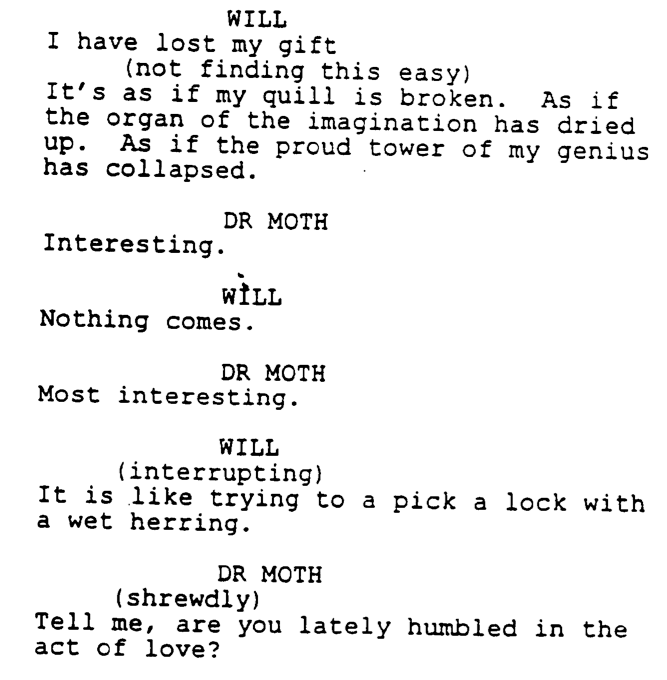
There are multiple layers of meaning to this dialogue. In the External World, Will uses metaphor after metaphor in an attempt to describe his inability to write. But in the Internal World of the scene, the subtext conveys much more:
- Quite clearly we hear Will’s frustration at his creative impasse.
- Dr. Moth is shrewd enough to make the connection between Will’s creative impotence and the possibility of a more physical form of incapacity.
- But in terms of the greater arc of Will’s metamorphosis, perhaps the most important aspect of subtext here is that he needs an object for his passion. This passion exists within him and he flits from woman to woman in an attempt to connect with it, but in the end they are nothing but meaningless sexual trysts. What Will needs is someone who connects with all aspects of who he is — physical, mental, emotional, and creative.
So while the text of the words in this dialogue says one thing in the External World, they convey something else in the Internal World: Will needs a muse. He needs Viola.
Actions [External World] / Intention [Internal World]
The other way characters cause things to happen is through their actions. Here, too, the principle — When something happens… something *else* happens — pertains: When something is being done… something else is being done. As subtext conveys what is going on beneath the surface of dialogue, there are underneath a character’s actions layers of intention at work.
A good example of this in Shakespeare in Love occurs when Will first lays eyes on Viola at a social event at her family estate. Stripping out the few lines of dialogue, here is the scene description from that scene:
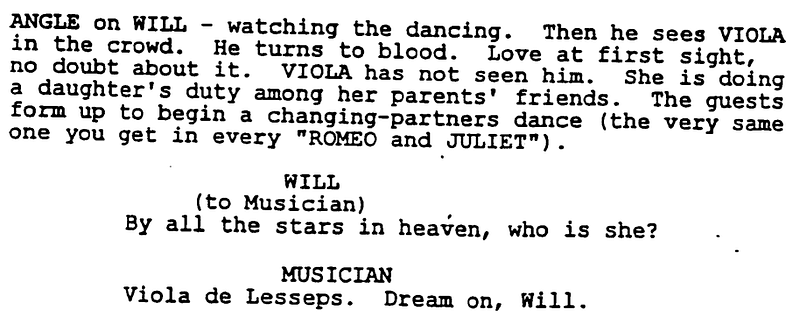
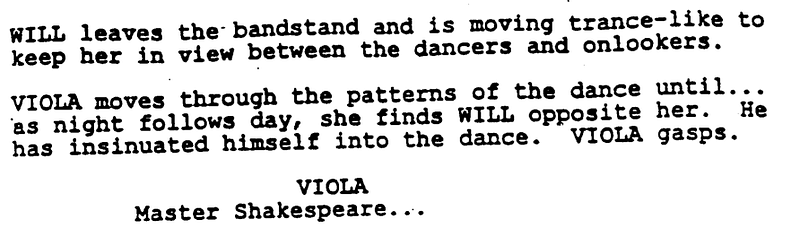

In the Plotline [External World], the action is quite simple: Will puts himself into a situation where he can dance with Viola. Yet in the Themeline [Internal World], what is the meaning of his actions? Screenwriters Norman and Stoppard provide insight through their scene description:
- He turns to blood. Love at first sight, no doubt about it. His initial reaction conveys the fact he is immediately smitten by Viola.
- WILL leaves the bandstand and is moving trancelike to keep her in view between the dancers and onlookers. He moves toward her, keeping her in sight because he is dazzled by her beauty.
- He has insinuated himself into the dance. He needs to get close to her.
- WILL tries to speak but the silver tongue won’t work. He is dumb with adoration. He is overcome with the rapture of love.
- He turns to blood. Love at first sight, no doubt about it. His initial reaction conveys the fact he is immediately smitten by Viola.
- WILL leaves the bandstand and is moving trancelike to keep her in view between the dancers and onlookers. He moves toward her, keeping her in sight because he is dazzled by her beauty.
- He has insinuated himself into the dance. He needs to get close to her.
- WILL tries to speak but the silver tongue won’t work. He is dumb with adoration. He is overcome with the rapture of love.
As indicated previously with Dr. Moth, Will is in need of an object for his passion. Here with the first image of Viola, Will knows he has found true love — and his muse.
Takeaway
It’s a simple takeaway: With every scene you write, ground everything that transpires in the Plotline in what is going on in the Themeline. A character’s Intentions incite Actions, a character’s Subtext influences Dialogue, and together they imbue scenes with layers of meaning, both in the External and Internal Worlds of the screenplay universe.
When something happens…something *else* happens.