The Business of Screenwriting: Swag
When you’re a movie star, things like this happen:
When you’re a movie star, things like this happen:
Upon completing the film Always, director Steven Spielberg gave Richard Dreyfuss, Holly Hunter and John Goodman each a Mazda Miata as a gift.
As to whether the actors actually needed a Mazda Miata, presumably an item they could have paid for with their spare change, is not the point. The gesture is. Somebody gave you a lavish gift. That is important in keeping up the perception you have value in the industry. And that the giver values you.
If you think I’m joking, think again. When Mike Ovitz ran CAA, among the numerous rumors floating around was that one of his multiple assistant’s main function was to handle gifts for agency clients. I mean what do you get an actor who routinely receives $20M per film?
Were one to dig through Google, it’s likely you would find numerous such examples of largesse aimed at movie directors and producers, but the pickings in terms of screenwriters would be mighty slim. In fact, the only comparable grand gesture I can think of involving a writer took place in 1988. Per the LAT:
The 1980 Honda Accord driven until recently by “Punchline” writer-director David Seltzer was such an eyesore that Columbia Pic Prez Dawn Steel jokingly threatened to bar it from the studio lot. Seltzer conceded that it had more sentimental than street value.
“Its antenna was broken, the transmission was falling out and it was badly dented,” he told us. “Still, I was very attached to it — it was my perverse status symbol.”
Then, shortly after negotiating a multipicture deal with Columbia last month, Seltzer did a power lunch with Steel. Afterward, she asked if he’d mind taking her claim check and getting her car.
Instead of Steel’s powermobile, the attendant brought Seltzer a 1988 BMW 325i convertible — a surprise gift from Columbia. List price: $35,000.
Note the salient face: Seltzer was a writer-director. Drop the right-side of the hyphenate, he’d probably have been lucky to get a Harry & David Holiday Moose Munch Gift Basket.
So today, we are here to discuss something near and dear to many a screenwriter’s heart: Swag. Or S.W.A.G.: Stuff We All Get. The “all” in this case meaning us 99% writer types in contrast to The Hyphenators and their freebie Miatas.
Swag is important not so much because of the item, but rather the impression it gives. And what is that? If we are wearing swag, we are in The Biz.
As writers, we are technically valued above-the-line people, but since we spend most of our time inside a room swearing at our computer screens in the hopes inspired words will magically appear there, it’s easy to forget we actually work in the business. Directors, producers, studio execs, agents, managers, actors, they’re out on the front line everyday. Us? Most of the time, we’re part of the Monkeys With Underwood crowd imprisoned in our offices.
So on those occasions when we actually do creep outside to drop off our progeny at Crossroads School or go to dinner at Kate Mantellini, wearing a Prometheus crew shirt or a The Dark Knight Rises cap provides visible proof — to us and the world — that we belong.
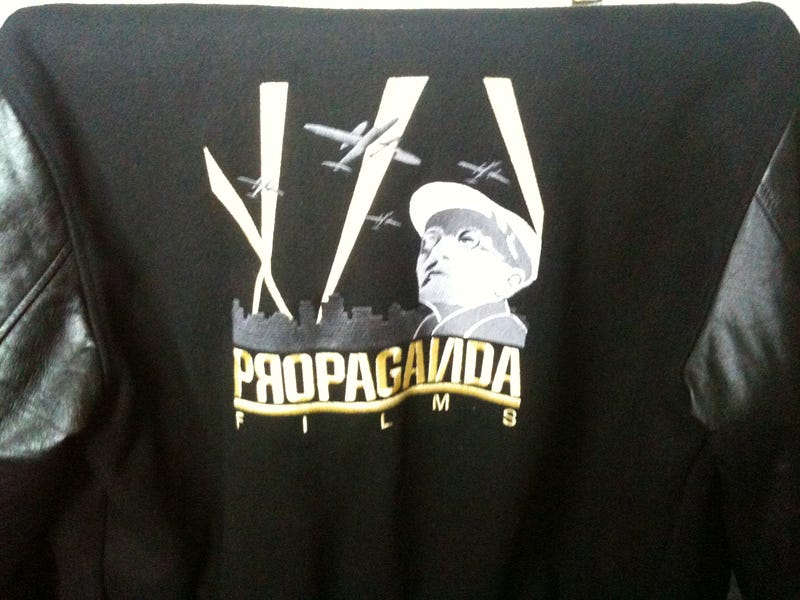
Plus some of it is just flat-out cool. Here is my own personal favorite piece of swag:
That, my friends, is a Propaganda Films crew jacket. What is Propaganda Films? It was a music video and film company founded in 1983. By 1990, the company was responsible for one-third of all music videos. They also produced numerous movies including Wild at Heart, Red Rock West, Kalifornia, Sleepers and Being John Malkovich. But what they’re really famous for is the lineup of music video directors that worked there who later went on to become famous movie directors including Michael Bay, David Fincher, Antoine Fuqua, Spike Jonze, and Gore Verbinski.
I worked on two lamentable projects there, but was smart enough to zero in on a crew jacket as a prized piece of swag. I mean take a close look at that kick-ass logo!

As a screenwriter, you may be hot, you may be cold, you may be rewriting, you may be being rewritten, your movie may open at #1 or go straight to VOD. But as long as you’ve got some cool swag, you are still in the game, baby!
Or at least look like you are… which in Hollywood is pretty much the same thing as reality.
So how to acquire swag? The key I have found is to combine “nice” with “obnoxious.” The nice part is your tone which is friendly (“Wow, you look great in that”) and fawning (“That logo… has there ever been anything cooler?”). The obnoxious part is suggestive (“Gee, I wonder what a jacket like that would look like on me?”) and steadfast (“Oh, remember about that jacket… does that come in a large?”).
The single best way to score swag, however, is to write a movie that actually gets made. Stuff just flows your way. But don’t stop there. If you’re on the set and you get to know some of crew members in the art department (buying them a round or two of drinks after hours can be a real benefit here), you’d be amazed at the stuff you can scarf up, like the “S. Myers, Attorney” sign I got from the movie Devil With a Blue Dress. And don’t forget the folks in the marketing department who are generally happy to give you all sorts of chotchkies like a Cubby backpack from Alaska or a K-9 movie poster in German, the title of which when translated into English is “My Partner With The Cold Nose.”
To those outside the 405–101–110–10 bubble, this obsession with swag may seem bizarre. I mean check this out:
Every winter, Hollywood’s biggest stars descend on film festivals and awards shows to promote their latest projects, exchange air kisses, and — most importantly — walk away with thousands of dollars in swag. At last month’s Sundance Film Festival, James Franco, Jeremy Piven, and Elizabeth Olsen (the other other Olsen sister) were frequent guests of gifting suites. Items up for grabs ranged from tubes of Supergoop! sunscreen and Samsung Galaxy Tab handheld computers to Carrera sunglasses and Puma sneakers. Attendees were following in the footsteps of Paris Hilton, who once left a 2009 Sundance lounge with more than two dozen bags of free merchandise.
These are people with serious coin! I mean Paris Hilton is worth, what, a gazillion dollars and here she is frothing over “free merchandise”?
Perhaps the best story I know on the subject involves an acquaintance who worked on the crew of “Seinfeld” when the TV series was the #1-rated show on the air. I visit this fellow’s new house and he takes me downstairs, opening the door to a room that is about 15 x 20 feet. There is no furniture, nothing on the walls, but almost every square inch of space is filled with boxes and boxes of stuff.
“I call it ‘Jerry’s Room’”.
Turns out Jerry would walk onto the set or into the show’s offices where network executives would introduce him to various business types, desperate to press the flesh of such a hot entertainment commodity. Then Jerry would utter something like, “Wow, I noticed my tennis shoes are squeaking. Guess it’s time for some new ones.” Next day? Boom! Dozens of boxes of tennis shoes arrive courtesy of said business types. Or “You know I was walking down the street, and I saw the coolest thing. These pens with a digital recorder in them.” Voila! Boxes of these pens would show up. Every company who made anything wanted to do all they could to be connected with the hit show. Jerry would open his piehole. Stuff would magically appear. And where did all that swag go? Into the storage rooms of houses like my friend who were lucky enough to be involved with the TV series.
So you can add this to your ultimate screenwriting fantasy. Someday you will write a huge hit movie. After a giant opening weekend, there will be a knock at the front door. Open it. There’s a handsome young assistant holding out some car keys, “A gift from the studio.” In your driveway, a brand new Prius [politically correct, of course].
I can envision that. Hell, I’m going to use that image to motivate myself to write today. Me, behind the wheel of my uber-swag car… wearing my Propaganda Films crew jacket.
And I’m looking totally like The Hyphenator!
The Business of Screenwriting is a Go Into The Story series of articles based upon my experiences as a complete Hollywood outsider who sold a spec script for a lot of money, parlayed that into a screenwriting career during which time I’ve made some good choices, some okay decisions, and some really stupid ones. Hopefully you’ll be the wiser for what you learn here.
For more Business of Screenwriting articles, go here.