The Business of Screenwriting: Net profits
“Net profit participation” sounds so nice, but…
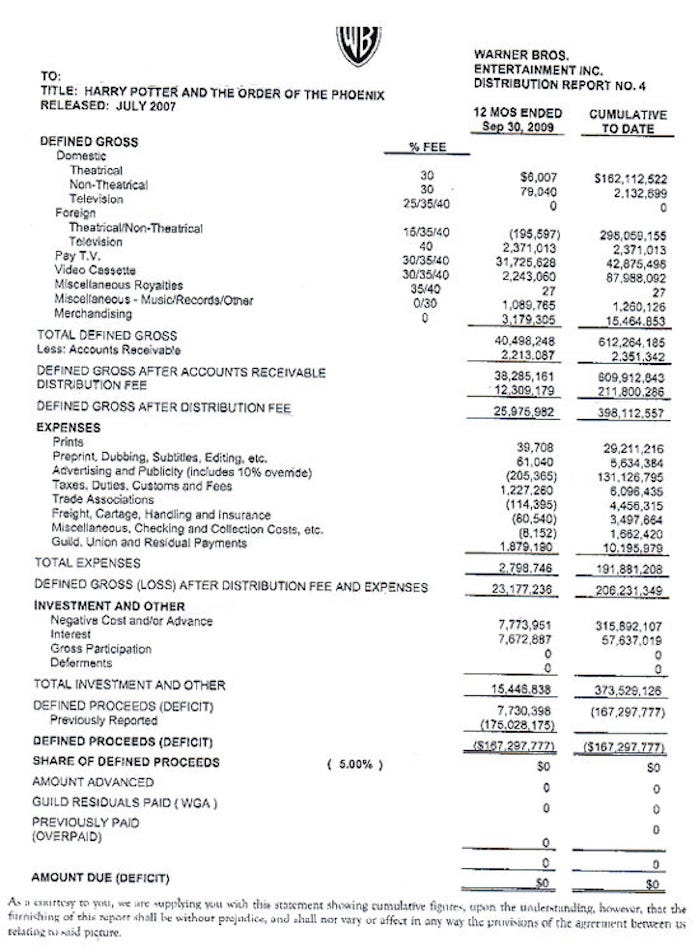
“Net profit participation” sounds so nice, but…
Whenever you sell a screenplay, set up a pitch, or get a writing assignment at a Hollywood studio, you will end up with a big ass contract. And toward the back of that big ass contract, there will be some language specifying that you, the writer, are to receive a percentage of “net profit proceeds.” I think the number ranges from 2.5–5% with the latter being pretty much standard. The concept has a nice enough sounding name: Net Profit Participation. I mean ‘profit,’ that’s a good money kind of word, right? And ‘participation,’ that’s like we’re all sharing in this project together, so let’s sing “Kum Ba Yah” and pass the dollars.
The sticking point is that word ‘net.’ Because in Hollywood, net profits = zilch.
Due to creative accounting techniques, it’s almost impossible for a movie to reach net profitability. Don’t believe me? Rain Man, Forrest Gump, and My Big Fat Greek Wedding are just a few examples of movies that ‘officially’ did not make a dime of net profit.
And if the movie doesn’t make net profit, you don’t see see any net profit proceeds.
[Note: You still get your writing fees, production bonus, and residuals. We’re only talking profit participation here.]
How do the studios manage to ‘lose’ money on so many box office hits? It’s quite complicated and I don’t claim to be an expert, but here is my understanding of a typical studio approach.
Let’s imagine you land the writing assignment for Slinky: The Movie with Studio A. You write a draft. They green light your movie. Here’s what happens:
Studio A sets up a subsidiary company Slinky Movie, Inc. All the money on that project flows through that entity.
Along the way the studio pulls out money related to production overhead for Slinky: The Movie through Slinky Movie, Inc. Let’s figure 15%.
The studio pulls out money related to marketing overhead for Slinky: The Movie through Slinky Movie, Inc. Let’s figure another 15%.
The studio pulls out money related to distribution overhead for Slinky: The Movie through Slinky Movie, Inc. This is the biggie due to infrastructure expenses, so let’s figure this to be 30%.
Are these number related to actual overhead costs? Who knows! The studios don’t let anybody look at their accounting figures. But the fact is about 60% of Slinky: The Movie is expensed off the top along with whatever other expenses they can toss onto the ledger. And that sort of thing happens all the time with Hollywood movies.
Then there are gross profit participation deals, say with A-list actors or directors. As I understand it, there are multiple definitions of ‘gross,’ but the bottom line for us ‘net’ lackeys is the money designated for any gross participants gets doled out first, thereby also cutting into any potential net profits for a movie.
For some interesting background, you can check out these articles:
Murphy movie made millions but stayed in the red, studio ledgers say
‘Forrest Gump’ has yet to make a net profit
Hanks sues over profit on ‘Greek Wedding’
And if you really want to go into the weeds on the subject, you can read this article by law professor Mark Weinstein: “Profit-Sharing Contracts in Hollywood: Evolution and Analysis”.
So your goal as a screenwriter re profit participation? Become a really big writer who can command some sort of gross position. If not, you end up with a net percentage. And with net profits…
You get zilch.
Any of you who have insight into these type of accounting practices, please enlighten us in comments.
UPDATE: Read how the three actors in the original Blair Witch Project have received no net profit money from a film that grossed $248 million.
The Business of Screenwriting is a Go Into The Story series posts based upon my experiences as a complete Hollywood outsider who sold a spec script for a lot of money, parlayed that into a screenwriting career during which time I’ve made some good choices, some okay decisions, and some really stupid ones. Hopefully you’ll be the wiser for what you learn here.
For more Business of Screenwriting articles, go here.