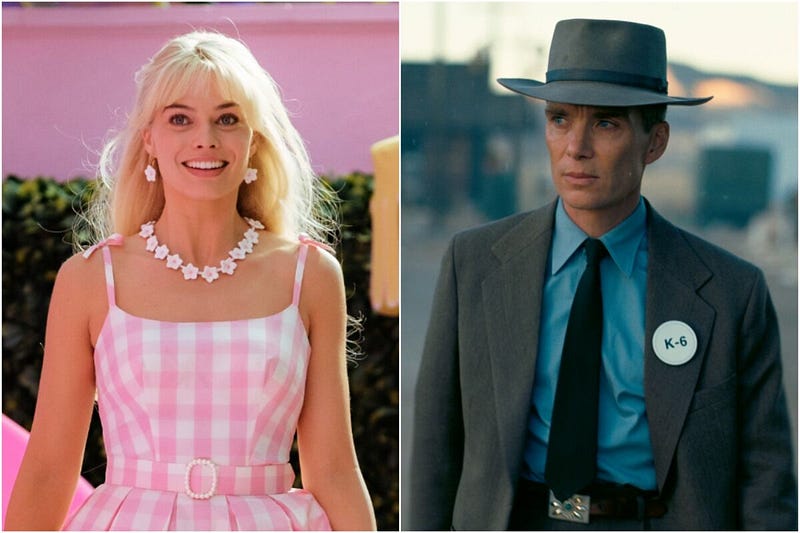
The ‘Barbenheimer’ effect should scare the studios into ending the strike
“The business may have changed, but two simple facts remain: If you want to make money in the movie business, you need to make movies. And…
“The business may have changed, but two simple facts remain: If you want to make money in the movie business, you need to make movies. And to make movies, you need writers and actors.”
Los Angeles Times culture columnist and critic Mary McNamara had something to say after her family’s ‘Barbenheimer’ experience over the weekend.
If the Alliance of Motion Picture and Television Producers, which represents the studios, thought they could force concessions by continuing to leverage the notion that America is out of the moviegoing business, “Barbenheimer” proved them wrong.
PG-13 “Barbie” grossed $155 million in the United States and Canada while the R-rated “Oppenheimer” earned $80-plus million. Together, they helped make this the highest-grossing weekend since the start of the COVID-19 pandemic and the fourth-highest ever.
Ever.
Yeah, that’s the time you want to have caused a full-on work stoppage — right slap in the middle of a record-breaking week at the box office.
How many future “Barbenheimer” weekends are the studios willing to sacrifice by their recalcitrance?
It’s one thing to plead poverty, and an irrevocably downward-spiraling film industry, when the box office is in a slump. It’s more difficult when a fun, female-empowering journey into Barbieland links arms with an earnest, arty film about the man behind the atomic bomb to create a revitalized movie audience.
Let’s set aside the legacy studios deeply flawed strategy of creating their own streaming services to chase after Netflix wherein they decimated a business model for television which had worked really well for decades.
Instead, let’s focus on movies.
Yes, the pandemic was a massive blow the film business, but a comparison of domestic box office revenues over the last 30+ years shows something interesting [all figures via Box Office Mojo]:
- In 1989, the total B.O. was $4.1B. Two decades later in 2008, the total was $9.7B.
- In 2009, the B.O. total was $10.6B. In 2019 (just before the COVID outbreak), the total was $11.3B.
Accounting for inflation, that means that from 1989 to 2008, the box office basically doubled in revenues, while from 2009 to 2019, revenues were essentially flat.
Why?
I’m sure there are plenty of reasons, but here’s my theory.
From 1989 to 2003 for a period of 15 years, of the #1 releases in each of those years, only two were non-original films: Terminator 2: Judgment Day (1991) and Star Wars: Episode I — The Phantom Menace (1999). One sequel. One prequel.
Then from 2003 to 2008, ever year’s #1 B.O. champion was a sequel: Shrek 2 (2004), Star Wars: Episode III — Revenge of the Sith (2005), Pirates of the Caribbean: Dead Man’s Chest (2006), and Spider-Man 3 (2007), The Dark Knight (2008). In fact, from 2003 when overall domestic B.O. revenue was $9.2B to 2008 when the total was $9.7B, taking inflation into account, the reliance on sequels led to a flat performance.
Then came 2009 to 2019, a period in which the box office was dominated by remakes, reboots, sequels, prequels, even shequels (sequels of male-led movies replaced by female leads such as the 2016 Ghostbusters remake and the 2018 Ocean’s Eight film).
Any screenwriter or film producer working in the business for the last two decades knows how challenging it has been to get any original movie off the ground. As one producer explained, the problem with original projects is they are “untested.” That is how addicted Hollywood has become to movies based on preexisting content. They need the security blanket of existing IP to green light any project.
But lo and behold, along comes ‘Barbenheimer.’ Sure, Barbie is based on a famous doll, but the storytelling in a script written by Greta Gerwig & Noah Baumbach is fresh, surprising, and delightfully original. And Oppenheimer? Yes, it’s a biopic, but — again — the storytelling is innovative, smart, and visually arresting.
Given the state of things in Hollywood, it’s entirely plausible to argue that these two movies represent original stories.
Compare the stunning box office performance of these two films with others which have been released this summer: the latest installments in the Mission: Impossible, Indiana Jones, Ant-Man, and Fast & Furious franchises, each of which significantly underperformed, not to mention The Flash which is set to lose a projected $200M.
Crazy thought. Maybe audiences are tired of what they see as retread content. (At the theater this weekend where I saw Oppenheimer, the audience jeered and laughed at the Blue Beetle trailer).
Maybe the embrace of Barbie and Oppenheimer reflects a desire of movie fans to have an in-house theatrical experience of original stories, not just retread content or the 32nd installment of a Marvel movie.
And if it’s stories … dynamic, distinctive, original stories that audiences want to see … perhaps it’s time for AMPTP company CEOs to quit fantasizing about AI and instead, make a deal with writers, actors, and filmmakers who have been yearning for years to bring their original stories to the big screen.
While we’re at it, instead of producing $300M movies, why not five $60M movies … or ten $30M movies … or thirty $10M movies. Instead of looking for grand slams with every movie, why not create slates of films that will be a B.O. success if they’re singles … or doubles … or triples … or home runs.
You know, like what the studios used to do!
Instead of seeing writers and actors are enemies, why not go back to the negotiating table, agree to a deal which serves everyone, then get back to the business of doing what Hollywood used to do best: Create movies which enticed audiences to enjoy the shared experience in a movie theater.
The legacy studios will never be able to compete with Netflix as streaming services. But what they can do that isn’t even part of the Netflix business model is make movies and put them into actual movie theaters.
Hopefully, the box office performance of the dynamic duo Barbie and Oppenheimer can rattle a few cages amongst the C-suite denizens.
Let’s make cinematic stories again. Not retread content.
For the rest of the Mary McNamara column, go here.
For the latest updates on the strike and news resources, go here.
Please consider contributing to the Entertainment Community Fund.