Tarantino, Sorkin, and Dialogue as Purpose
Analysis of long dialogue-centric scenes in The Social Network and Pulp Fiction reveals that underneath the entertaining conversations lies…
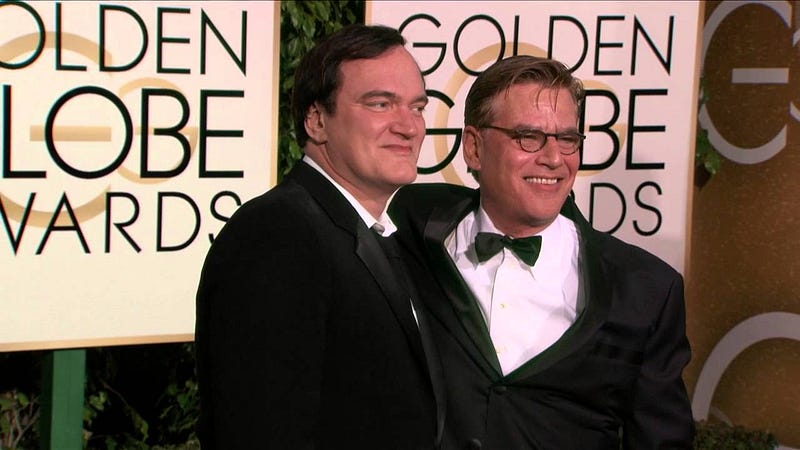
Analysis of long dialogue-centric scenes in The Social Network and Pulp Fiction reveals that underneath the entertaining conversations lies their respective narrative function: to move the plot forward.
In a recent online class I taught on dialogue, the writers taking the course and I had some really enlightening discussions including this one about two masters in this arena: Aaron Sorkin and Quentin Tarantino. Both of them are known for the occasional long dialogue-laden scene and we might be tempted to interpret these as just being about entertainment.
Read this excerpt from my first lecture which precipitated the online conversation, considering the screenwriting principle Dialogue = Purpose.
The first 8+ pages of The Social Network script would appear to be the very epitome of purposelessness. Apart from introducing two key characters — Mark Zuckerberg (Jesse Eisenberg) and Erica (Rooney Mara) — the dialogue zigs and zags from one topic to the next, a confused quilt of references and observations. Here is a list of topics in the scene:
- People with genius IQs in China
- How to “distinguish yourself” amongst people who got 1600 on SAT’s
- A Capella choir, rowing crew, inventing a “25 dollar PC”
- Final club
- World class athletes rowing crew
- How girls like cowboys
- Exclusivity
- Various final clubs at Harvard with the Porc being the “best of the best”
- Theodore Roosevelt
- Mark’s friend Eduardo made $300,000 betting on oil futures
- Predicting weather and the price of heating oil
- Spat about Erica asking which final club is the “easiest to get into”
- Spat about Erica calling it “finals” club
- Spat about Erica calling Mark “obsessed,” he says he’s “motivated”
- Mark thinks Erica speaks in “code”
- Mark says “I need to do something substantial” to get the “attention” of the clubs
- Mark: “Because they’re exclusive. And fun and they lead to a better life.”
- Mark: “You should be a lot more supportive,” benefits for her if he was in a club
- She tells him she is no longer his girlfriend
- Mark says Erica used to sleep with the door guy of the club they’re drinking in
- Erica gets angry and says she’s leaving
- Mark tries to apologize
- Erica says dating Mark is “exhausting”
- Mark disparages B.U. (Boston University) where Erica goes to college
- Erica delivers two “stingers” and leaves him
8 plus pages. 111 sides of dialogue. Where is the purpose in this scene?
Dialogue conveys exposition: If we define exposition as information, data, and backstory, we can see how Sorkin laces a lot of it into these pages:
Information: Mark attends Harvard; Erica attends B.U.; the Porcellian is the most exclusive final club at Harvard; Teddy Roosevelt was a Porc.
Data: The number of geniuses in China; Eduardo made $300K last year.
Backstory: Mark got 1600 on his SAT; Mark and Erica have been romantically involved; Mark thinks Erica used to sleep with the door guy.
This exposition is key in establishing the story’s setting (contemporary Harvard) and some of the basics of the Protagonist (Mark) and Attractor (Erica) characters.
Dialogue reveals a character’s inner life: Through text and subtext, Sorkin conveys important aspects of both Mark and Erica’s thoughts and feelings:
Mark: He is looking to distinguish himself; he feels pressure to do “something substantial” with his life; his reaction to Erica’s comment about the easiest final club shows he has personal insecurities; he thinks she should be more supportive of his desire to join a final club; Mark is dismissive of B.U. as an academic institution; his goal is a “better life.”
Erica: She thinks Mark is “obsessed” with final clubs; she has a difficult time following Mark’s way of thinking and talking; she gets angry at Mark’s insensitivity (i.e., door guy accusation, derision of B.U. and by extension her own intellect); she finds being with Mark “exhausting.”
The purpose of this facet of the scene’s dialogue is to go beyond exposition and provide readers a deeper insight into the inner workings of these two pivotal characters.
Dialogue distinguishes one character from another: In what they say and how they say it, Sorkin creates a clear sense of Mark and Erica’s individual identities:
Mark: He is extremely, almost excessively verbal; he is kinetic, his ideas spewing forth; he carries on his own internal conversation that often loses Erica; he is essentially humorless.
Erica: Less intelligent, but smarter socially; she tries to use humor to make points (“You don’t care if side effects may include blindness, okay, just do it,” “What part of Long Island are you from — England”); she is primarily reactive to him; she does not waffle in her decision to break up with him.
There is also this subtle distinction between them. Whereas Erica is actually hurt by Mark’s derisive comments, unintentional though they may be, when Erica dumps him, Mark doesn’t feel distress so much as shock, as if it is unfathomable she would have any reason to terminate their relationship.
At this level of purpose, Sorkin not only distinguishes the two characters in terms of the text of their words, but also the subtext, the deeper emotional meaning under their words.
Dialogue moves the plot forward: Within the realm of a story universe, perhaps the single most important purpose of dialogue is to advance the plot. On the surface this extended exchange between these two characters in The Social Network seems precisely like a conversation with little or no substantive part to play in terms of the narrative. A closer examination reveals the scene moves the plot ahead in two ways: (1) The scene itself has a clear Beginning, Middle and End; (2) Its end point is a critical event that sets into motion everything else that follows in the plot.
Scene structure: The Beginning of the scene revolves around establishing Mark’s powerful desire to get into a final club. The Middle involves Erica calling into question Mark’s obsession while Mark challenges her to support him, and in so doing provides one dismissive comment toward her after another. The Ending centers on Erica breaking up with Mark.
Point of the scene: It’s the break-up and specifically Erica’s final lines to Mark as she leaves:

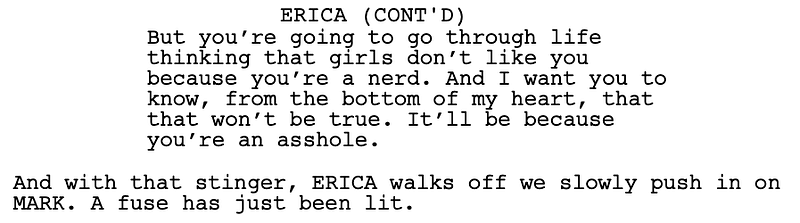
Here is the scene from the movie:
The point of the scene is two-fold: (1) Erica breaks up with Mark. (2) Erica’s parting shot becomes a verbal talisman to inspire Mark to make something of himself and join a final club. The scene’s ending dialogue caps off this key purpose of the scene tied to the plot.
Mark Walker, one of the writers in the class, responded with this:
I think that is a key observation that those new to screenwriting (like myself) need to get into their heads. I think, when I started out, I was probably of the mind that dialogue wasn’t as important as the scene description and visual “delivery” of the film.
As I have wised up a bit (there is still a lot of room for further improvement) from reading books and blogs, and the SMC (Screenwriting Master Class), it has become clearer just how powerful good dialogue can be, let alone great dialogue. it is interesting to watch films knowing this and think about how the dialogue works so well.
Scott’s example clearly shows this, and how it is an art to make it look like conversation when it actually isn’t. To throw all that stuff at you that you probably don’t recognize as character building and exposition until later in the movie when you get those call-backs that relate to some of that conversation and it all clicks into place, is a vital skill.
I would compare this to Tarantino introducing Jules and Vincent as they approach the building where the guys with Marcellus’ brief case are waiting. An excerpt:
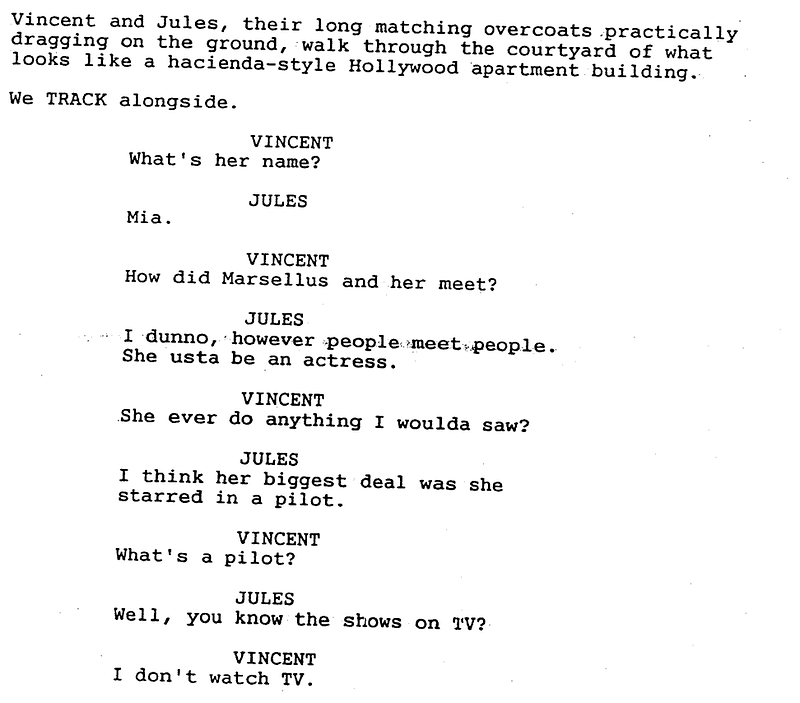
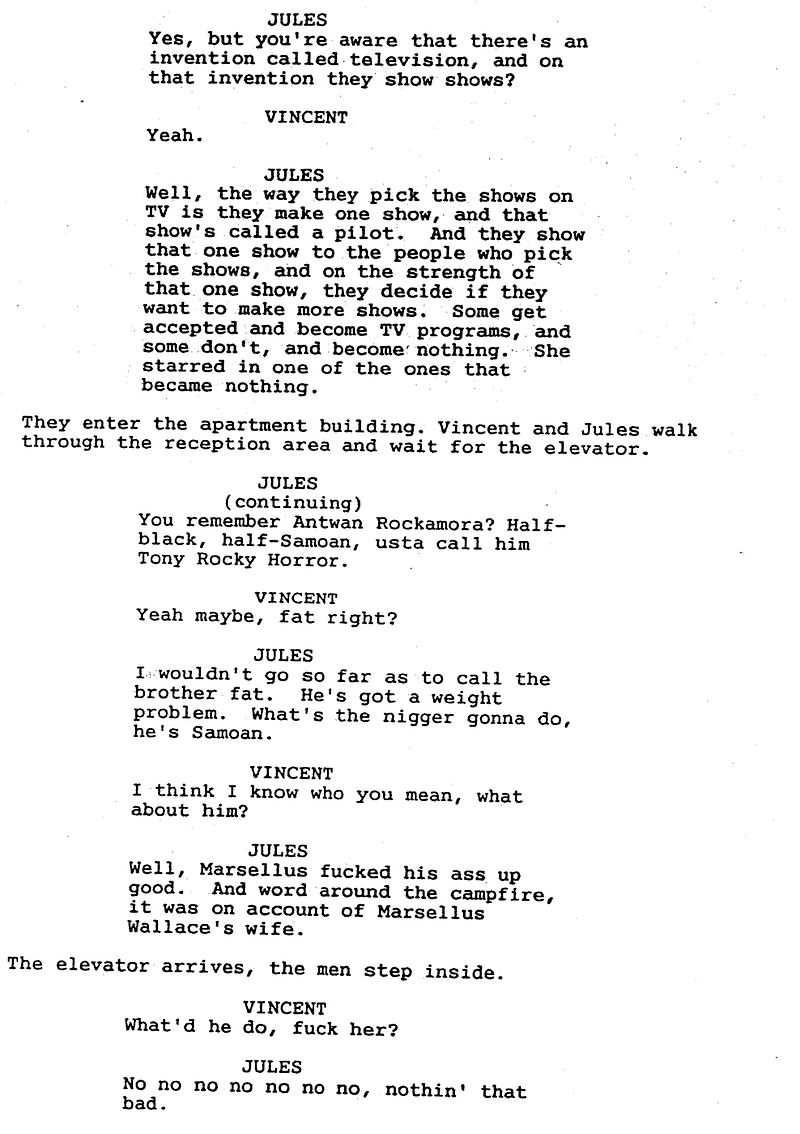
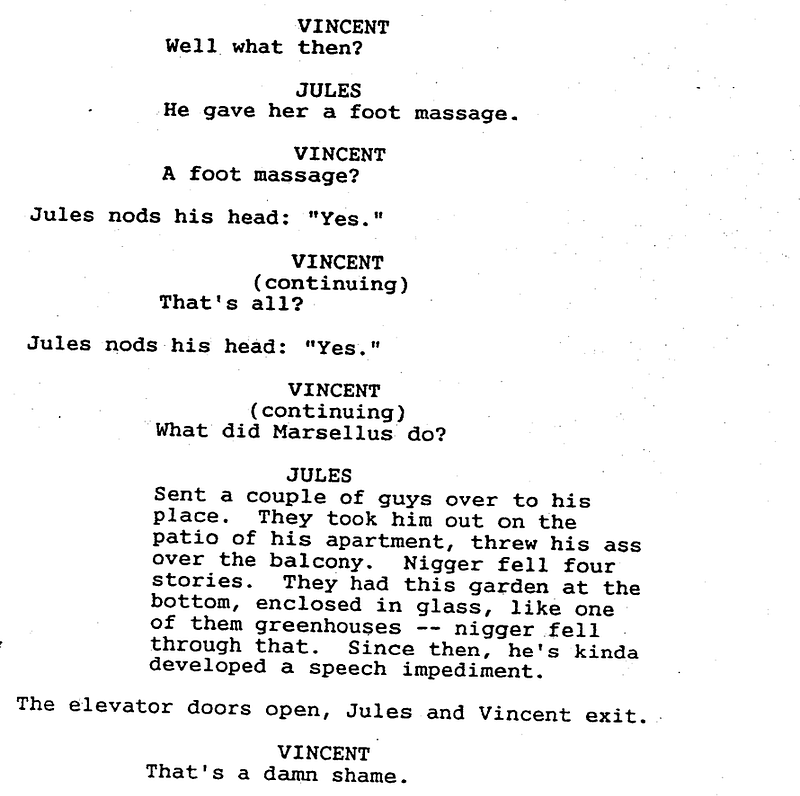
Here’s the scene from the movie:
I think we get all four of Scott’s purposes in that conversation which, on the surface of it, sounds like two guys just chewing the fat about work and shit. But we hear about (amongst everything else):
- Vincent being in Amsterdam — he has been away and missed some stuff
- We get banter about their weapons which tells us they are gangsters/hitmen….dangerous
- Jules is catching him up about the guy that gave Mia foot massage
- This tells us their boss is a hard man not to be messed with
- We hear Vincent has been asked to “take her out” while Marcellus is away — setting up the next part of the story.
- Jules concern in relation to foot massages tells us more about their boss and theor perception of him.
- The dialogue tells us about the suitcase Macguffin.
- We get to learn that Vincent and Jules are very different — Jules is respectful and more refined than Vincent who is a little more brash — all found from a conversation about giving foot massages
We get everything; exposition, inner life of the characters, we learn how they are different from each other and plot moves forward with regards the macguffin. By the time we are ready to kick the door down we know exactly who these two guys are, what they do for a living and who they work for, as well as a bit about their past and what is in store for them (or at least Vincent) in the next chapter. None of the dialogue is “wasted” or “filler” — like everything else with screenwriting — if it doesn’t serve the story, does it need to be cut?
That example you cite from Pulp Fiction works as entertainment straight-out, thus if we don’t look closer, we may assume it’s just QT riffing with dialogue, pure and simple. But if we do examine the content, we see, as you pointed out so well with your analysis, Mark, that there is a purpose to the conversation; in fact, several of them, in effect setting up a few important subplots.
A comparison of this scene and the opening to The Social Network reveals that everything hangs on the dialogue’s tie-in to and advancement of the plot. In fact, if one were to boil down each scene to the single most important contribution each makes to the plot, it’s right there:
- Pulp Fiction: To establish the upcoming “date” Vincent is going to have with Mia and the pressure he will be under to handle that properly re Marcellus and his temper. That sets everything in that subplot into motion including Vincent scoring the heroin as a way of taking the edge of the date which leads to Mia overdosing on it (thinking it’s cocaine), and so forth.
- The Social Network: The breakup of Mark and Erica which, as the denouement shows [even though the entirety of their subplot is only four or five beats], provides one huge motivation on Mark’s part to succeed: To prove he has worth in response to her rejection of him.
Takeaway: Dialogue = Purpose. This is true even if you go off on a riff à la Tarantino and Sorkin. Tie the dialogue to those four markers, but most especially to the advancement of the plot.
I don’t care how good you are with dialogue, if you write a scene in which the dialogue has zero impact on the plot, you should consider reshaping the scene to make it relevant to the plot or drop the scene entirely as being extraneous.
What are your thoughts about how important dialogue is to plot?