Talismans
“Any physical object which takes on symbolic meaning to a character or characters.”
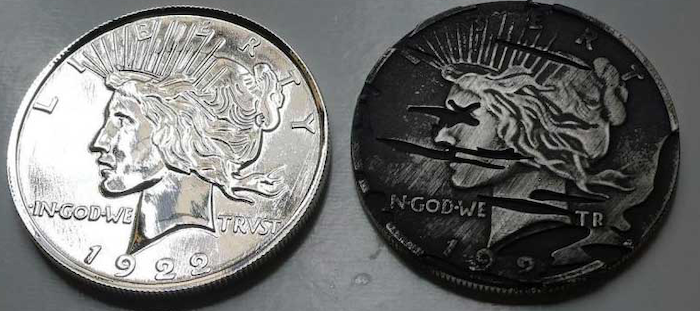
“Any physical object which takes on symbolic meaning to a character or characters.”
The definition of talisman is, “An object believed to confer on its bearer supernatural powers or protection.” The word’s roots are Greek: telesma, which means “consecration ceremony,” and the more primitive root telos, which means “result.”
Throughout human history, people have used talismans to conjure magical power and create good luck, or to ward off evil and bad luck. For instance, in ancient African cultures, carrying the foot of a swift creature was believed to help someone flee with the speed of that animal; this is where the tradition of the “lucky rabbits foot” derived from. The “luck of the Irish” is symbolized in the four-leaf clover. During the Middle Ages, Norse soldiers used a magical alphabet to create runes for their personal safekeeping. While the cross symbolizes Jesus’ death to Christians, over the years people have worn the crucifix to protect them, even as legend has it, against vampires.
From a writer’s point of view, we may take a more general view of talismans: Any physical object which takes on symbolic meaning to a character or characters.
To demonstrate something of the breadth of possibilities with talismans in storytelling, here are several examples from movies:
- The letters of transit in Casablanca.
- Zuzu’s petals in It’s a Wonderful Life.
- Moths in The Silence of the Lambs.
- The bicycle in Butch Cassidy and the Sundance Kid.
- Red roses in American Beauty.
- Cobb’s spinning top in Inception.
- Baxter’s key in The Apartment.
- Walt’s car in Gran Torino.
- The grape soda badge in Up.
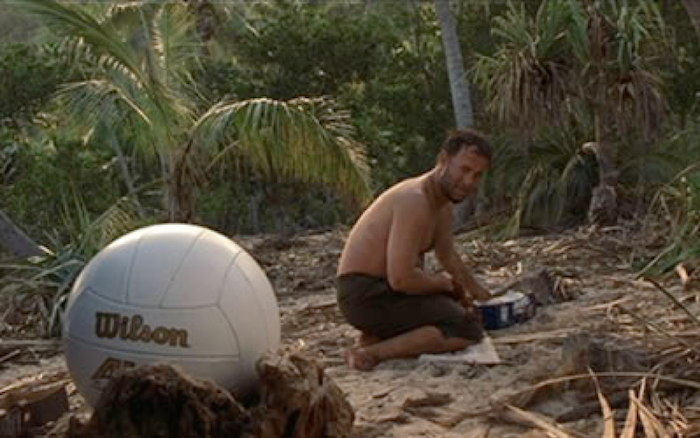
Indeed, physical objects can become so important, they evolve into characters themselves such as Wilson in the movie Cast Away:
We could choose to refer to such objects as merely symbols or signs, but that does not do justice to what can transpire in a movie: the piece of his lover’s cloth as William Wallace dies in Braveheart, the statuette in The Maltese Falcon, the snow globe in Citizen Kane. Empowered to an almost magical degree of meaning, we are right to call them talismans.
How is it physical objects can obtain the power of a talisman? A few key aspects:
- The object itself is a tangible thing. Unlike a concept, a character can hold a talisman, see it, touch it, providing a visceral degree of reality and presence.
- The object is a carrier. Whatever emotional attachment there is to the object goes along with it as long as it is in the mind of the character for whom it has meaning.
- The object is a reminder. While memories or feelings fade, a talisman retrieves the original association and brings it back to life.
In all these ways, a talisman can be a focal point of a story’s themes.
Let’s consider three movie talismans to see how they work in terms of the story’s thematic content.
The Dark Knight: Harvey Dent’s special coin
Harvey Dent, Gotham City’s charismatic Attorney General, has a special coin he produces throughout the story:
- P. 16–17: Dent introduces it [“My father’s lucky coin”] as a way of determining who will take the lead — he or the Assistant D.A. Rachel Dawes — in the cross examination of a bad guy in court.
- P. 67–68: Dent uses it to interrogate a thug involved in Gordon’s shooting [“Heads — you get to keep your heat. Tails… not so lucky”].
- P. 74: Dent reveals to Rachel the coin is double-headed [“You make your own luck”].
- P. 96: After Rachel has been killed and Dent badly burned, Batman finds the lucky coin — now burned black and scarred on one side — and puts it on Dent’s hospital bed side table.
- P. 108: When Joker visits Dent in the hospital and puts a gun in Dent’s hands pointed at his [Joker’s] head, Dent produces the coin [“You live… you die”].
- P. 112: Dent flips it to determine that fellow cop Wuertz will die.
- P. 120–121: Dent uses it to determine that Ramirez will live.
- P. 136: At the Final Struggle, Dent flips it in a crazed game of Russian Roulette.
The coin begins as a nifty little joke on Dent’s part, but with a romantic association: It’s how he won a first date with Rachel. After her murder and Joker’s propaganda [“And you know the thing about chaos… it’s fair”], the coin becomes an arbiter of life or death, its clean side and black “scarred” side a projection of Dent’s own injured face, and reflection of Dent’s dual personalities: The good Attorney General and the bad Angel of Revenge.
Super 8: Joe’s silver locket
The Protagonist is Joe, a teenager whose mother has recently died. His estrangement from his father comparable to his attachment to his mother:
- Outside his family’s house where guests mingle following his mother’s memorial service, Joe sits alone, clutching the “silver locket.”
- Later, Alice visits Joe and asks about the locket. He claims it belonged to his Mother, and they retrieved it after the accident that killed her.
- After breaking into their school, Joe and his high school friends are taken prisoner by a group of soldiers, and his locket is confiscated.
- When the creature attacks the soldiers, Joe escapes and retrieves the locket.
- At the very end per IMDB: “As they watch, the locket in Joe’s pocket attempts to fly away. Joe catches it, and we see what was inside it the whole time: a picture of Joe’s Mom and him as a baby. Joe finally lets go and the locket flies up to the magnetized water tower, where the metallic objects and the white cubes morph into a spaceship. The creature climbs aboard… Everyone watches as the ship ascends into the sky. As they do, Joe and Alice hold each other’s hands.”
The locket not only symbolizes Joe’s mother, it also signifies the power of his attachment to her and unwillingness to let go of her after her death. Of course, this sets up for him letting go at the very end, the alien zooming off into space [Heaven?] with Joe now free to move on with his life, symbolized by the transference of holding onto the locket to holding Alice’s hand.
Bull Durham: A baseball
The sport is a thematic backdrop for this wonderful 1988 romantic comedy, but more specifically the three lead characters each have their own unique relationship with the actual physical object of a baseball.
In the voiceover narration that begins the movie, Annie Savoy provides her take:
I believe in the Church of Baseball. I’ve tried all the major religions, and most of the minor ones. I’ve worshipped Buddha, Allah, Brahma, Vishnu, Siva, trees, mushrooms, and Isadora Duncan. I know things. For instance, there are 108 beads in a Catholic rosary and there are 108 stitches in a baseball. When I heard that, I gave Jesus a chance. But it just didn’t work out between us. The Lord laid too much guilt on me. I prefer metaphysics to theology. You see, there’s no guilt in baseball, and it’s never boring… which makes it like sex. There’s never been a ballplayer slept with me who didn’t have the best year of his career. Making love is like hitting a baseball: you just gotta relax and concentrate.
Young Nuke LaLoosh has a different connection to a baseball:
THE PENINSULA WHITE SOX LEADOFF HITTER steps in.
TEDDY THE RADIO MAN (V.O.)
The word on LaLoosh is that the good
looking young lefty has a major league
fastball but sometimes has problems with
his control.
EBBY CALVIN LALOOSH WINDS UP and fires. The pitch sails
over the batter’s head, over the catcher’s head, over the backstop,
and CRASHES INTO THE PRESS BOX.
Then there’s Crash Davis who has spent almost all of his career in the minor leagues, a veteran who understands the sport and the head games it can play with you. Check out his relationship with a baseball in this scene:
Three characters, one baseball, three different themes:
- Annie: Baseball as spirituality / Does she really know the Truth?
- Nuke: Baseball as power / Will he gain control of it?
- Crash: Baseball as contest / Will he know when it’s time to quit?
Takeaway: When physical objects take on emotional meaning to a character, they are transformed into talismans.
One final thing. When I wrote the original script for K-9, I had a photograph on my desk. It was a snapshot of a police dog named Sonny, a German Shepherd who had been killed in the line of duty and was the inspiration for the movie. For another project, I had a 160 year-old piece of wood from a chair hand-crafted by the story’s Protagonist.
To wit: A writer can create their own writing talismans. I am not going to sit here and tell you that such objects can literally empower you. However selecting a writing talisman may be helpful with your creative process:
- The object becomes a point of focus. When you find your mind wandering, the writing talisman can bring you back on point.
- The object serves as a reminder. When you find it hard to get motivated, the writing talisman can pull you back to what inspired you in the first place.
- The object connects you to the story world. When you are stuck in the realm of concepts and questions, the writing talisman can transport you from your head to the world where your characters live.
A writing talisman is something you can see, you can touch. It exists, it’s there, a constant reminder that your story is there as well, waiting for you to unearth it.
So two uses: (1) Story talismans within your story universe. (2) Writing talismans outside your story universe.